Sales Development Representative (SDR) Career Roadmap
A sales development rep finds the buyers and starts the conversation. You research who a company should sell to, reach them by email, phone and social message, find out whether they have a real problem and a reason to act, and hand the ones that qualify to an account executive as a booked meeting. You are measured on meetings booked and pipeline sourced, not on revenue closed. The work is research, repetition, rejection and careful CRM notes. It is the standard first rung into B2B tech sales, and the title itself is the entry-level job: nobody expects you to have sold software before.
Is this the right path for you?
This is the door, not the second floor. In the live job postings we track, 281 carry "sales development", "business development rep", SDR or BDR in the title, across 55 companies. Only 12 carry early-career words like associate, junior, entry or new grad, because the title itself is the entry-level job. Realistic routes in: a recent graduate from any degree, a career changer from retail, hospitality, recruiting or support who already talks to people for a living, a customer-facing hire already inside a software company, or someone finishing an SDR certificate or apprenticeship. Technical backgrounds help when the product sells to engineers.
The temperament is plain. You can hear no many times in a day and still pick up the phone. You're curious about how other companies work, willing to research before you reach out, and organised enough to follow up and log it. You can take coaching without defending yourself. People who need warm, reciprocal conversations all day, or who need to see long-term results quickly, usually burn out. The job is built on repetition, and a promotion depends on showing you improve at it.
Honest note: our postings come from roughly a hundred tech-company job boards, skewed toward AI, infrastructure and SaaS scale-ups, so they show how those employers hire and not every sales market. In them, Fivetran and Snowflake each have 16 such postings, Brex and Elastic 13, Cloudflare, Flexport and Okta 12, Block and Navan 11. The same boards show 9 titles with "senior" and about 38 mentioning manager, lead or director, so the ladder above the entry seat is much narrower. The next step for most people is out of the team, into an account executive seat, inside the company or at another one. Well-known employers are competitive to get into, so a specific, researched application matters.
Career Progression
Where does this role lead?
Click any role to explore timeline, key skills and, where the Department of Labor publishes it, pay.
Entry
Sales / Business Development Rep
~0–2 yrs
You create the first conversation and hand qualified meetings to an AE. Your record here (meetings the AE accepts, quality of your notes, how you take coaching) is what any later move rests on.
Key skills
What the postings say you’ll do
Lines copied word for word from live Sales Development Representative postings we track, read September 30, 2026. They show how employers word the job, not what every Sales Development Representative does. Postings change and expire.
“Drive initial prospect qualification and schedule discovery meetings”
“Generate qualified meetings for the Enterprise AE team through outbound outreach (email, phone, LinkedIn).”
“Prospect companies that are growing and spending; educate them on our modern corporate card and spend management software”
“Maintain active inbound and outbound communications with prospects using creative follow-up, including personalized email, cold calling, and social selling”
“Collaborate with sales teams to understand their needs and optimize lead handoff processes”
“You will use a data-driven approach to outbound sales that incorporates prospecting, email communication, and calling at scale.”
“The role focuses on strategically identifying key decision makers from key commercial accounts and generating meetings across all levels the APAC region.”
Who is hiring right now
Drawn from live postings across many employers today. Employers with live postings we tag to this roadmap, counted today. The sample is about a hundred tech-company job boards, tilted toward AI, data and infrastructure companies, so agencies, consultancies and most non-tech employers are not represented.
| Employer | Live postings | Early-career titles | Most common title |
|---|---|---|---|
| Cloudflare | 16 | 0 | Business Development Representative (BDR) |
| Canonical | 15 | 3 | Sales Development Representative |
| Snowflake | 15 | 2 | Sales Development Representative |
| Block | 14 | 10 | Business Development Rep Associate |
| Stripe | 14 | 0 | Manager, Sales Development |
| Brex | 13 | 0 | Manager, Sales Development |
| Flexport | 12 | 2 | Sales Development Representative |
| Harvey | 12 | 0 | Manager, Sales Development |
| Fivetran | 11 | 0 | Business Development Representative, Enterprise |
| Navan | 11 | 0 | Sales Development Representative |
| Notion | 11 | 0 | Business Development Representative |
| Braze | 9 | 0 | Business Development Representative |
“Early-career titles” are roles whose title signals an entry-level or new-graduate position. Top 12 of 84 employers shown.
Look-alike roles, compared
Neighbouring titles read very differently once you open the posting. One line from a real posting for each, with how many live postings we track under that title and how many carry early-career wording.
Sales Development Representative
326 live postings · 84 employers · 18 with early-career wording
“Conduct outbound outreach by cold calling and emailing prospective customers”
Datadog · Sales Development Representative posting
Account Executive
1,916 live postings · 111 employers · 14 with early-career wording
“Create and manage a pipeline of Enterprise accounts to consistently meet or exceed quarterly and annual sales targets”
Figma · Account Executive, Enterprise posting
Customer Success Manager
341 live postings · 60 employers · 12 with early-career wording
“own NRR for your book: identify expansion opportunities, lead renewal conversations, and partner with AEs on upsells and cross-sells”
Composio · Founding Customer Success Manager posting
Account Manager
245 live postings · 49 employers · 9 with early-career wording
“Successfully manage the end-to-end renewal process required to hit or exceed team renewal targets/quotas, leveraging your product knowledge to efficiently meet customers needs.”
Hootsuite · Account Manager, Scale posting
Quotes read September 30, 2026, from the live postings we track.
Visual roadmap
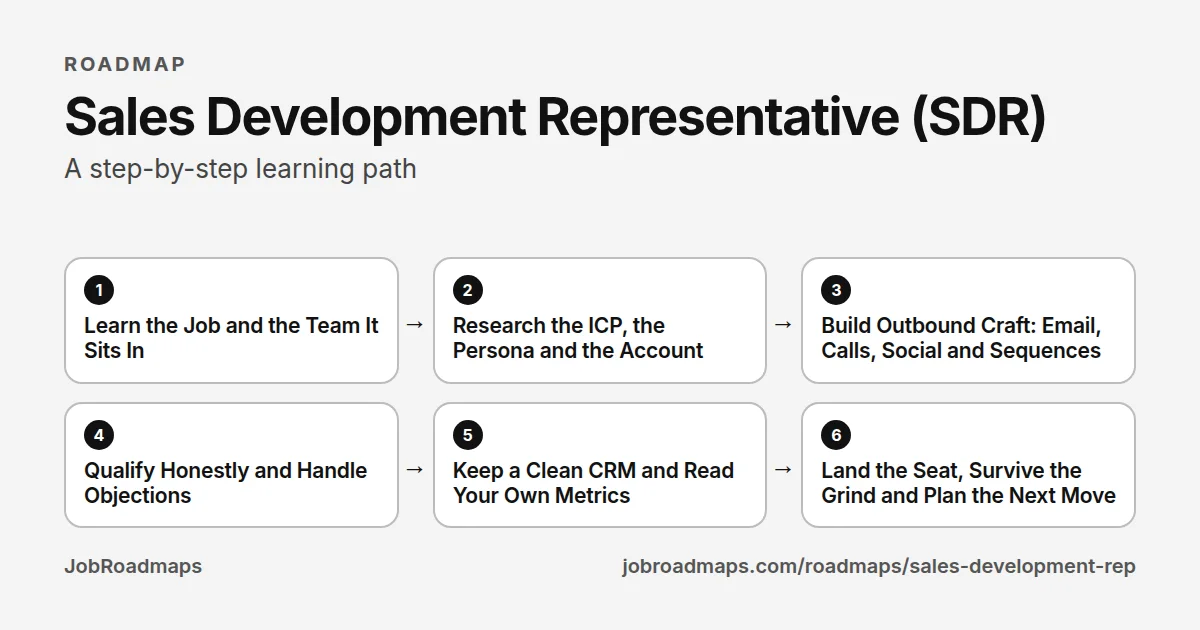
Sales Development Representative learning path
Work down the line, one step at a time. Tick each skill as you can do it.
- 1
Learn the Job and the Team It Sits In
2–4 weeksStart with the machine, not the script. An SDR sits at the front of a software sales team: you create the first conversation, an account executive runs the deal, a sales engineer handles technical proof, and customer success keeps the account afterwards. Learn what a lead, a qualified meeting and an opportunity each mean at your target company, who gets paid on what, and why a meeting an AE rejects counts against you. The free HubSpot course and the Coursera SDR certificate cover the vocabulary and the day-to-day shape of the role.
Skills to learn
- SDR vs BDR (inbound vs outbound) role split
- Funnel stages: lead, qualified meeting, opportunity
- How SDRs, AEs, sales engineers and CSMs divide a deal
- SaaS business model basics
- What a good handoff looks like
Start with
- 2
Research the ICP, the Persona and the Account
3–5 weeksGood outreach is mostly research you can't see. An ideal customer profile (ICP) says which companies fit: size, industry, tech stack, the trigger that makes them buy now. A persona says who inside them cares: the person with the problem, the person who owns the budget, the person who can block it. Practise building a target list for one real product, then write two lines per account: why this company, why now. Sales Navigator and data tools such as ZoomInfo help you find names and signals. The thinking about who to contact is yours.
Skills to learn
- Ideal customer profile (ICP) definition
- Buyer persona and buying-committee mapping
- Account research and trigger events
- LinkedIn Sales Navigator search
- Contact data tools such as ZoomInfo
- Target-list building
Start with
- 3
Build Outbound Craft: Email, Calls, Social and Sequences
1–2 months, then continuousOutreach is a sequence, not a message: a planned run of emails, calls and social touches spread over days, each one adding a reason to reply. Write short emails about the buyer's problem, not your product. Make calls and learn to open them in a few seconds. Know the tools that run this at scale, Outreach and Salesloft being the two best-known sequencing platforms. Learn the rules too. Commercial email has legal requirements (the FTC's CAN-SPAM guide), and mailbox providers publish sender guidelines that affect whether anyone sees your messages at all. Check the rules for the countries you contact.
Skills to learn
- Cold email writing
- Cold calling and voicemail
- Social selling on LinkedIn
- Multi-touch sequence design
- Sequencing tools such as Outreach and Salesloft
- Email compliance and deliverability basics
- A/B testing your own messages
Start with
- 4
Qualify Honestly and Handle Objections
1–2 months, then for the rest of your careerA booked meeting that isn't real wastes an AE's afternoon and your credibility. Qualification is a short list of questions you ask before you hand a prospect over. BANT (budget, authority, need, timeline) is the classic and a fine place to start. MEDDICC, the framework many B2B teams use to inspect deals, is useful as a lens: is there a measurable pain, an economic buyer, a champion? You won't answer all of it from a first call, but you should know which gaps you're passing along. Objections ("not interested", "send me info", "we use a competitor") are mostly the buyer protecting their time. Practise answering them with a question, not a pitch, and learn when to stop.
Skills to learn
- BANT qualification
- MEDDICC-style discovery questions
- Objection handling
- Listening and asking follow-up questions
- Disqualifying politely
- Meeting-setting and confirmation
- Writing a clear handoff note
Start with
- 5
Keep a Clean CRM and Read Your Own Metrics
3–5 weeks, then continuousYour CRM is how the AE knows what you promised and how your manager knows what you did. Log every call, reply and meeting with enough detail that someone else could pick up the account. Learn leads, contacts, accounts and opportunities in Salesforce or HubSpot, how sequences write activity back, and which fields your team treats as mandatory. Then read your numbers honestly. Meetings booked and pipeline sourced are the headline measures, but look underneath: how many were accepted by the AE, how many were held, where replies dropped off. The fix for a weak number is usually in the targeting or the opening line, not in working harder.
Skills to learn
- CRM data entry and hygiene
- Salesforce basics: leads, contacts, accounts, opportunities
- HubSpot CRM basics
- Activity and outcome tracking
- Meetings booked and pipeline sourced
- Spotting the weak step in your own funnel
Start with
- 6
Land the Seat, Survive the Grind and Plan the Next Move
3–6 months to land, then a year or more in seatTreat the application like outbound: research the company, write a short note about its buyer, and show a specific piece of prospecting work. In seat, expect rejection on most contacts and a tough rhythm of repetition. Plan for it, don't be surprised by it: protect your sleep, ask for call reviews, and keep a log of what worked. Then decide where you're going. The usual route is promotion to account executive, which you ask your manager about plainly and early. Sideways exits are real too: sales engineering, customer success and marketing all value someone who already talks to buyers. A senior SDR role and a manager role are the other branches if you like coaching more than closing.
Skills to learn
- Interviewing for SDR roles with a prospecting sample
- Handling rejection without burning out
- Asking for call reviews and coaching
- Building a promotion case from your own results
- Working with AEs on handoff and feedback
- Mapping a move to AE, sales engineering, customer success or marketing
Start with
jobroadmaps.com/roadmaps/sales-development-rep · Pay, demand and employer data for this role are further down the page.
Job Market Insights for Sales Development Representative
Data-backed
What do employers actually ask for?
Read from live job postings — how often each credential is named, from rare to almost always.
"Bachelor's degree" is the most common credential named, yet it appears only rarely in what we could read. Postings that state it are the minority, but these counts are a floor, so do not read this as "no one asks".
Some postings say outright that equivalent experience or a self-taught route is accepted. That wording is worth reading closely when you see it.
Our read: a portfolio that proves the skill, and a referral from someone inside the company, usually carry more weight than a credential match on paper. That is judgement, not something these counts measure.
Requirement
How often named
Equivalent experience accepted
Bachelor's degree
Our read: how often a credential is named is not how strictly it is enforced. Equivalent experience, a standout portfolio, or a referral often counts for more than the credential listed.
Data-backed
Which skills appear most in job postings?
Read from live job postings, ranked from most to least often named.
prospecting leads the list and is named frequent. If you are only going to learn one thing before applying, the postings say start here.
Past the fundamentals, 2 specialisation skills (prospecting included) start separating candidates who can do the job from candidates who have done it. The 18 niche skills are named rarely enough that knowing them is upside, not prerequisite.
Skill
How often named
prospecting
cold calling
pipeline generation
discovery
verbal communication
social selling
outbound campaigns
objection handling
Command of the Message
coachability
time management
MEDDPICC
lead qualification
SaaS sales
active listening
solution selling
written communication
resilience
quota attainment
industry knowledge
Sorted by how often named · JobRoadmaps
Data-backed
Which tools and artifacts appear most in job postings?
Read from live job postings, ranked from most to least often named.
Outreach tops the list and is named frequent. That is not a preference, it is what this market has standardised on.
One tool sits at the top of the scale. At that level it is less a differentiator than a prerequisite, and a gap shows up in first-round screens.
Tool / Artifact
How often named
Outreach
Salesforce
Zoom
ZoomInfo
Notion
ChatGPT
HubSpot
Slack
Google Workspace
Gmail
Intercom
Sorted by how often named · JobRoadmaps
Industry overlay
Targeting a specific industry?
The core roadmap gets you through the door anywhere. The difference between "qualified" and "they hired someone else" often lives in industry-specific context — the norms, the compliance floors, the tools assumed fluent in that sector.
Persona-based messaging
The end user, the budget owner and the IT or security reviewer care about different things. One message to all three rarely gets a reply.
Using product signals
Many software products are tried by individuals or small teams before a sale. Noticing who is already using a product, or has just hired for a relevant role, gives you a better reason to reach out.
Qualifying the buying team
Software purchases often involve several people. Finding out early who else is involved makes your handoff to an AE much more useful.
Security and trust conversations
Identity and security tools sell to people who are wary of outreach. Credibility and precise claims count for more than volume.
Companies hiring:
NotionOktaNavanAbnormal SecurityElevenLabsSpeaking to finance and technical buyers
Payments and finance products usually have a finance owner and a technical implementer. An opener that works for one rarely works for the other.
Knowing what you can and cannot say
Financial products come with regulatory language. SDRs need to know when a question goes to an AE or a specialist, and avoid making claims about compliance that nobody has cleared.
Business-case framing
Finance buyers want a cost or revenue reason to talk. A first email that names a measurable problem lands better than a feature list.
Segment-aware outreach
Startups, mid-size companies and large enterprises buy these products differently. Your list and your sequence should reflect which one you are writing to.
Companies hiring:
StripeBrexBlockIndustry premiums based on aggregated job posting data · Updated quarterly
Interactive
How ready are you right now?
Check the skills you already have to see your current job-market fit.
The most-named skill for this role is prospecting, so a gap there costs you the most. Skills at the top of the scale appear across most postings, so a single gap there narrows your options more than a gap in a rarer skill. Check what you already have to see your biggest current gap.
Readiness Check
Check the skills you already have
0/5
base skills
Your biggest gap: prospecting, the most often named of the skills you have not ticked.
Start there, then work down the list.
Books worth reading as a Sales Development Representative
Where to start, in order. The full list of 10, grouped by career stage, is on its own page.
Getting started

Fanatical Prospecting
by Jeb Blount · 2015
~290 pages~7 hrs to read
Covers daily prospecting across phone, email, social and in person, with time-blocking and cadence advice. A starting point for new SDRs building a consistent outbound routine.
View book →
Predictable Revenue
by Aaron Ross, Marylou Tyler · 2011
Describes the outbound model that separates prospecting from closing, including dedicated lead-generation roles. Read early to understand why the SDR job exists and how it feeds the sales team.
View book →
Doing the job
The Sales Development Playbook
by Trish Bertuzzi · 2016
A practical look at how sales development teams are built and run, from process to metrics. Helps SDRs see the system around their role and what a well-run team expects of them.
View book →
The Challenger Sale
by Matthew Dixon, Brent Adamson · 2011
~220 pages~6 hrs to read
Argues, from research on sales reps, that teaching buyers something new beats relationship building alone. Helps SDRs sharpen outreach messaging and prepares them for an AE seat.
View book →
Senior and leading
The Sales Acceleration Formula
by Mark Roberge · 2015
~200 pages~5 hrs to read
Roberge, a former HubSpot sales leader, lays out a data-driven approach to hiring, training and managing sales reps. For SDRs stepping up to team lead or first-line management.
View book →From Impossible to Inevitable
by Aaron Ross, Jason Lemkin · 2016
~320 pages~8 hrs to read
Covers how SaaS companies scale revenue past the early stage, including the outbound pipeline engine. For SDR managers and leaders thinking about pipeline at company scale.
View book →
All 10 books for a Sales Development Representative →Browse all books →
Some book links are affiliate links: we earn a small commission if you buy, at no cost to you. It does not affect what we list.
Prerequisites & Education
What credentials do employers look for?
These are the most common paths into this role — no single one is required.
Education Level
View list — coming soon- Bachelor's in business, communications, marketing or any other field — SDR hiring is not tied to a specific major
- Recent graduate, including from a university sales program — the University Sales Center Alliance lists member institutions
- Technical or analytical background — useful when the product is sold to developers, data teams or security buyers
- No degree — a customer-facing record, a completed SDR program or a strong prospecting sample is what many hiring managers weigh instead
This is an entry-level seat built on results, not transcripts. Read the requirements on the postings you want; the thing that moves you up is a record of qualified meetings and clean handoffs.
Certifications
View list — coming soon- HubSpot Academy Inbound Sales Certification — free, short, and a quick way to learn the vocabulary
- Coursera Salesforce Sales Development Representative Professional Certificate — an SDR-specific program built with SV Academy
- Salesforce Certified Agentforce Sales Foundations — Salesforce's sales-process credential, useful if your team runs on Salesforce
- MEDDPICC Masterclass via MEDDICC.com — signals fluency in a qualification framework many B2B teams use; more relevant once you are a few months in
None of these is a licence to sell, and none replaces a record of booked and accepted meetings. Use them to learn the vocabulary and show initiative, not as a stack in place of real prospecting.
Bootcamps & Training
View list — coming soon- Vendition — sales apprenticeship and online sales bootcamp that place graduates into sales development roles
- Coursera Salesforce Sales Development Representative Professional Certificate — teaches the SDR role and its tool stack
- HubSpot Academy — free courses on inbound selling and CRM basics
- Trailhead — free Salesforce learning paths for CRM basics
Be sceptical of any paid program that promises a job. Ask for outcome data first, and prefer routes where you are paid to learn (an SDR seat) over routes where you pay to be told you will be.
Portfolio & Other
View list — coming soon- A target-account list for one real product — ICP, three personas, and a one-line "why now" for each of ten companies
- A three- or four-step outreach sequence you wrote for that list — email, call script and a social message, each tied to a specific buyer problem
- A recorded mock cold call or discovery call — role-play with a friend or mentor and review your own questions and objection answers
- A sample handoff note to an account executive — what the prospect said, qualification gaps and the agreed next step
SDR candidates rarely have a public portfolio, so a researched sample for the employer you are applying to stands out. If you are already in an SDR seat, keep your own results log (meetings booked, accepted, held). Never publish confidential customer data from a current or former employer.
Your Roadmap
6 stepsLearn the Job and the Team It Sits In
2–4 weeksStart with the machine, not the script. An SDR sits at the front of a software sales team: you create the first conversation, an account executive runs the deal, a sales engineer handles technical proof, and customer success keeps the account afterwards. Learn what a lead, a qualified meeting and an opportunity each mean at your target company, who gets paid on what, and why a meeting an AE rejects counts against you. The free HubSpot course and the Coursera SDR certificate cover the vocabulary and the day-to-day shape of the role.
Skills to learn
Research the ICP, the Persona and the Account
3–5 weeksGood outreach is mostly research you can't see. An ideal customer profile (ICP) says which companies fit: size, industry, tech stack, the trigger that makes them buy now. A persona says who inside them cares: the person with the problem, the person who owns the budget, the person who can block it. Practise building a target list for one real product, then write two lines per account: why this company, why now. Sales Navigator and data tools such as ZoomInfo help you find names and signals. The thinking about who to contact is yours.
Skills to learn
Build Outbound Craft: Email, Calls, Social and Sequences
1–2 months, then continuousOutreach is a sequence, not a message: a planned run of emails, calls and social touches spread over days, each one adding a reason to reply. Write short emails about the buyer's problem, not your product. Make calls and learn to open them in a few seconds. Know the tools that run this at scale, Outreach and Salesloft being the two best-known sequencing platforms. Learn the rules too. Commercial email has legal requirements (the FTC's CAN-SPAM guide), and mailbox providers publish sender guidelines that affect whether anyone sees your messages at all. Check the rules for the countries you contact.
Skills to learn
Qualify Honestly and Handle Objections
1–2 months, then for the rest of your careerA booked meeting that isn't real wastes an AE's afternoon and your credibility. Qualification is a short list of questions you ask before you hand a prospect over. BANT (budget, authority, need, timeline) is the classic and a fine place to start. MEDDICC, the framework many B2B teams use to inspect deals, is useful as a lens: is there a measurable pain, an economic buyer, a champion? You won't answer all of it from a first call, but you should know which gaps you're passing along. Objections ("not interested", "send me info", "we use a competitor") are mostly the buyer protecting their time. Practise answering them with a question, not a pitch, and learn when to stop.
Skills to learn
Keep a Clean CRM and Read Your Own Metrics
3–5 weeks, then continuousYour CRM is how the AE knows what you promised and how your manager knows what you did. Log every call, reply and meeting with enough detail that someone else could pick up the account. Learn leads, contacts, accounts and opportunities in Salesforce or HubSpot, how sequences write activity back, and which fields your team treats as mandatory. Then read your numbers honestly. Meetings booked and pipeline sourced are the headline measures, but look underneath: how many were accepted by the AE, how many were held, where replies dropped off. The fix for a weak number is usually in the targeting or the opening line, not in working harder.
Skills to learn
Land the Seat, Survive the Grind and Plan the Next Move
3–6 months to land, then a year or more in seatTreat the application like outbound: research the company, write a short note about its buyer, and show a specific piece of prospecting work. In seat, expect rejection on most contacts and a tough rhythm of repetition. Plan for it, don't be surprised by it: protect your sleep, ask for call reviews, and keep a log of what worked. Then decide where you're going. The usual route is promotion to account executive, which you ask your manager about plainly and early. Sideways exits are real too: sales engineering, customer success and marketing all value someone who already talks to buyers. A senior SDR role and a manager role are the other branches if you like coaching more than closing.
Skills to learn
Start here this week
This week: pick one software company you'd like to sell for and write the first page of your own prospecting plan. Who is the ideal customer, which two job titles would care, what trigger would make them buy now, and what three-line cold email would you send them. Then finish the free HubSpot Academy Inbound Sales course. That page, not a certificate, is what you'll bring to an interview.
For a structured route: take the Coursera SDR certificate or an apprenticeship such as Vendition's, or aim for a customer support or customer success seat at a software company and ask to shadow the sales team. Apply to SDR and BDR roles with a short researched note about each company's buyer. Once in seat, log your own meetings booked and how many the AE accepted, learn BANT and MEDDICC, and ask early what the criteria are for promotion to account executive.
Job Titles at Each Level
Entry
Sales Development Representative / Business Development Representative
Mid
Senior Sales Development Representative
Senior
Sales Development Manager / Manager, Sales Development
Steps Overview
- 1
Learn the Job and the Team It Sits In
2–4 weeks
- 2
Research the ICP, the Persona and the Account
3–5 weeks
- 3
Build Outbound Craft: Email, Calls, Social and Sequences
1–2 months, then continuous
- 4
Qualify Honestly and Handle Objections
1–2 months, then for the rest of your career
- 5
Keep a Clean CRM and Read Your Own Metrics
3–5 weeks, then continuous
- 6
Land the Seat, Survive the Grind and Plan the Next Move
3–6 months to land, then a year or more in seat
Explore more roadmaps
Not sure this is the right path? Browse all business career roadmaps.
View Similar RoadmapsBuilt a project while following this roadmap?
Turn it into a hiring-ready case study in 10 seconds — free.
Ready to explore more?
Browse all career roadmaps across tech, business, and creative fields.