Revenue Operations Manager (RevOps) Career Roadmap
A revenue operations manager makes the revenue engine run. You own the process, data and systems that connect sales, marketing and customer success: how leads are routed, how deals move, how the forecast is built, how territories and quotas are set and how the numbers reach leadership. The postings call the job revenue operations, sales operations, GTM operations or business operations. It is not a sales manager's job (leading reps), not a finance analyst's (the company's accounts) and not a software engineer's, though the best people automate their own work.
Is this the right path for you?
The routes in are varied. Sales and business development reps who became the person everyone asks about the CRM. Marketing-operations specialists, finance and strategy analysts, consultants and customer success staff who like systems and numbers. Graduates in business, economics or information systems with strong spreadsheets and SQL. We track 64 postings with revenue or sales operations titles across 41 companies, from Brex, MongoDB, New Relic and Pure Storage to Crusoe, Gusto and GitLab, and 21 use analyst, associate or coordinator wording, so there are entry seats as well as senior ones.
The temperament is a calm organiser who is comfortable with numbers and with people. You like finding why two reports disagree, you can say no to a sales leader with a reason and you enjoy making a team's week easier. If you want to carry a quota, a sales role fits better; if you want to build software, a GTM engineering or software role does. This job is about making the revenue machine run and showing leaders how it is doing.
Honest note: the title is used for very different jobs, from a CRM administrator to a strategic planning role, so read each posting. Of the 64 titles, 28 carry senior-level words, 24 say manager and 9 are director, head or vice-president roles. In the stored text, 46 mention process, 41 mention reporting or dashboards, 36 mention automation or workflows, 36 mention AI or agents, 33 mention territories or quotas, 26 mention forecasting, 25 mention Salesforce, 16 mention compensation or incentives, 13 mention data quality and 8 mention SQL. Our sample leans toward technology companies, so seats in other industries will read differently.
Career Progression
Where does this role lead?
Click any role to explore timeline, key skills and, where the Department of Labor publishes it, pay.
Entry
Revenue / Sales Operations Analyst
~0–2 yrs
You build reports, clean data and answer questions from sales leaders. Entry seats are common in this field, and the best way to stand out is to automate your own recurring work.
Key skills
Visual roadmap
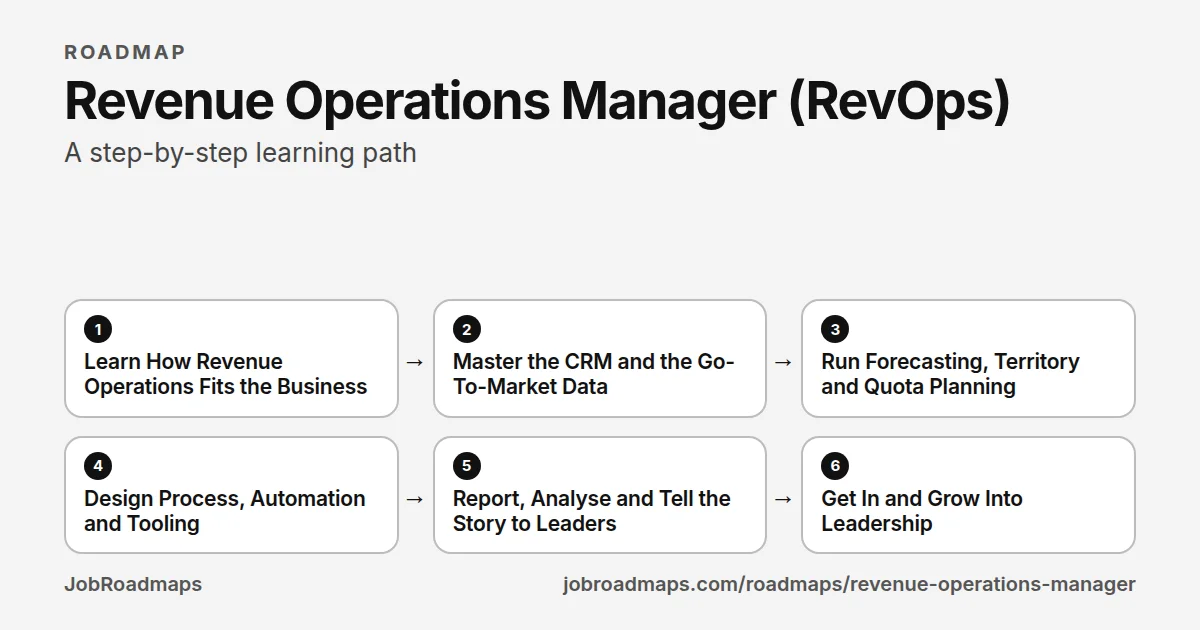
Revenue Operations Manager learning path
Work down the line, one step at a time. Tick each skill as you can do it.
- 1
Learn How Revenue Operations Fits the Business
2–3 weeksStart with what the function owns. RevOps joins what used to be separate sales operations, marketing operations and customer success operations, so that one team owns the process, the data and the systems across the whole customer journey. Learn the parts: planning and territories, process and handoffs, systems (the CRM and its connected tools), data and reporting, forecasting and often compensation. Read three postings from companies you like and note which parts each one stresses.
Skills to learn
- RevOps versus sales ops, marketing ops and finance
- The customer journey from lead to renewal
- The planning cycle: targets, territories, quotas
- Handoffs between marketing, sales and customer success
- What executives ask revenue operations for
Start with
- 2
Master the CRM and the Go-To-Market Data
6–10 weeksThe CRM is the system of record, and its quality sets the ceiling for everything else. Learn how Salesforce or HubSpot models accounts, contacts, opportunities and activities, how fields, stages and permissions work and why data decays. Learn enough SQL to answer questions the CRM reports cannot. Data quality is a recurring theme in the postings, so practise finding duplicates, missing fields and broken stage logic and fixing them at the source.
Skills to learn
- Salesforce or HubSpot objects, fields and permissions
- Opportunity stages and definitions
- Data hygiene, deduplication and validation rules
- SQL for revenue questions
- Reports and dashboards in the CRM
- Documenting definitions so everyone counts the same way
Start with
- 3
Run Forecasting, Territory and Quota Planning
6–10 weeksThis is the analytical core. Learn how a forecast is built (pipeline coverage, conversion by stage, historical bookings), how territories and quotas are designed to be fair and reachable, and how to review a number with a sceptical sales leader. Planning cycles are deadline-driven and political, so practise explaining your assumptions plainly and showing what changes if they are wrong.
Skills to learn
- Pipeline coverage and stage conversion
- Forecast methods and forecast reviews
- Territory design and account assignment
- Quota setting and capacity planning
- Scenario analysis in a spreadsheet
- Explaining assumptions to sales leaders
Start with
- 4
Design Process, Automation and Tooling
6–10 weeksGood revenue operations removes friction. Learn to map a process (lead routing, qualification, quoting, approvals, renewals), find the manual steps and decide whether to fix them with a rule, a workflow, a tool or a conversation. Deal desk and pricing rules, quoting and approval flows appear in several postings. Many postings also mention automation and AI, so learn to use workflow tools and language models to remove repetitive work, with a person in the loop where mistakes are costly.
Skills to learn
- Process mapping and redesign
- Lead routing and assignment rules
- Quote, approval and deal desk workflows
- Workflow automation tools
- AI-assisted reporting and data enrichment
- Change management with sales teams
Start with
- 5
Report, Analyse and Tell the Story to Leaders
4–6 weeksRevenue operations earns trust through numbers people believe. Build a small set of dashboards that answer the questions leaders ask every week (pipeline, conversion, forecast versus actual, productivity) and a monthly narrative that explains what changed and what to do about it. Practise one-page summaries, because most of your audience will give you two minutes.
Skills to learn
- Pipeline and conversion dashboards
- Forecast-versus-actual analysis
- Sales productivity and capacity metrics
- One-page executive summaries
- Telling the story behind a number
- Presenting to sales and finance leaders
Start with
- 6
Get In and Grow Into Leadership
6–12 monthsMost people enter as a sales operations or revenue operations analyst, often after a sales, marketing-operations, finance or consulting role. Show a portfolio of work (a forecast model, a routing redesign, a data clean-up with before-and-after numbers) and describe it in revenue terms. From analyst the path leads to manager, then to senior manager and director seats such as those at Brex and Replicant, or to specialist tracks like deal desk, planning, systems or compensation.
Skills to learn
- Entry routes: sales ops, marketing ops, finance, consulting, customer success
- A portfolio of revenue projects with outcomes
- Specialist tracks: deal desk, planning, systems, compensation
- Managing analysts and managers
- Moving toward head of revenue operations or chief of staff
Start with
jobroadmaps.com/roadmaps/revenue-operations-manager · Pay, demand and employer data for this role are further down the page.
Books worth reading as a Revenue Operations Manager
Where to start, in order. The full list of 12, grouped by career stage, is on its own page.
Getting started

Predictable Revenue
by Aaron Ross, Marylou Tyler · 2011
The book that shaped modern outbound sales: how teams split roles and build a repeatable pipeline. Read it to understand the process you will measure and improve, and why it is organised the way it is.
View book →The Sales Acceleration Formula
by Mark Roberge · 2015
~200 pages~5 hrs to read
A practical look at how revenue teams are structured, measured and scaled. It gives you the funnel, the roles and the metrics that every planning meeting depends on.
View book →
Doing the job
Customer Success: How Innovative Companies Are Reducing Churn and Growing Recurring Revenue
by Nick Mehta, Dan Steinman, Lincoln Murphy · 2016
~240 pages~6 hrs to read
Explains the recurring-revenue model that revenue operations supports: onboarding, adoption, health and renewal. Read it to see where the customer success team fits in the revenue picture.
View book →
The Challenger Customer: Selling to the Hidden Influencer Who Can Multiply Your Results
by Brent Adamson, Matthew Dixon, Pat Spenner, Nick Toman · 2015
~270 pages~7 hrs to read
How buying decisions are made inside customer organisations and how salespeople teach customers something new. Helpful when you design qualification and handoff stages that reflect real buying.
View book →
Senior and leading

Measure What Matters: How Google, Bono, and the Gates Foundation Rock the World with OKRs
by John Doerr · 2018
~320 pages~8 hrs to read
How to set goals that are measurable and visible. Relevant when you design quotas, targets and review cadences that teams actually understand.
View book →
The Manager's Path
by Camille Fournier · 2017
~240 pages~6 hrs to read
A level-by-level guide from technical lead to executive. Read it when you are asked to lead analysts and managers and need to know how the job changes.
View book →
All 12 books for a Revenue Operations Manager →Browse all books →
Some book links are affiliate links: we earn a small commission if you buy, at no cost to you. It does not affect what we list.
Courses and certifications for a Revenue Operations Manager
8 courses, tutorials and certifications, each read on the provider's own page. One from each stage to start; the full list, with a guide to choosing, is on its own page.
Getting started · Course
HubSpot Academy
HubSpot
Doing the job · Course
Intro to SQL
Kaggle Learn
Senior and leading · Course
Revenue Operations Certification: Professional Edition
RevOps Co-op
Prerequisites & Education
What credentials do employers look for?
These are the most common paths into this role — no single one is required.
Education Level
View list — coming soon- Bachelor's in business, economics, finance, information systems or a related field: the most common signal
- Bachelor's in any field plus strong spreadsheet, SQL and CRM skills shown in real work: a regular route
- Associate degree or self-taught with a CRM admin credential and a portfolio of reports and processes: possible with clear results
- Experience in sales, marketing operations, finance, consulting or customer success: how many people actually move in
Check the postings you target. Many name years of operations experience and CRM skill more than a specific degree, and analyst seats are open to people with a good portfolio.
Certifications
View list — coming soon- Salesforce Certified Platform Administrator: the most common CRM credential in the postings
- HubSpot Academy certifications: useful for HubSpot-based teams
- SQL or data-analysis certificates: help show you can work beyond CRM reports
- Planning and analytics tool certifications (for example your BI tool): helpful once you own reporting
Certifications are a modest signal. Most hiring managers want to see how you handled a forecast, a clean-up or a process change.
Bootcamps & Training
View list — coming soon- Salesforce Trailhead: free hands-on modules and a developer org
- HubSpot Academy: free courses on CRM, sales and operations
- SQLBolt: free SQL practice
- RevOps Co-op and Pavilion: communities, templates and talks from practitioners
A paid bootcamp is rarely needed. A portfolio with real before-and-after numbers matters more.
Portfolio & Other
View list — coming soon- A pipeline analysis in a spreadsheet: coverage, conversion by stage and stuck deals, with a short recommendation
- A forecast model with stated assumptions and a scenario table
- A lead-routing or handoff redesign with the before and after process maps
- A data clean-up write-up: what was wrong, how you found it and the rules you added to prevent it
- A one-page executive summary of a month's revenue numbers
This job is judged on trust in the numbers and clarity of explanation. Portfolio pieces that show reasoning, not only charts, work best.
Your Roadmap
6 stepsLearn How Revenue Operations Fits the Business
2–3 weeksStart with what the function owns. RevOps joins what used to be separate sales operations, marketing operations and customer success operations, so that one team owns the process, the data and the systems across the whole customer journey. Learn the parts: planning and territories, process and handoffs, systems (the CRM and its connected tools), data and reporting, forecasting and often compensation. Read three postings from companies you like and note which parts each one stresses.
Skills to learn
Master the CRM and the Go-To-Market Data
6–10 weeksThe CRM is the system of record, and its quality sets the ceiling for everything else. Learn how Salesforce or HubSpot models accounts, contacts, opportunities and activities, how fields, stages and permissions work and why data decays. Learn enough SQL to answer questions the CRM reports cannot. Data quality is a recurring theme in the postings, so practise finding duplicates, missing fields and broken stage logic and fixing them at the source.
Skills to learn
Run Forecasting, Territory and Quota Planning
6–10 weeksThis is the analytical core. Learn how a forecast is built (pipeline coverage, conversion by stage, historical bookings), how territories and quotas are designed to be fair and reachable, and how to review a number with a sceptical sales leader. Planning cycles are deadline-driven and political, so practise explaining your assumptions plainly and showing what changes if they are wrong.
Skills to learn
Design Process, Automation and Tooling
6–10 weeksGood revenue operations removes friction. Learn to map a process (lead routing, qualification, quoting, approvals, renewals), find the manual steps and decide whether to fix them with a rule, a workflow, a tool or a conversation. Deal desk and pricing rules, quoting and approval flows appear in several postings. Many postings also mention automation and AI, so learn to use workflow tools and language models to remove repetitive work, with a person in the loop where mistakes are costly.
Skills to learn
Report, Analyse and Tell the Story to Leaders
4–6 weeksRevenue operations earns trust through numbers people believe. Build a small set of dashboards that answer the questions leaders ask every week (pipeline, conversion, forecast versus actual, productivity) and a monthly narrative that explains what changed and what to do about it. Practise one-page summaries, because most of your audience will give you two minutes.
Skills to learn
Get In and Grow Into Leadership
6–12 monthsMost people enter as a sales operations or revenue operations analyst, often after a sales, marketing-operations, finance or consulting role. Show a portfolio of work (a forecast model, a routing redesign, a data clean-up with before-and-after numbers) and describe it in revenue terms. From analyst the path leads to manager, then to senior manager and director seats such as those at Brex and Replicant, or to specialist tracks like deal desk, planning, systems or compensation.
Skills to learn
Start here this week
This week: take a sample sales pipeline (invent twenty deals with stages, amounts and dates in a spreadsheet) and answer three questions: what is the pipeline coverage for the quarter, which stage leaks the most deals and which deals look stuck. Then write a half-page note a sales leader could act on. That exercise is close to what the first interview will ask you to do.
For structure: spend the first month on the revenue process and one CRM, the next two on SQL, forecasting and dashboards, then redesign one process (lead routing is a good choice) on paper and in a free CRM account and write up the before and after. Keep it as your portfolio, and apply for analyst seats at companies that have a revenue operations team.
Job Titles at Each Level
Entry
Revenue Operations Analyst / Sales Operations Analyst
Mid
Revenue Operations Manager / Sales Operations Manager
Senior
Senior Revenue Operations Manager / Director of Revenue Operations
Steps Overview
- 1
Learn How Revenue Operations Fits the Business
2–3 weeks
- 2
Master the CRM and the Go-To-Market Data
6–10 weeks
- 3
Run Forecasting, Territory and Quota Planning
6–10 weeks
- 4
Design Process, Automation and Tooling
6–10 weeks
- 5
Report, Analyse and Tell the Story to Leaders
4–6 weeks
- 6
Get In and Grow Into Leadership
6–12 months
Explore more roadmaps
Not sure this is the right path? Browse all tech career roadmaps.
View Similar RoadmapsBuilt a project while following this roadmap?
Turn it into a hiring-ready case study in 10 seconds — free.
Ready to explore more?
Browse all career roadmaps across tech, business, and creative fields.