Recruiter Career Roadmap
An in-house recruiter owns a pipeline of searches: you sit down with a hiring manager to turn a vague need into a profile, find and approach the people who fit, screen them, run the interview loop, and close the offer. The craft is judgement under uncertainty, so you are paid to say "this person, not that one" and defend it with evidence. The work splits by what you hire for: technical, go-to-market, G&A, university, executive. It is a people job run on data, and the funnel numbers decide how well you are doing.
Is this the right path for you?
Recruiters rarely start as recruiters. The common routes: recruiting coordinator, where you learn the process by scheduling it; sourcer, where you learn the market by searching it; agency recruiter, where you learn to close; an HR or people-ops generalist job; or sales, where outreach, objection handling and closing are already the day job. In the live postings we track, 137 carry recruiter, sourcer or talent-acquisition-partner titles across 41 companies, and the entry-level end is thin, so plan on a route rather than a single application.
This job suits people who like being useful to two sets of strangers at once: a hiring manager who wants the answer yesterday and a candidate who is making a life decision. You need to be organised enough to run many searches at once, direct enough to tell a manager their bar is off, and warm enough that a candidate who loses still speaks well of the process. If you dislike rejection, ambiguity or being measured on a funnel, this is the wrong job.
The honest competitive picture: of those 137 postings, 14 carry early-career words (junior, associate, entry, intern, graduate, university) and 51 carry senior-level words (senior, staff, principal, lead). Note that "University Recruiter" is a role type that recruits students, not an early-career job. The largest employers in our data are Stripe, Brex, Anthropic, Datadog, Veeva Systems, Ramp and MongoDB. Our postings come from about 100 tech-company job boards skewed to AI, infrastructure and SaaS, so these are in-house tech recruiters, not agency or non-tech recruiters, and the market elsewhere may look different.
Career Progression
Where does this role lead?
Click any role to explore timeline, key skills and, where the Department of Labor publishes it, pay.
Entry
Recruiting Coordinator
~0–2 yrs
$46,550 (Level I)
You run the logistics of other people's searches. Watch how good recruiters talk to hiring managers; that is the education.
Key skills
Pay shown is the U.S. Department of Labor prevailing wage for Level I (entry), Level III (mid) and Level IV (senior) in the nearest BLS occupation, base wage for the typical metro, wage year 2025, shown for the main track only. It is a benchmark, not an offer; branches and lead, staff and executive stages have no official figure.
What the postings say you’ll do
Lines copied word for word from live Recruiter postings we track, read September 30, 2026. They show how employers word the job, not what every Recruiter does. Postings change and expire.
“Run structured intakes with security hiring managers, translating ambiguous needs into scoped requirements, calibrated bars, and search strategies”
“Find qualified talent for our open roles via sourcing, job posts, referrals, and agencies”
“Conduct talent mapping, competitive intelligence research, and focused pipelining to support ever-changing business needs”
“Deliver an excellent candidate experience with timely communication, structured assessments, and clear feedback loops from first touch to close.”
“Create closing strategies that win against the most competitive offers in the market and manage stakeholder expectations with data.”
“Use market insights and candidate signals to influence hiring decisions, leveling, and compensation strategy for highly specialized research roles.”
“Track and analyze recruiting metrics, providing regular reports on hiring progress to business leadership to ensure transparency and alignment with goals”
Who is hiring right now
Drawn from live postings across many employers today. Employers with live postings we tag to this roadmap, counted today. The sample is about a hundred tech-company job boards, tilted toward AI, data and infrastructure companies, so agencies, consultancies and most non-tech employers are not represented.
| Employer | Live postings | Early-career titles | Most common title |
|---|---|---|---|
| Anthropic | 14 | 0 | Recruiter, AI Research |
| Brex | 14 | 0 | Senior Technical Sourcer |
| Stripe | 11 | 0 | Technical Recruiter (Fixed Term Contract) |
| Datadog | 10 | 0 | Senior Sourcer |
| Harvey | 7 | 0 | Executive Recruiter |
| OpenAI | 7 | 0 | Business Recruiter, APAC |
| Ramp | 7 | 1 | Associate GTM Recruiter |
| Sierra | 7 | 0 | Recruiter |
| Veeva Systems | 7 | 0 | University Recruiter |
| Mistral AI | 6 | 1 | Talent Acquisition Specialist , GTM & Corporate - EMEA |
| MongoDB | 6 | 1 | Senior Recruiter |
| Notion | 6 | 0 | GTM Recruiter, EMEA |
“Early-career titles” are roles whose title signals an entry-level or new-graduate position. Top 12 of 59 employers shown.
Look-alike roles, compared
Neighbouring titles read very differently once you open the posting. One line from a real posting for each, with how many live postings we track under that title and how many carry early-career wording.
Recruiter / Sourcer / Talent Acquisition Partner
190 live postings · 59 employers · 3 with early-career wording
“Manage full-cycle recruiting for multiple, complex searches across our Engineering organization, owning every stage from first touch to signed offer”
Ramp · Technical Recruiter | Engineering posting
Recruiting Coordinator
28 live postings · 20 employers · 0 with early-career wording
“Schedule high volume interviews for Stripe candidates globally, with speed and efficiency”
Stripe · Recruiting Coordinator (Fixed-Term Contract) posting
Recruiting Manager / Talent Acquisition Leader
27 live postings · 18 employers · 1 with early-career wording
“Lead, coach, and develop a team of recruiters by setting clear expectations, providing thoughtful feedback, and fostering a high-performing, inclusive team culture”
Affirm · Senior Manager, Technical Recruiting posting
People Partner / HR Business Partner
58 live postings · 37 employers · 2 with early-career wording
“Utilizing people metrics to drive key insights/decisions around growth and retention to help support the leadership teams”
PagerDuty · Senior HR Business Partner posting
Quotes read September 30, 2026, from the live postings we track.
Visual roadmap
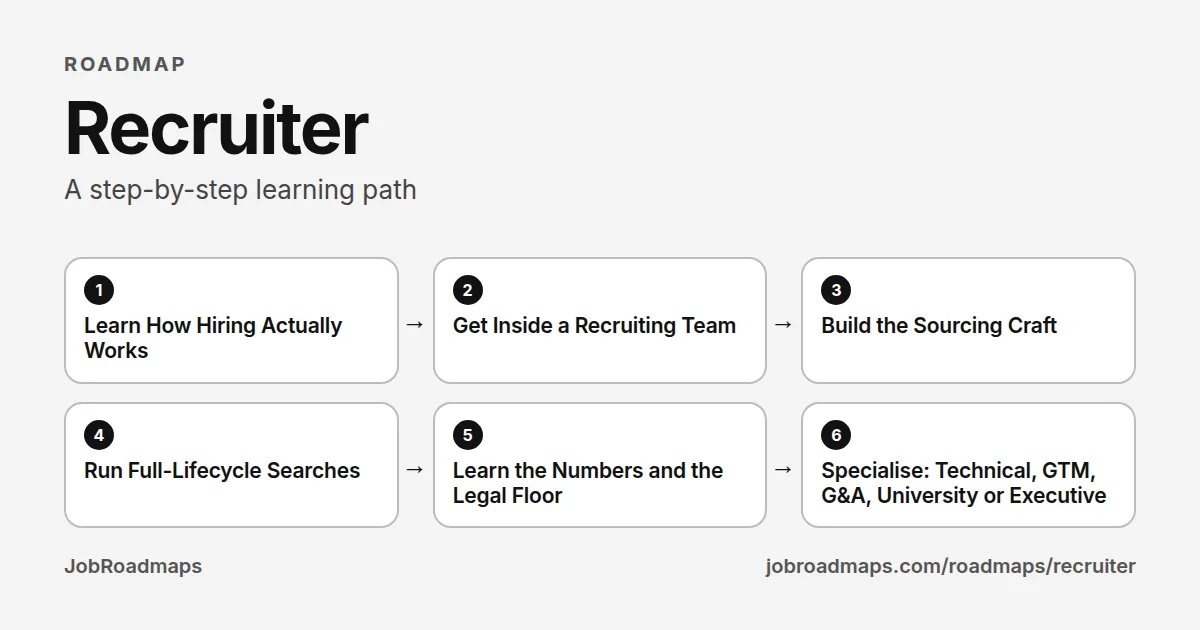
Recruiter learning path
Work down the line, one step at a time. Tick each skill as you can do it.
- 1
Learn How Hiring Actually Works
4–6 weeksBefore you touch a sourcing tool, understand the machine: workforce planning, the job intake, screening, structured interviews, offers, onboarding. A recruiter who knows why a loop is built the way it is can fix it; one who only schedules it cannot. Learn the vocabulary of the funnel (applied, screened, onsite, offer, accepted) because every hiring manager will use it.
Skills to learn
- Hiring process end to end
- Job intake and role scoping
- Structured interviewing basics
- Funnel stages and conversion
- Applicant tracking system concepts
- Candidate experience
Start with
- 2
Get Inside a Recruiting Team
3–9 monthsThere is no single front door. People arrive as recruiting coordinators (scheduling and candidate logistics), as sourcers (finding and approaching candidates), from agency recruiting, from HR or people-ops generalist jobs, and from sales, where outreach and closing are already the daily work. Pick the door you can realistically open and take it. The goal of this step is proximity: watching real searches run, with real hiring managers, from the inside.
Skills to learn
- Interview scheduling and logistics
- Candidate communication
- Applicant tracking system hygiene
- Confidentiality and discretion
- Working with hiring managers
- Reading a recruiting team structure
Start with
- 3
Build the Sourcing Craft
6–10 weeksSourcing is the part of the job you can practise before anyone hires you. Learn Boolean search, talent mapping (which companies and teams hold the people you want), and outreach that is specific enough to get a reply. Passive candidates, the ones not looking, are most of the market for senior technical roles, and the job postings we track repeatedly describe pipeline-building as a core duty.
Skills to learn
- Boolean search
- Talent mapping and competitor mapping
- Outreach writing
- Passive candidate engagement
- Recruiter-grade search tools
- Referral and network sourcing
Start with
- 4
Run Full-Lifecycle Searches
6–12 months on the jobThis is the job. You run the intake with the hiring manager and push back until the profile is specific, build the pipeline, screen, prep the candidate, keep the loop moving, calibrate after each interview, and close. The offer stage is where recruiters earn their keep: counter-offers, competing offers, and a candidate who wants to know exactly why. Own a small set of searches end to end before you ask for a bigger one.
Skills to learn
- Intake and calibration with hiring managers
- Phone screening
- Interview loop management
- Offer structuring and negotiation
- Closing against competing offers
- Managing several searches at once
Start with
- 5
Learn the Numbers and the Legal Floor
4–8 weeks, then ongoingPostings for this role ask you to track and report recruiting metrics, and hiring managers argue with your numbers, so know them cold: pipeline by stage, time in stage, offer acceptance, source of hire. Know the legal floor too. Equal employment rules shape what you can ask, how you document decisions, and what you write in a feedback note. A recruiter who gets this wrong creates risk for the company, not just for themselves.
Skills to learn
- Funnel and pipeline metrics
- Reporting to hiring leaders
- Equal employment opportunity basics
- Documentation of hiring decisions
- Diversity-aware pipeline building
- Data hygiene in recruiting systems
Start with
- 6
Specialise: Technical, GTM, G&A, University or Executive
OngoingRecruiter titles in the live postings we track are specialised: technical, go-to-market, G&A, university, executive. Depth pays. A recruiter who can hold a credible conversation with a security engineer or a sales leader gets the searches nobody else can run. University recruiting is its own discipline built around campus relationships and early-career programs. Pick one lane and become the person hiring managers ask for.
Skills to learn
- Technical domain fluency
- Go-to-market and sales hiring
- University and early-career programs
- Executive search basics
- Market and compensation context
- Coaching other recruiters
Start with
jobroadmaps.com/roadmaps/recruiter · Pay, demand and employer data for this role are further down the page.
Job Market Insights for Recruiter
Data-backed
What do employers actually ask for?
Read from live job postings — how often each credential is named, from rare to almost always.
"Bachelor's degree" is the most common credential named, yet it appears only rarely in what we could read. Postings that state it are the minority, but these counts are a floor, so do not read this as "no one asks".
Some postings say outright that equivalent experience or a self-taught route is accepted. That wording is worth reading closely when you see it.
Our read: a portfolio that proves the skill, and a referral from someone inside the company, usually carry more weight than a credential match on paper. That is judgement, not something these counts measure.
Requirement
How often named
Bachelor's degree
Equivalent experience accepted
Our read: how often a credential is named is not how strictly it is enforced. Equivalent experience, a standout portfolio, or a referral often counts for more than the credential listed.
Data-backed
Which skills appear most in job postings?
Read from live job postings, ranked from most to least often named.
sourcing leads the list and is named frequent. If you are only going to learn one thing before applying, the postings say start here.
The 1 base skill sit at the top of the scale, appearing across company sizes and seniority levels. Treat them as the baseline an application is read against.
Past the fundamentals, 2 specialisation skills (candidate experience included) start separating candidates who can do the job from candidates who have done it. The 17 niche skills are named rarely enough that knowing them is upside, not prerequisite.
Skill
How often named
sourcing
candidate experience
full-cycle recruiting
hiring strategy
communication skills
LinkedIn Recruiter
talent mapping
technical recruiting
relationship building
offer negotiation
market intelligence
executive search
campus recruiting
GTM recruiting
offer management
subject matter expertise
interview process design
Boolean search
data driven recruiting
Sorted by how often named · JobRoadmaps
Data-backed
Which tools and artifacts appear most in job postings?
Read from live job postings, ranked from most to least often named.
Gem is the most-named tool, but no tool is a universal requirement here.
Tool / Artifact
How often named
Sorted by how often named · JobRoadmaps
Industry overlay
Targeting a specific industry?
The core roadmap gets you through the door anywhere. The difference between "qualified" and "they hired someone else" often lives in industry-specific context — the norms, the compliance floors, the tools assumed fluent in that sector.
AI researcher sourcing
Highly competitive talent market requiring recruiters to identify and engage top researchers across academia, competitor labs, and emerging ventures before formal hiring.
technical depth in ML
Recruiters must understand kernels, inference optimization, model shaping, and research roadmaps to evaluate candidates and shape hiring priorities with technical leadership.
academic network building
Cultivating relationships with universities, conferences, and thought leaders to access emerging talent and understand research trends.
Companies hiring:
AnthropicOpenAIxAITogether AICohereElevenLabsGo-to-market recruiting
Recruiter titles in the live postings we track often name GTM or sales as the focus, which means hiring for quota-carrying and customer-facing roles across regions.
University and early-career programs
Some of these companies post university recruiter and university talent acquisition roles, which are about campus relationships and structured programs rather than open-market search.
Regional hiring
Several postings are scoped to a region or country, so you work with local market conditions, languages and employment norms.
Working with a recruiting operations team
Recruiters sit alongside coordinators, sourcers and operations staff, and the work depends on handing off cleanly.
Companies hiring:
NotionFigmaAppianVeeva SystemsIndustry premiums based on aggregated job posting data · Updated quarterly
Interactive
How ready are you right now?
Check the skills you already have to see your current job-market fit.
The most-named skill for this role is sourcing, so a gap there costs you the most. Skills at the top of the scale appear across most postings, so a single gap there narrows your options more than a gap in a rarer skill. Check what you already have to see your biggest current gap.
Readiness Check
Check the skills you already have
0/5
base skills
Your biggest gap: sourcing, the most often named of the skills you have not ticked.
Start there, then work down the list.
Books worth reading as a Recruiter
Where to start, in order. The full list of 12, grouped by career stage, is on its own page.
Getting started

Who: The A Method for Hiring
by Geoff Smart, Randy Street · 2008
~190 pages~5 hrs to read
A step-by-step hiring process: define the outcomes a role needs, source, run a screening interview, then a structured interview and reference checks. A good first book for learning what a disciplined hiring loop looks like and what to ask hiring managers for.
View book →
Hire with Your Head
by Lou Adler · 1998
~320 pages~8 hrs to read
Argues for defining a job by the work to be done rather than a list of requirements, and interviewing against that. Useful in your first months for intake conversations and for rewriting job descriptions with a hiring manager.
View book →
Doing the job

Work Rules! Insights from Inside Google That Will Transform How You Live and Lead
by Laszlo Bock · 2015
~420 pages~11 hrs to read
Google's former head of people operations on how it approached hiring, including structured interviews, hiring committees and measuring what works. Read it once you run loops and want ideas for evidence-based process changes.
View book →Noise: A Flaw in Human Judgment
by Daniel Kahneman, Olivier Sibony, Cass R. Sunstein · 2021
~480 pages~12 hrs to read
Explains why different people judge the same case differently and how to reduce that variability, including in interviews and hiring decisions. Helpful when you design scorecards, calibrate interviewers or run debriefs.
View book →
Senior and leading

Talent Wins: The New Playbook for Putting People First
by Ram Charan, Dominic Barton, Dennis Carey · 2018
~190 pages~5 hrs to read
A view of talent as a company's central strategic resource, with the HR and talent leader working closely with the CEO and board. Best for recruiting leads and heads of talent who need to make the case for hiring investment.
View book →
Powerful: Building a Culture of Freedom and Responsibility
by Patty McCord · 2018
~230 pages~6 hrs to read
Netflix's former chief talent officer on hiring, team composition and candid performance conversations. Read it when you shape hiring philosophy for a team or company.
View book →
All 12 books for a Recruiter →Browse all books →
Some book links are affiliate links: we earn a small commission if you buy, at no cost to you. It does not affect what we list.
Prerequisites & Education
What credentials do employers look for?
These are the most common paths into this role — no single one is required.
Education Level
View list — coming soon- Bachelor's in any field — recruiting teams hire from business, psychology, communications, HR and liberal arts alike
- Bachelor's in HR, business or psychology — useful context for assessment, hiring law and organisational behaviour
- No degree — coordinator, sourcer, agency and sales routes get people into the function on proof of work
- Technical background (engineering or data) — a real advantage for technical recruiting, where domain fluency earns credibility
Postings we read describe years of recruiting experience, sourcing skill and hiring-manager partnership far more than a degree. Experience in-house, in a staffing agency or in executive search is often named as acceptable.
Certifications
View list — coming soon- aPHR (HRCI) — an entry-level HR credential for people moving into the field from outside
- SHRM-CP (SHRM) — operational-level HR certification; useful if your route runs through HR or people operations
- SHRM-SCP (SHRM) — the senior-level counterpart, relevant once you lead teams or programs
- AIHR Strategic Talent Acquisition Certificate Program — online, covers strategy, candidate experience and recruitment analytics
No certification is a gate for this job in the postings we track; owned searches and a clean funnel matter more. Take an HR credential if your path goes through HR, and treat it as a supplement, not a substitute for experience.
Courses & Training
View list — coming soon- AIHR Sourcing & Recruitment Certificate Program — self-paced, covers intake, Boolean search, screening, employer branding and analytics
- University of Minnesota, Recruiting, Hiring, and Onboarding Employees (Coursera) — a low-cost foundation in the full hiring process
- ERE Media — industry articles and events on sourcing, candidate experience and recruiting trends
- NACE — the association for college hiring; relevant if you want to work in university recruiting
The craft is learned on live searches. Courses give you vocabulary and a structure so the first coordinator or sourcer interview goes well.
Portfolio & Other
View list — coming soon- A sample sourcing project: a talent map and a list of target profiles for a real posting, with the Boolean strings you used
- Outreach samples — first-touch messages tied to a specific profile, with what you would change after a no-reply
- A mock intake — a one-page role brief and scorecard you would agree with a hiring manager before opening a search
- A LinkedIn profile that reads like someone in the function: specialisation, the types of roles you have supported, and recruiting-community activity
- References from hiring managers or recruiters you have supported
Recruiting is easy to claim and hard to prove. Anything that shows how you think about a search (a talent map, a brief, a message) is better than a list of tools.
Your Roadmap
6 stepsLearn How Hiring Actually Works
4–6 weeksBefore you touch a sourcing tool, understand the machine: workforce planning, the job intake, screening, structured interviews, offers, onboarding. A recruiter who knows why a loop is built the way it is can fix it; one who only schedules it cannot. Learn the vocabulary of the funnel (applied, screened, onsite, offer, accepted) because every hiring manager will use it.
Skills to learn
Get Inside a Recruiting Team
3–9 monthsThere is no single front door. People arrive as recruiting coordinators (scheduling and candidate logistics), as sourcers (finding and approaching candidates), from agency recruiting, from HR or people-ops generalist jobs, and from sales, where outreach and closing are already the daily work. Pick the door you can realistically open and take it. The goal of this step is proximity: watching real searches run, with real hiring managers, from the inside.
Skills to learn
Build the Sourcing Craft
6–10 weeksSourcing is the part of the job you can practise before anyone hires you. Learn Boolean search, talent mapping (which companies and teams hold the people you want), and outreach that is specific enough to get a reply. Passive candidates, the ones not looking, are most of the market for senior technical roles, and the job postings we track repeatedly describe pipeline-building as a core duty.
Skills to learn
Run Full-Lifecycle Searches
6–12 months on the jobThis is the job. You run the intake with the hiring manager and push back until the profile is specific, build the pipeline, screen, prep the candidate, keep the loop moving, calibrate after each interview, and close. The offer stage is where recruiters earn their keep: counter-offers, competing offers, and a candidate who wants to know exactly why. Own a small set of searches end to end before you ask for a bigger one.
Skills to learn
Learn the Numbers and the Legal Floor
4–8 weeks, then ongoingPostings for this role ask you to track and report recruiting metrics, and hiring managers argue with your numbers, so know them cold: pipeline by stage, time in stage, offer acceptance, source of hire. Know the legal floor too. Equal employment rules shape what you can ask, how you document decisions, and what you write in a feedback note. A recruiter who gets this wrong creates risk for the company, not just for themselves.
Skills to learn
Specialise: Technical, GTM, G&A, University or Executive
OngoingRecruiter titles in the live postings we track are specialised: technical, go-to-market, G&A, university, executive. Depth pays. A recruiter who can hold a credible conversation with a security engineer or a sales leader gets the searches nobody else can run. University recruiting is its own discipline built around campus relationships and early-career programs. Pick one lane and become the person hiring managers ask for.
Skills to learn
Start here this week
This week: pick one live recruiter posting at a company you would want to work for and read it line by line. Write down every duty (intake, sourcing, screening, loop, close, reporting). Then run a Boolean search yourself for the kind of person that posting would hire, build a list of twenty names, and write the first-line message you would send to three of them. That one exercise tells you whether you enjoy the work.
For structure: take a foundation course in hiring (University of Minnesota on Coursera is a low-risk start), then get inside a recruiting team through the best door you can open: coordinator, sourcer, agency, people-ops or a sales role with a move to recruiting. Aim to own your first full searches within the first year. Add the AIHR sourcing program if you want a credential for the sourcing craft, and an HR certification (aPHR or SHRM-CP) only if your route runs through HR. Nothing here is a required credential; owned searches are.
Pay
U.S. Department of Labor data for the nearest BLS occupation, Human resources specialists. BLS has no occupation for this exact title, so treat these as a benchmark.
Median: U.S. Bureau of Labor Statistics, Occupational Employment and Wage Statistics (median wage, May 2024) and Employment Projections (2024–34). Levels: U.S. Department of Labor Office of Foreign Labor Certification prevailing wage levels (wage year 2025, typical metro), a base-wage benchmark for the metro in the middle of 529 areas, not an offer. See every metro.
Job Titles at Each Level
Entry
Associate Recruiter / Junior Recruiter
Mid
Recruiter / Technical Recruiter
Senior
Senior Recruiter / Lead Recruiter
Steps Overview
- 1
Learn How Hiring Actually Works
4–6 weeks
- 2
Get Inside a Recruiting Team
3–9 months
- 3
Build the Sourcing Craft
6–10 weeks
- 4
Run Full-Lifecycle Searches
6–12 months on the job
- 5
Learn the Numbers and the Legal Floor
4–8 weeks, then ongoing
- 6
Specialise: Technical, GTM, G&A, University or Executive
Ongoing
Explore more roadmaps
Not sure this is the right path? Browse all business career roadmaps.
View Similar RoadmapsBuilt a project while following this roadmap?
Turn it into a hiring-ready case study in 10 seconds — free.
Ready to explore more?
Browse all career roadmaps across tech, business, and creative fields.