Project Manager Career Roadmap
Project management is the discipline of making sure the right things happen in the right order before the money or the patience runs out. It's less about Gantt charts than about people: the vendor who's slipping, the stakeholder who changed their mind, the engineer who's quietly blocked and won't say so. Good project managers are professional reducers of chaos — they turn ambiguity into a plan, a plan into commitments, and commitments into a shipped thing. And it's one of the few high-paying careers you can enter without writing a line of code or holding a specific degree.
Is this the right path for you?
Project management is a classic pivot career, and that's its strength: people arrive from operations, marketing, customer success, engineering, the military, and event planning. If you've ever been the person who quietly made a chaotic effort actually finish — kept the spreadsheet, chased the blockers, ran the meeting that mattered — you've already done the core of the job without the title. No specific degree is required.
The aptitude signal is temperament more than intellect: can you stay calm and organised while several things go wrong at once, and can you hold a group to a commitment without being the person everyone resents? This work suits people who get satisfaction from things shipping on time and are comfortable being accountable for outcomes they don't personally produce.
Honest note: 'entry-level PM' is more competitive than it looks, because everyone treats it as a safe pivot. The way you win isn't the Google certificate — thousands of applicants have it — it's a concrete, documented project you ran, ideally at your current employer. Break in through a coordinator title or an internal move; cold-applying to PM roles with no delivery track record is the slow road.
Career Progression
Where does this role lead?
Click any role to explore timeline, key skills and, where the Department of Labor publishes it, pay.
Entry
Project Coordinator
~0–2 yrs
$59,342 (Level I)
You keep the trains visible, not running — tracking, chasing, documenting. Learn how projects fail by watching closely; that knowledge is the whole job later.
Key skills
Pay shown is the U.S. Department of Labor prevailing wage for Level I (entry), Level III (mid) and Level IV (senior) in the nearest BLS occupation, base wage for the typical metro, wage year 2025, shown for the main track only. It is a benchmark, not an offer; branches and lead, staff and executive stages have no official figure.
Visual roadmap
Project Manager learning path
Work down the line, one step at a time. Tick each skill as you can do it.
- 1
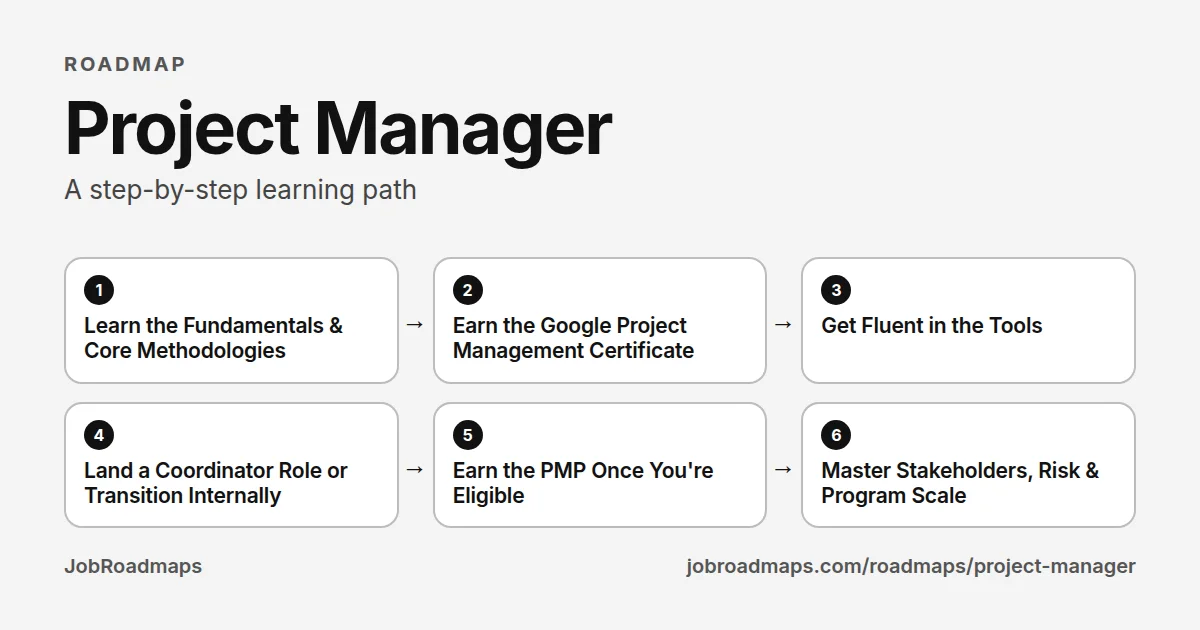
Learn the Fundamentals & Core Methodologies
3–4 weeksBefore any certificate, understand the shape of the job: scope, schedule, budget, risk, stakeholders, and the trade-offs between them. Learn how waterfall, agile, and the hybrid approach most real companies actually use each fit different kinds of work. This vocabulary is what you'll be tested on and what you'll speak every day.
Skills to learn
- Project lifecycle & phases
- Scope, schedule & budget management
- Waterfall vs agile vs hybrid
- Risk identification
- Stakeholder mapping
- The triple constraint
- Requirements gathering
Start with
- 2
Earn the Google Project Management Certificate
3–6 monthsThis is the highest-leverage credential for breaking in — recognised by employers, self-paced, affordable, and structured well enough to give you a portfolio of practice artifacts. It won't make you a PM by itself, but paired with any coordination experience it gets your resume past the first filter.
Skills to learn
- Project charters & plans
- Agile & Scrum foundations
- Cost & quality management
- Communication planning
- Documentation artifacts
- Change management basics
Start with
- 3
Get Fluent in the Tools
3–5 weeksPMs live inside project software, and fluency signals credibility fast. Learn Jira for agile teams, Asana or Monday for cross-functional work, and Microsoft Project for traditional plans and Gantt charts. Build a sample project in each so you can speak from experience, not brochures.
Skills to learn
- Jira boards, sprints & backlogs
- Asana / Monday workflows
- Microsoft Project & Gantt charts
- Confluence documentation
- Roadmapping & timelines
- Reporting dashboards
- Excel for tracking
Start with
- 4
Land a Coordinator Role or Transition Internally
2–4 monthsThe most reliable entry point is a project coordinator title or an internal move from a role you already hold — ops, marketing, support, engineering. Volunteer to run a cross-team initiative where you work now; that documented win is worth more than any cover letter. Target coordinator and associate PM postings, not senior ones.
Skills to learn
- Running standups & meetings
- Status reporting
- Timeline coordination
- Cross-functional communication
- Internal networking
- Resume framing for PM roles
Start with
- 5
Earn the PMP Once You're Eligible
3–6 months (after eligibility)The PMP is the anchor credential of the profession, but you can't rush it — PMI requires documented project leadership hours (roughly three years) before you sit the exam. Once eligible, it typically translates into a meaningful salary bump and unlocks senior postings. Plan for it from day one and log your hours as you go.
Skills to learn
- PMBOK & the PMP exam domains
- Earned value management
- Advanced risk & procurement
- Predictive, agile & hybrid delivery
- Exam preparation discipline
Start with
- 6
Master Stakeholders, Risk & Program Scale
OngoingSeniority in PM is measured in ambiguity handled and stakeholders aligned, not tasks tracked. Sharpen negotiation, executive communication, and quantitative risk management, then grow from single projects into programs — coordinated portfolios of related work. This is the jump from project manager to program manager.
Skills to learn
- Executive stakeholder management
- Negotiation & conflict resolution
- Quantitative risk analysis
- Program & portfolio management
- Budget ownership at scale
- Vendor & contract management
Start with
jobroadmaps.com/roadmaps/project-manager · Pay, demand and employer data for this role are further down the page.
Job Market Insights for Project Manager
Data-backed
What do employers actually ask for?
Read from live job postings — how often each credential is named, from rare to almost always.
"Certification mentioned" is the most common credential named, yet it appears only rarely in what we could read. Postings that state it are the minority, but these counts are a floor, so do not read this as "no one asks".
Our read: a portfolio that proves the skill, and a referral from someone inside the company, usually carry more weight than a credential match on paper. That is judgement, not something these counts measure.
Requirement
How often named
Certification mentioned
Bachelor's degree
Our read: how often a credential is named is not how strictly it is enforced. Equivalent experience, a standout portfolio, or a referral often counts for more than the credential listed.
Data-backed
Which skills appear most in job postings?
Read from live job postings, ranked from most to least often named.
governance is the most-named skill. Common, but not universal: many postings do not list it.
Past the fundamentals, 1 specialisation skill (governance included) start separating candidates who can do the job from candidates who have done it. The 19 niche skills are named rarely enough that knowing them is upside, not prerequisite.
Skill
How often named
governance
program management
enablement
communication
customer success
onboarding
automation
documentation
change management
risk management
vendor management
localization
process improvement
cross-functional collaboration
legal operations
operations strategy
M&A integration
benefits administration
Sorted by how often named · JobRoadmaps
Data-backed
Which tools and artifacts appear most in job postings?
Read from live job postings, ranked from most to least often named.
No tool dominates. The most-named, Salesforce, is still rare; postings for this role rarely list tools by name.
Tool / Artifact
How often named
Salesforce
Claude
Jira
Outreach
Asana
Confluence
Notion
Sorted by how often named · JobRoadmaps
Industry overlay
Targeting a specific industry?
The core roadmap gets you through the door anywhere. The difference between "qualified" and "they hired someone else" often lives in industry-specific context — the norms, the compliance floors, the tools assumed fluent in that sector.
Agile delivery fluency
Engineering teams run Scrum or Kanban, so PMs plan in sprints and epics rather than Gantt charts — fighting that rhythm fails fast.
Product launch coordination
Launches synchronise engineering, marketing, support, and sales enablement — the PM owns the checklist that makes it land on one day.
Cross-functional roadmapping
Dependencies between platform, product, and design teams need someone maintaining the single view of who blocks whom.
Customer onboarding programs
Enterprise SaaS deals include implementation projects, and PMs who can face customers directly are a distinct, valued track.
Jira administration
The tooling is the process in SaaS — PMs who can build boards, workflows, and dashboards remove friction for everyone.
Companies hiring:
SalesforceAtlassianHubSpotWorkdayServiceNowinfrastructure deployment
PMs must coordinate white space commissioning, MEP installation, equipment procurement, and facility handoff; managing critical path milestones with external contractors.
construction and project management
Data center builds require deep familiarity with construction timelines, change orders, regulatory compliance, and coordinating with multiple specialized subcontractors.
technical infrastructure knowledge
PMs must understand compute architectures, colocation requirements, power density, networking, and hardware integration to make trade-off decisions.
Companies hiring:
xAITogether AIAnthropicOpenAIIndustry premiums based on aggregated job posting data · Updated quarterly
Interactive
How ready are you right now?
Check the skills you already have to see your current job-market fit.
The most-named skill for this role is governance, so a gap there costs you the most. No single skill dominates, but each gap narrows which postings fit you. Check what you already have to see your biggest current gap.
Readiness Check
Check the skills you already have
0/5
base skills
Your biggest gap: governance, the most often named of the skills you have not ticked.
Start there, then work down the list.
Books worth reading as a Project Manager
Where to start, in order. The full list of 12, grouped by career stage, is on its own page.
Getting started
Project Management for the Unofficial Project Manager
by Kory Kogon, Suzette Blakemore, James Wood · 2015
~260 pages~7 hrs to read
An accessible guide to the five stages of a project, from defining scope to closing it out, aimed at people who manage projects without the title. A good first read if you are new to the work.
View book →
Making Things Happen: Mastering Project Management
by Scott Berkun · 2005
~400 pages~10 hrs to read
A practitioner's view of scope, schedules, decisions and politics on real software and product projects. Read it early for realism about how projects actually go.
View book →
Doing the job

Peopleware: Productive Projects and Teams
by Tom DeMarco, Timothy Lister · 1987
~250 pages~6 hrs to read
Argues that most project problems are about people and environment, not technology, with advice on staffing, teams and interruptions. Read it when you run a team for the first time.
View book →
Software Estimation: Demystifying the Black Art
by Steve McConnell · 2006
~310 pages~8 hrs to read
Covers estimation techniques, uncertainty ranges and why estimates go wrong. Helps you give schedules you can defend.
View book →
Senior and leading

Turn the Ship Around!: A True Story of Turning Followers into Leaders
by L. David Marquet · 2013
~240 pages~6 hrs to read
A submarine captain's account of pushing decisions down to the people who hold the information. Read it when you manage managers or a program of teams.
View book →
Never Split the Difference: Negotiating As If Your Life Depended On It
by Chris Voss, Tahl Raz · 2016
~290 pages~7 hrs to read
A former FBI hostage negotiator's tactics for listening, labeling and calibrated questions. Useful for negotiating scope, timelines and vendor terms when you lead larger programs.
View book →
All 12 books for a Project Manager →Browse all books →
Some book links are affiliate links: we earn a small commission if you buy, at no cost to you. It does not affect what we list.
Prerequisites & Education
What credentials do employers look for?
These are the most common paths into this role — no single one is required.
Education Level
View list — coming soon- Bachelor's in business, management, or any field — the standard baseline for PM roles
- Bachelor's in a technical discipline — valued for software and engineering project roles
- MBA — helpful for program and portfolio management, unnecessary for entry
- No degree — possible via coordinator roles and the PMP once you accumulate experience hours
Project management values evidence of delivery over academic pedigree. Most postings ask for a bachelor's in "any field" — what they screen for is projects you have actually run.
Certifications
View list — coming soon- Google Project Management Certificate — the best zero-experience entry credential; counts toward PMP prerequisites
- CAPM (PMI) — the recognised stepping stone when you lack the experience hours for PMP
- PMP (PMI) — the anchor certification; requires 36 months of project experience plus 35 training hours
- PMI-ACP — validates agile delivery experience; useful in software organisations
PMP is the salary-moving credential, but you cannot start with it — the 36-month experience requirement is enforced. Sequence: Google PM Cert or CAPM now, PMP at year three.
Bootcamps & Training
View list — coming soon- Google Project Management Certificate (Coursera) — 3–6 months, self-paced, provides PMP-qualifying training hours
- PMI Authorized Training Partners — the required 35 contact hours for the PMP exam
- Scrum.org or Scrum Alliance courses — agile fundamentals that most modern PM roles assume
- LinkedIn Learning project management paths — inexpensive supplements for tools and templates
Training hours are a PMP admission requirement, so choose courses that double as qualifying hours. Beyond that, running real projects teaches more than any course.
Portfolio & Other
View list — coming soon- Documented projects you led — scope, budget, timeline, outcome; volunteer and internal projects count
- Project artifacts — charters, RAID logs, status reports, and retrospectives you personally produced
- Tool proficiency — Jira, Asana, Smartsheet, and MS Project appear in most job descriptions
- Cross-functional coordination stories — quantified examples of unblocking teams and managing stakeholders
- Coordinator or team-lead experience — project coordinator is the standard on-ramp title
PM interviews are behavioural. A portfolio of specific, quantified delivery stories ("shipped X two weeks early by Y") is what separates candidates with identical certs.
Your Roadmap
6 stepsLearn the Fundamentals & Core Methodologies
3–4 weeksBefore any certificate, understand the shape of the job: scope, schedule, budget, risk, stakeholders, and the trade-offs between them. Learn how waterfall, agile, and the hybrid approach most real companies actually use each fit different kinds of work. This vocabulary is what you'll be tested on and what you'll speak every day.
Skills to learn
Earn the Google Project Management Certificate
3–6 monthsThis is the highest-leverage credential for breaking in — recognised by employers, self-paced, affordable, and structured well enough to give you a portfolio of practice artifacts. It won't make you a PM by itself, but paired with any coordination experience it gets your resume past the first filter.
Skills to learn
Get Fluent in the Tools
3–5 weeksPMs live inside project software, and fluency signals credibility fast. Learn Jira for agile teams, Asana or Monday for cross-functional work, and Microsoft Project for traditional plans and Gantt charts. Build a sample project in each so you can speak from experience, not brochures.
Skills to learn
Land a Coordinator Role or Transition Internally
2–4 monthsThe most reliable entry point is a project coordinator title or an internal move from a role you already hold — ops, marketing, support, engineering. Volunteer to run a cross-team initiative where you work now; that documented win is worth more than any cover letter. Target coordinator and associate PM postings, not senior ones.
Skills to learn
Earn the PMP Once You're Eligible
3–6 months (after eligibility)The PMP is the anchor credential of the profession, but you can't rush it — PMI requires documented project leadership hours (roughly three years) before you sit the exam. Once eligible, it typically translates into a meaningful salary bump and unlocks senior postings. Plan for it from day one and log your hours as you go.
Skills to learn
Master Stakeholders, Risk & Program Scale
OngoingSeniority in PM is measured in ambiguity handled and stakeholders aligned, not tasks tracked. Sharpen negotiation, executive communication, and quantitative risk management, then grow from single projects into programs — coordinated portfolios of related work. This is the jump from project manager to program manager.
Skills to learn
Start here this week
This week: volunteer to coordinate something real where you already work — a cross-team launch, a process fix, an event — and start running it like a project, with a written plan, a stakeholder list, and a status update. That single artifact will teach you more than a month of coursework and gives you a story to tell in interviews.
For a structured path: enrol in the Google Project Management Certificate and work it over three to four months while you run that volunteer project in parallel. Log every hour you spend leading work, because those hours count toward PMP eligibility later. Once you have the certificate plus one documented project, start applying to coordinator and associate PM roles.
Pay
U.S. Department of Labor data for the nearest BLS occupation, Project management specialists. BLS has no occupation for this exact title, so treat these as a benchmark.
Median: U.S. Bureau of Labor Statistics, Occupational Employment and Wage Statistics (median wage, May 2024) and Employment Projections (2024–34). Levels: U.S. Department of Labor Office of Foreign Labor Certification prevailing wage levels (wage year 2025, typical metro), a base-wage benchmark for the metro in the middle of 519 areas, not an offer. See every metro.
Job Titles at Each Level
Entry
Project Coordinator
Mid
Project Manager
Senior
Senior Project Manager / Program Manager
Steps Overview
- 1
Learn the Fundamentals & Core Methodologies
3–4 weeks
- 2
Earn the Google Project Management Certificate
3–6 months
- 3
Get Fluent in the Tools
3–5 weeks
- 4
Land a Coordinator Role or Transition Internally
2–4 months
- 5
Earn the PMP Once You're Eligible
3–6 months (after eligibility)
- 6
Master Stakeholders, Risk & Program Scale
Ongoing
Explore more roadmaps
Not sure this is the right path? Browse all business career roadmaps.
View Similar RoadmapsBuilt a project while following this roadmap?
Turn it into a hiring-ready case study in 10 seconds — free.
Ready to explore more?
Browse all career roadmaps across tech, business, and creative fields.