Product Marketing Manager (PMM) Career Roadmap
A product marketing manager sits between product, sales and marketing and owns the story of the product: who it is for, why it beats the alternative, and how it reaches the market. Product decides what gets built. Marketing runs the channels. The PMM decides what gets said, to whom, and what sales needs in hand when the buyer says "why you?". The work is positioning and messaging, competitive and market research, launches, sales enablement and a seat in the pricing conversation. It rewards people who can interview a skeptical buyer on Tuesday and brief a sales team on the answer by Friday.
Is this the right path for you?
Almost nobody starts here. The people who land PMM roles usually arrive from one of five places: product (an associate PM or product ops person who prefers the market side), content or marketing (a writer or marketer who got pulled into launches), sales or sales engineering (someone who knows exactly why deals are lost), consulting (strong at structured research and storytelling), and customer research (already talking to buyers for a living). Each brings half the job; the work is learning the other half.
You will like this if you enjoy being the translator: turning engineering detail into a sentence a buyer repeats, and turning a lost deal into a changed message. You need comfort with influence without authority, since you do not own the roadmap, the sales team or the channel budget but you need all three to move. Writing is the daily craft. If you want to own a number you can move alone, a channel role is a cleaner fit.
Honest competition note. In the live postings we track (about 100 tech-company job boards, skewed to AI, infrastructure and SaaS scale-ups, not all employers), 173 postings carry "product marketing" in the title across 53 companies. Only 7 carry early-career words, and about 53 carry "senior". The associate door is narrow; the realistic way in is an adjacent role first. A handful of employers account for much of the volume, so expect to be competing for the same few teams.
Career Progression
Where does this role lead?
Click any role to explore timeline, key skills and, where the Department of Labor publishes it, pay.
Entry
Associate PMM
~0–2 yrs
You support launches and build the enablement assets while learning how a message survives a sales call. Most people reach this seat from an adjacent job, not straight from school.
Key skills
What the postings say you’ll do
Lines copied word for word from live Product Marketing Manager postings we track, read September 30, 2026. They show how employers word the job, not what every Product Marketing Manager does. Postings change and expire.
“Develop positioning, messaging, and core narratives for feature releases, key launches, and strategic product narratives”
“Drive end-to-end product launches, including define audience segments, gather user insights, craft launch narratives, inform pricing and packaging, ensure cross-functional readiness, and execute launch activities”
“Collaborate with Enterprise PMMs and Sales to build sales enablement materials that turn product capability into stories reps can use in the field.”
“Develop high-impact sales enablement assets (battlecards, pitch decks, demos) grounded in deep market and competitive insights.”
“Define the ICP, buyer, user, jobs to be done, workflow, alternatives, and reasons customers will switch or expand.”
“Partner with demand generation and field marketing to build campaign briefs, messaging frameworks, and content assets (web copy, ebooks, webinars, videos) that translate technical differentiation into buyer-relevant narratives.”
“Develop a differentiated narrative for securing device sign-in and enabling seamless, passwordless, phishing-resistant access from device to applications.”
Who is hiring right now
Drawn from live postings across many employers today. Employers with live postings we tag to this roadmap, counted today. The sample is about a hundred tech-company job boards, tilted toward AI, data and infrastructure companies, so agencies, consultancies and most non-tech employers are not represented.
| Employer | Live postings | Early-career titles | Most common title |
|---|---|---|---|
| Stripe | 8 | 0 | GTM Product Marketing Manager, Commerce Experiences |
| Veeva Systems | 8 | 2 | Product Marketing Manager - Commercial Content |
| Snowflake | 7 | 0 | Product Marketing Manager – Platform, EMEA |
| Anthropic | 6 | 0 | Product Marketing Manager, Knowledge Work - Core Products |
| Perplexity | 5 | 1 | Associate Product Marketing Manager |
| Braze | 4 | 0 | Lead, Technology Partners Product Marketing Manager |
| Harvey | 4 | 0 | Senior Product Marketing Manager, Core |
| Intercom | 4 | 0 | Senior Product Marketing Manager |
| Navan | 4 | 0 | Product Marketing Manager |
| OpenAI | 4 | 0 | Industry Product Marketing Manager |
| Verkada | 4 | 0 | Product Marketing Manager, Privacy and Data Security |
| Baseten | 3 | 0 | Product Marketing Manager, Dedicated Inference |
“Early-career titles” are roles whose title signals an entry-level or new-graduate position. Top 12 of 67 employers shown.
Look-alike roles, compared
Neighbouring titles read very differently once you open the posting. One line from a real posting for each, with how many live postings we track under that title and how many carry early-career wording.
Product Marketing Manager
212 live postings · 81 employers · 8 with early-career wording
“Develop differentiated messaging and positioning, equip GTM teams with knowledge and content to sell and market effectively”
Stripe · Product Marketing Manager, Payments posting
Product Manager
817 live postings · 113 employers · 15 with early-career wording
“Perform up-front discovery through user interviews, competitive research, data analysis, etc. and present findings to the team with conviction and rigor”
Linear · Product Manager posting
Growth / Demand Marketing
91 live postings · 48 employers · 0 with early-career wording
“In this role, you will be accountable for down-funnel pipeline, efficient CAC, and customer acquisition.”
Brex · Senior Growth Marketing Manager, Paid Social posting
Content / Brand Marketing
32 live postings · 20 employers · 0 with early-career wording
“Develop and implement content production and distribution strategies to maximize reach and engagement across relevant channels and target audiences.”
Adyen · Senior B2B Content Marketing Manager, Global posting
Quotes read September 30, 2026, from the live postings we track.
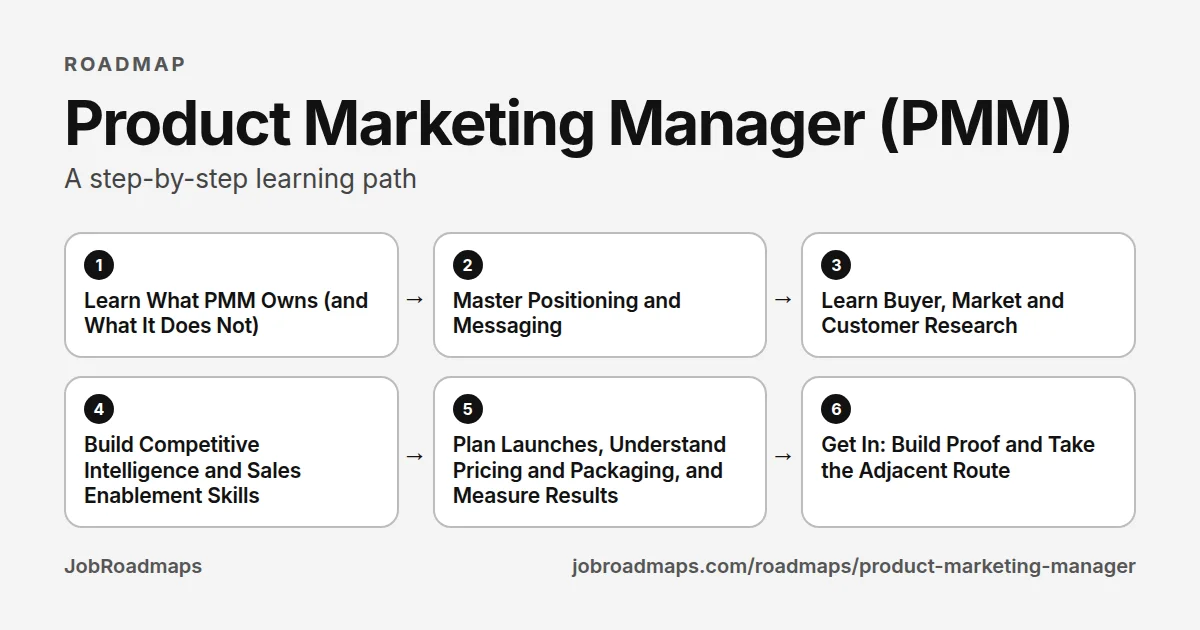
Visual roadmap
Product Marketing Manager learning path
Work down the line, one step at a time. Tick each skill as you can do it.
- 1
Learn What PMM Owns (and What It Does Not)
2–3 weeksStart by drawing the borders. A PMM is not the product manager: PM owns what gets built and why, PMM owns who it is for and how it is described and sold. A PMM is not the marketing manager either: that role runs campaigns, channels and spend, while PMM supplies the positioning those campaigns carry. The core remit is positioning and messaging, launches, sales enablement, market and customer research, and competitive intelligence. Read how practitioners describe the job before you decide you want it.
Skills to learn
- Product vs. product marketing vs. demand generation
- Go-to-market motions (product-led vs. sales-led)
- Buyer vs. user vs. champion
- The product lifecycle
- Reading a product roadmap
- Reading a job description for the real remit
Start with
- 2
Master Positioning and Messaging
4–6 weeksPositioning is the core craft and the one most candidates cannot show. Learn to name the real competitive alternative, the attributes only you have, the value those attributes create and the customer who cares most. Then turn it into messaging a salesperson can say out loud. Practise on products you know: write the positioning, then argue with it. The test is whether a stranger can repeat it back correctly.
Skills to learn
- Competitive alternatives and differentiated value
- Target-customer definition
- Market category choice
- Value propositions and messaging hierarchy
- Proof points
- Writing for a buyer, not for the product team
Start with
- 3
Learn Buyer, Market and Customer Research
4–6 weeksPositioning built on opinion collapses in the first sales call. The research half of the job is talking to real buyers: who was involved, what they compared, what almost stopped them. Learn interview technique that avoids leading questions, build personas from what buyers actually said, and learn win-loss analysis: structured conversations after a deal is won or lost, because the CRM field rarely tells the true reason.
Skills to learn
- Customer and buyer interviews
- Interview technique (no leading questions)
- Buyer personas and buying committees
- Win-loss analysis
- Survey design basics
- Synthesising findings into decisions
Start with
- 4
Build Competitive Intelligence and Sales Enablement Skills
4–6 weeksSales is your most demanding internal customer. Learn to track competitors without drowning in feature tables, to write a battlecard a rep will actually open mid-call, and to run a short, useful enablement session. Content nobody uses is the common failure here. Ask sales what they got stuck on last week, then build exactly that, and check back on whether it got used.
Skills to learn
- Competitive research and tracking
- Battlecards
- Sales decks and one-pagers
- Objection handling content
- Enablement sessions and feedback loops
- Working with sales leaders and sales engineers
Start with
- 5
Plan Launches, Understand Pricing and Packaging, and Measure Results
4–6 weeksLaunches are where the work becomes visible. Learn how teams tier launches by how much the change matters to customers and the business, what a launch plan has to cover (messaging, enablement, assets, channels, internal readiness) and who has to sign off. Learn the concepts behind pricing and packaging well enough to give useful input to the people who decide it. Then decide, before launch, what success will mean and how you will check it afterwards.
Skills to learn
- Launch tiering and launch planning
- Cross-functional launch coordination
- Pricing and packaging concepts (willingness to pay, tiers)
- Launch success metrics defined up front
- Adoption and pipeline signals
- Post-launch review
Start with
- 6
Get In: Build Proof and Take the Adjacent Route
3–12 monthsVery few people are hired as a PMM straight out of school. Build proof where you already work: volunteer to write the positioning for the next feature, run the win-loss calls nobody has time for, or draft the battlecard your sales team keeps asking for. Then ask for the move internally, or apply from the adjacent role with a portfolio of real, redacted artifacts: a positioning document, a launch plan, a battlecard. A certification can help a recruiter filter you in, but the artifacts do the convincing.
Skills to learn
- Portfolio of redacted work samples
- Internal transfer strategy
- Telling a PMM story from a non-PMM job
- Interviewing with a positioning exercise
- Networking with PMM practitioners
Start with
jobroadmaps.com/roadmaps/product-marketing-manager · Pay, demand and employer data for this role are further down the page.
Job Market Insights for Product Marketing Manager
Data-backed
What do employers actually ask for?
Read from live job postings — how often each credential is named, from rare to almost always.
"Certification mentioned" is the most common credential named, yet it appears only rarely in what we could read. Postings that state it are the minority, but these counts are a floor, so do not read this as "no one asks".
Our read: a portfolio that proves the skill, and a referral from someone inside the company, usually carry more weight than a credential match on paper. That is judgement, not something these counts measure.
Requirement
How often named
Certification mentioned
Our read: how often a credential is named is not how strictly it is enforced. Equivalent experience, a standout portfolio, or a referral often counts for more than the credential listed.
Data-backed
Which skills appear most in job postings?
Read from live job postings, ranked from most to least often named.
go-to-market strategy is the most-named skill. Common, but not universal: many postings do not list it.
Past the fundamentals, 2 specialisation skills (go-to-market strategy included) start separating candidates who can do the job from candidates who have done it. The 14 niche skills are named rarely enough that knowing them is upside, not prerequisite.
Skill
How often named
go-to-market strategy
sales enablement
demand generation
product launches
competitive intelligence
customer research
market research
pricing strategy
product positioning
cross-functional leadership
launch communications
competitive positioning
partner marketing
enterprise sales
developer relations
technical marketing
Sorted by how often named · JobRoadmaps
Data-backed
Which tools and artifacts appear most in job postings?
Read from live job postings, ranked from most to least often named.
No tool dominates. The most-named, Segment, is still rare; postings for this role rarely list tools by name.
Tool / Artifact
How often named
Segment
Salesforce
Intercom
Pendo
Sorted by how often named · JobRoadmaps
Industry overlay
Targeting a specific industry?
The core roadmap gets you through the door anywhere. The difference between "qualified" and "they hired someone else" often lives in industry-specific context — the norms, the compliance floors, the tools assumed fluent in that sector.
Compliance-aware messaging
Claims about rates, fees, speed or security usually need review. PMMs learn to write copy that is both persuasive and defensible.
Trust and credibility positioning
Money products are bought on confidence. The message must show reliability without sounding evasive or overpromising.
Developer vs. business buyer messaging
Payments platforms are often chosen by engineers and funded by finance or business leaders; the story differs for each.
Partner and ecosystem launches
Financial products often launch alongside banks, platforms or integration partners, which adds coordination and co-marketing sign-off.
Companies hiring:
StripeChimeIT admin and security messaging
Enterprise SaaS buyers include IT admins and security teams who gate purchasing decisions. PMMs must translate product capabilities into governance, compliance, and control narratives.
implementation and ROI messaging
Enterprise deals are large and complex. PMMs must communicate quick time-to-value, low implementation risk, and clear business case to justify investment to CFOs and procurement.
multi-stakeholder positioning
Enterprise buyers involve technical leaders, department heads, procurement, and finance. PMMs craft messaging for each stakeholder group addressing their specific concerns.
Companies hiring:
OktaNotionLinearSmartsheetJustworksOpenTableInstacartIndustry premiums based on aggregated job posting data · Updated quarterly
Interactive
How ready are you right now?
Check the skills you already have to see your current job-market fit.
The most-named skill for this role is go-to-market strategy, so a gap there costs you the most. No single skill dominates, but each gap narrows which postings fit you. Check what you already have to see your biggest current gap.
Readiness Check
Check the skills you already have
0/5
base skills
Your biggest gap: go-to-market strategy, the most often named of the skills you have not ticked.
Start there, then work down the list.
Books worth reading as a Product Marketing Manager
Where to start, in order. The full list of 12, grouped by career stage, is on its own page.
Getting started

Obviously Awesome
by April Dunford · 2019
~200 pages~5 hrs to read
A step-by-step method for positioning a product: pick competitive alternatives, isolate unique attributes, and tie them to value for a target customer. The first book to read when you own positioning.
View book →
Positioning: The Battle for Your Mind
by Al Ries, Jack Trout · 1981
~210 pages~5 hrs to read
A short book on how a product is placed in a buyer's mind relative to rivals. Useful grounding for new PMMs before a first messaging or competitive-framing project.
View book →
Doing the job
Building a StoryBrand
by Donald Miller · 2017
~240 pages~6 hrs to read
Lays out a seven-part narrative framework that puts the customer at the center of website and campaign copy. Useful when turning positioning into clear messaging for pages, decks and launches.
View book →
Competing Against Luck
by Clayton M. Christensen, Taddy Hall, Karen Dillon, David S. Duncan · 2016
~290 pages~7 hrs to read
Applies the jobs-to-be-done lens to explain why customers hire products. Helps PMMs structure customer research and write segments and messages around the progress buyers are trying to make.
View book →
Senior and leading

Crossing the Chasm
by Geoffrey A. Moore · 1991
~270 pages~7 hrs to read
Covers taking a technology product from early adopters to the mainstream market, including beachhead segments and whole-product thinking. Core reading for PMMs setting go-to-market strategy.
View book →
Play Bigger
by Al Ramadan, Dave Peterson, Christopher Lochhead, Kevin Maney · 2016
~260 pages~7 hrs to read
Argues for defining a new market category rather than competing inside an existing one. Useful for senior PMMs and heads of marketing shaping category narrative and launch strategy.
View book →
All 12 books for a Product Marketing Manager →Browse all books →
Some book links are affiliate links: we earn a small commission if you buy, at no cost to you. It does not affect what we list.
Prerequisites & Education
What credentials do employers look for?
These are the most common paths into this role — no single one is required.
Education Level
View list — coming soon- Bachelor's in marketing, business, communications or economics — the common baseline in postings
- Bachelor's in a technical field — useful for developer and infrastructure products where you must follow the engineering conversation
- Bachelor's in any field plus time in product, sales or content — the usual career-changer profile
- MBA — sometimes seen at the senior end; not an entry requirement
Employers screen for evidence you can position a product and work with sales, not for a particular degree. Your previous role and your work samples matter more than your major.
Certifications
View list — coming soon- Product Marketing Certified (Product Marketing Alliance) — core, advanced and leadership levels; a recognised PMM-specific credential
- Product Marketer Certification (Pragmatic Institute) — three courses: Foundations, Market and Launch
- AMA Professional Certified Marketer, Marketing Management (American Marketing Association) — general marketing credential; a broad résumé signal rather than PMM-specific
- Optional extras: vendor certifications for the CRM or marketing tools your target employers use
No certification is required to be hired as a PMM. They can help a recruiter filter you in when you come from an adjacent field; a positioning document and a launch plan do more of the convincing.
Bootcamps & Training
View list — coming soon- Product Marketing Alliance cohort programmes — on-demand, live virtual and in-person formats exist
- Pragmatic Institute — online courses on market, positioning and launch
- Klue battlecards course library — free video training on competitive enablement
- Clozd win-loss guides — free, practical material on buyer interviews and win-loss programmes
PMM training is thin compared with engineering fields. Treat courses as scaffolding for a practice project of your own, not as a substitute for one.
Portfolio & Other
View list — coming soon- A positioning document for a real product, with the alternative, differentiators, target customer and proof points spelled out
- A launch plan with tiering, audiences, assets, enablement and a pre-defined success measure
- A battlecard or sales one-pager, ideally one your sales team actually used
- A short buyer-research readout: interview themes and what you changed because of them
- A before-and-after messaging rewrite with a note on what happened (redact confidential details)
Hiring managers read PMM work samples for clarity and judgment. Show the thinking, not just the polished slides, and keep claims modest and checkable.
Your Roadmap
6 stepsLearn What PMM Owns (and What It Does Not)
2–3 weeksStart by drawing the borders. A PMM is not the product manager: PM owns what gets built and why, PMM owns who it is for and how it is described and sold. A PMM is not the marketing manager either: that role runs campaigns, channels and spend, while PMM supplies the positioning those campaigns carry. The core remit is positioning and messaging, launches, sales enablement, market and customer research, and competitive intelligence. Read how practitioners describe the job before you decide you want it.
Skills to learn
Master Positioning and Messaging
4–6 weeksPositioning is the core craft and the one most candidates cannot show. Learn to name the real competitive alternative, the attributes only you have, the value those attributes create and the customer who cares most. Then turn it into messaging a salesperson can say out loud. Practise on products you know: write the positioning, then argue with it. The test is whether a stranger can repeat it back correctly.
Skills to learn
Learn Buyer, Market and Customer Research
4–6 weeksPositioning built on opinion collapses in the first sales call. The research half of the job is talking to real buyers: who was involved, what they compared, what almost stopped them. Learn interview technique that avoids leading questions, build personas from what buyers actually said, and learn win-loss analysis: structured conversations after a deal is won or lost, because the CRM field rarely tells the true reason.
Skills to learn
Build Competitive Intelligence and Sales Enablement Skills
4–6 weeksSales is your most demanding internal customer. Learn to track competitors without drowning in feature tables, to write a battlecard a rep will actually open mid-call, and to run a short, useful enablement session. Content nobody uses is the common failure here. Ask sales what they got stuck on last week, then build exactly that, and check back on whether it got used.
Skills to learn
Plan Launches, Understand Pricing and Packaging, and Measure Results
4–6 weeksLaunches are where the work becomes visible. Learn how teams tier launches by how much the change matters to customers and the business, what a launch plan has to cover (messaging, enablement, assets, channels, internal readiness) and who has to sign off. Learn the concepts behind pricing and packaging well enough to give useful input to the people who decide it. Then decide, before launch, what success will mean and how you will check it afterwards.
Skills to learn
Get In: Build Proof and Take the Adjacent Route
3–12 monthsVery few people are hired as a PMM straight out of school. Build proof where you already work: volunteer to write the positioning for the next feature, run the win-loss calls nobody has time for, or draft the battlecard your sales team keeps asking for. Then ask for the move internally, or apply from the adjacent role with a portfolio of real, redacted artifacts: a positioning document, a launch plan, a battlecard. A certification can help a recruiter filter you in, but the artifacts do the convincing.
Skills to learn
Start here this week
This week: pick a product you know well, ideally one you use at work, and write a one-page positioning document. Name the real alternative a buyer would pick instead, what only this product does, why that matters and who cares most. Then read April Dunford's positioning material and rewrite it. Show both drafts to someone in sales. Their reaction tells you whether you have the instinct for this job.
For a structured route: spend a month each on positioning, buyer research and sales enablement, then a launch-planning month with a certification (Product Marketing Alliance or Pragmatic Institute) only if it helps your resume get read. Meanwhile work the adjacent-role plan: ask your current product, marketing or sales team for one real PMM-shaped task per quarter, and collect the artifacts. Apply when you have three redacted samples and one story about a deal or launch you changed.
Job Titles at Each Level
Entry
Associate Product Marketing Manager
Mid
Product Marketing Manager
Senior
Senior Product Marketing Manager / Director of Product Marketing / Head of Product Marketing
Steps Overview
- 1
Learn What PMM Owns (and What It Does Not)
2–3 weeks
- 2
Master Positioning and Messaging
4–6 weeks
- 3
Learn Buyer, Market and Customer Research
4–6 weeks
- 4
Build Competitive Intelligence and Sales Enablement Skills
4–6 weeks
- 5
Plan Launches, Understand Pricing and Packaging, and Measure Results
4–6 weeks
- 6
Get In: Build Proof and Take the Adjacent Route
3–12 months
Explore more roadmaps
Not sure this is the right path? Browse all business career roadmaps.
View Similar RoadmapsBuilt a project while following this roadmap?
Turn it into a hiring-ready case study in 10 seconds — free.
Ready to explore more?
Browse all career roadmaps across tech, business, and creative fields.