Mobile Developer Career Roadmap
Mobile development means building software for the device in nearly every human's pocket — a context defined by unreliable networks, intermittent attention, and hardware constraints that force genuine engineering discipline. iOS and Android represent different philosophical approaches to the same problem. React Native and Flutter offer a third path: write once, deploy everywhere, accept the trade-offs. The market rewards fluency in all three contexts.
Is this the right path for you?
Mobile developers come from web development (the JavaScript muscle memory translates to React Native, though native requires starting over), CS degrees, and bootcamp graduates who chose a mobile track. The native vs. cross-platform split is a real fork in the path that should be decided early — React Native widens the job market and is faster to learn; native Swift or Kotlin gets you deeper access to platform features and more senior roles at companies that ship serious mobile products.
If you care about the 200ms delay between touch and response — if you notice when a scroll doesn't match the physics of the device — you're already wired for mobile. The platform is unforgiving: battery, latency, limited screen real estate, users who are distracted and impatient. Getting those constraints right is the whole job.
One honest note: the mobile market is smaller than the web market but less crowded at the top. Companies that build serious mobile products — the Airbnbs, the DoorDashes — have fewer candidates with genuine native expertise than they have open positions. If you go native and go deep, the market is better than people assume.
Career Progression
Where does this role lead?
Click any role to explore timeline, key skills and, where the Department of Labor publishes it, pay.
Entry
Junior Mobile Dev
~1 yr
$74,464 (Level I)
Pick a platform (iOS or Android) and go deep. Shipping a feature through App Store review for the first time teaches more than any tutorial.
Key skills
Pay shown is the U.S. Department of Labor prevailing wage for Level I (entry), Level III (mid) and Level IV (senior) in the nearest BLS occupation, base wage for the typical metro, wage year 2025, shown for the main track only. It is a benchmark, not an offer; branches and lead, staff and executive stages have no official figure.
Visual roadmap
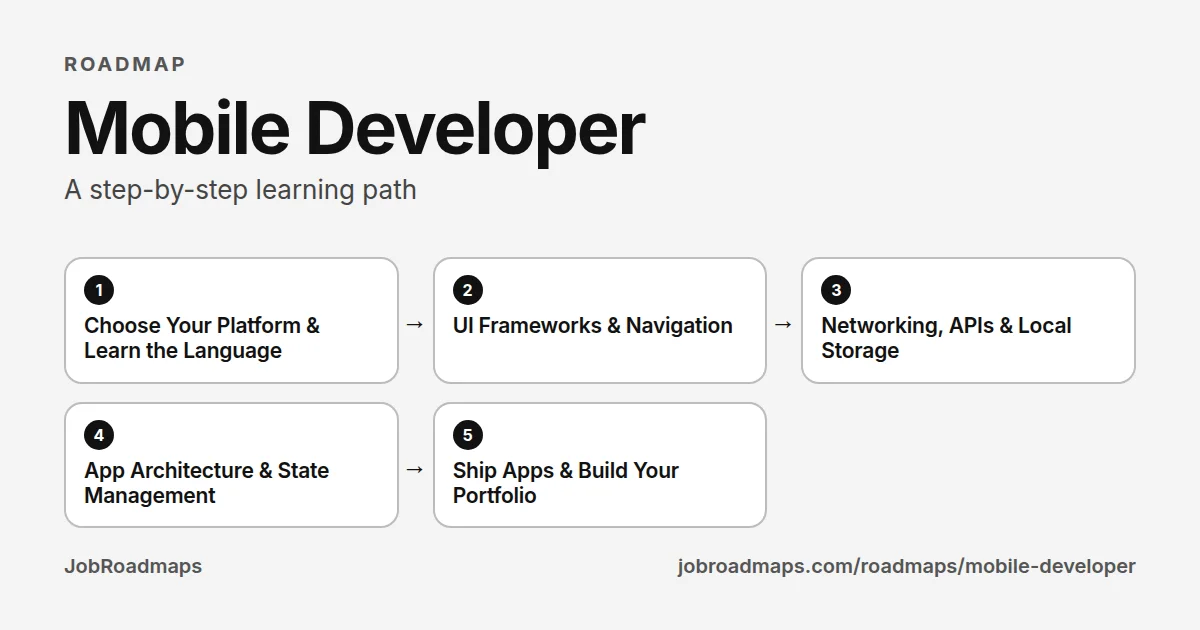
Mobile Developer learning path
Work down the line, one step at a time. Tick each skill as you can do it.
- 1
Choose Your Platform & Learn the Language
6–8 weeksDecide: iOS (Swift + Xcode + SwiftUI), Android (Kotlin + Jetpack Compose), or cross-platform (Flutter/React Native). Most employers prefer native expertise. Learn the language fundamentals: optionals, closures, generics (Swift) or coroutines, lambdas (Kotlin).
Skills to learn
- Swift 5.9+ (optionals, generics, protocols)
- Kotlin 1.9+ (coroutines, sealed classes)
- Xcode 15 (iOS) / Android Studio (Android)
- OOP & Protocol-Oriented Programming
- Functional Patterns (map, filter, reduce)
- Debugging (simulator / emulator)
- App Lifecycle (foreground, background)
- Memory Management (ARC)
Start with
- 2
UI Frameworks & Navigation
6–8 weeksBuild user interfaces with SwiftUI (iOS) or Jetpack Compose (Android). Learn declarative UI patterns, navigation stacks, custom animations, and responsive layouts for different screen sizes and orientations.
Skills to learn
- SwiftUI (iOS) / Jetpack Compose (Android)
- NavigationStack / Navigation Component
- Custom Animations
- Adaptive Layouts (size classes)
- VoiceOver / TalkBack Accessibility
- Dark Mode & Dynamic Type support
- Localization & Internationalisation
- Lists, Grids & Lazy Loading
Start with
- 3
Networking, APIs & Local Storage
5–7 weeksIntegrate REST APIs using URLSession (iOS) or Retrofit (Android). Handle JSON parsing, authentication tokens, and error states. Store data locally with CoreData / SwiftData (iOS) or Room (Android). Implement caching strategies.
Skills to learn
- URLSession (iOS) / Retrofit (Android)
- JSON Decoding (Codable / Gson, Moshi)
- CoreData / SwiftData (iOS)
- Room Database (Android)
- Firebase Realtime DB & Firestore
- Firebase Auth (Apple, Google sign-in)
- Keychain (iOS) / EncryptedSharedPrefs
- Offline-First Caching Strategy
- Push Notifications (APNs / FCM)
Start with
- 4
App Architecture & State Management
6–8 weeksLearn architectural patterns (MVVM, MVI, Clean Architecture) that make apps testable and maintainable. Implement dependency injection. Write unit and UI tests. Handle app lifecycle, background tasks, and push notifications.
Skills to learn
- MVVM Pattern
- Clean Architecture (Use Cases, Repos)
- Dependency Injection (Swinject / Hilt)
- Unit Testing (XCTest / JUnit)
- UI Testing (XCUITest / Espresso)
- Combine / Swift Concurrency (async/await)
- Kotlin Flow & Coroutines
- Background Tasks (BackgroundTasks API)
- Snapshot Testing
Start with
- 5
Ship Apps & Build Your Portfolio
4–8 weeksPublish 1–2 apps on the App Store and/or Google Play. Even free apps with real users prove deployment skills. Learn app store optimisation (ASO), analytics (Firebase, Mixpanel), crash reporting (Sentry), and A/B testing.
Skills to learn
- App Store Connect & TestFlight (iOS)
- Google Play Console & Internal Track
- App Store Optimisation (ASO)
- Firebase Crashlytics
- Firebase Analytics / Amplitude
- StoreKit 2 / Google Billing Library
- Firebase Remote Config (A/B testing)
- Instruments / Android Profiler
Start with
jobroadmaps.com/roadmaps/mobile-developer · Pay, demand and employer data for this role are further down the page.
Job Market Insights for Mobile Developer
Data-backed
What do employers actually ask for?
Read from live job postings — how often each credential is named, from rare to almost always.
"Bachelor's degree" is the most common credential named, yet it appears only rarely in what we could read. Postings that state it are the minority, but these counts are a floor, so do not read this as "no one asks".
Our read: a portfolio that proves the skill, and a referral from someone inside the company, usually carry more weight than a credential match on paper. That is judgement, not something these counts measure.
Requirement
How often named
Bachelor's degree
Our read: how often a credential is named is not how strictly it is enforced. Equivalent experience, a standout portfolio, or a referral often counts for more than the credential listed.
Data-backed
Which skills appear most in job postings?
Read from live job postings, ranked from most to least often named.
Swift is the most-named skill. Common, but not universal: many postings do not list it.
Past the fundamentals, 2 specialisation skills (Swift included) start separating candidates who can do the job from candidates who have done it. The 9 niche skills are named rarely enough that knowing them is upside, not prerequisite.
Skill
How often named
SwiftUI
UIKit
Jetpack Compose
code review
accessibility
Coroutines
performance optimization
mentorship
Sorted by how often named · JobRoadmaps
Data-backed
Which tools and artifacts appear most in job postings?
Read from live job postings, ranked from most to least often named.
No tool dominates. The most-named, Xcode, is still rare; postings for this role rarely list tools by name.
Tool / Artifact
How often named
Xcode
Gradle
Sorted by how often named · JobRoadmaps
Industry overlay
Targeting a specific industry?
The core roadmap gets you through the door anywhere. The difference between "qualified" and "they hired someone else" often lives in industry-specific context — the norms, the compliance floors, the tools assumed fluent in that sector.
Biometric & secure enclave integration
Financial apps must use Face ID/Touch ID and hardware-backed keystores correctly to protect credentials and authorize transactions.
Offline transaction queuing
Payments initiated with poor connectivity must queue and reconcile safely without risking duplicate charges once connectivity returns.
App security hardening (jailbreak/root detection, certificate pinning)
Financial apps are high-value tampering targets, so certificate pinning and integrity checks are standard, unlike typical consumer apps.
Regulatory-driven UX constraints
Disclosures, KYC flows, and transaction confirmations are shaped by compliance requirements that limit how much UI simplification is allowed.
Push-based fraud alerting
Real-time transaction alerts require tight integration between backend fraud scoring and mobile push delivery with near-zero acceptable delay.
Companies hiring:
Cash App (Block)ChimeRobinhoodVenmoRevolutcross-device sync
Users expect seamless experience across iOS, Android, web, and desktop; state management is complex.
offline-first architecture
Email and productivity apps must work offline and sync when connection returns; requires local state handling.
conversational UX
AI-powered productivity tools require novel interaction patterns and context awareness beyond traditional UI.
Companies hiring:
MozillaNavanIndustry premiums based on aggregated job posting data · Updated quarterly
Interactive
How ready are you right now?
Check the skills you already have to see your current job-market fit.
The most-named skill for this role is Swift, so a gap there costs you the most. No single skill dominates, but each gap narrows which postings fit you. Check what you already have to see your biggest current gap.
Readiness Check
Check the skills you already have
0/5
base skills
Your biggest gap: Swift, the most often named of the skills you have not ticked.
Start there, then work down the list.
Books worth reading as a Mobile Developer
Where to start, in order. The full list of 12, grouped by career stage, is on its own page.
Getting started

Head First Android Development
by Dawn Griffiths, David Griffiths · 2015
~850 pages~21 hrs to read
A visual, hands-on walk through building Android apps, covering activities, layouts, navigation and data. Read it when you are choosing Android as your first platform.
View book →Kotlin in Action
by Sebastian Aigner, Roman Elizarov, Svetlana Isakova, Dmitry Jemerov · 2017
Teaches Kotlin from the language's own designers' point of view, including lambdas, null safety, coroutines and idioms. Read it early if you are going to write Android code.
View book →
Doing the job
Android UI Development with Jetpack Compose
by Thomas Künneth · 2022
~250 pages~6 hrs to read
Shows how to build Android interfaces declaratively with Compose, covering layouts, state, theming and animation. Read it when you start building real screens.
View book →
Modern Concurrency in Swift
by Marin Todorov · 2021
Teaches async/await, tasks, actors and structured concurrency in Swift through projects. Read it once you fetch data or run background work in an iOS app.
View book →
Senior and leading

Clean Architecture
by Robert C. Martin · 2017
~430 pages~11 hrs to read
Argues for separating business rules from frameworks, databases and UI through dependency rules and boundaries. Read it when you design an app's structure so screens and storage can change independently.
View book →
Release It!
by Michael T. Nygard · 2007
~380 pages~10 hrs to read
Stability patterns and anti-patterns such as timeouts, circuit breakers and bulkheads, drawn from real production failures. Read it once you are on call for a service that other systems depend on.
View book →
All 12 books for a Mobile Developer →Browse all books →
Some book links are affiliate links: we earn a small commission if you buy, at no cost to you. It does not affect what we list.
Prerequisites & Education
What credentials do employers look for?
These are the most common paths into this role — no single one is required.
Education Level
View list — coming soon- Bachelor's in Computer Science, Software Engineering, or related field
- Bachelor's in any discipline — mobile is skills and portfolio-gated at most companies
- Bootcamp graduate with published App Store or Google Play app
- Self-taught — viable with a strong published app history
Mobile development is heavily portfolio-gated. A published app with good reviews is often more persuasive than a CS degree during the screening stage.
Certifications
View list — coming soon- Google Associate Android Developer — official Android certification, listed in Android JDs
- Apple Developer Program membership — required to publish iOS apps (not a cert but signals commitment)
- Meta React Native Developer Certificate (Coursera)
- AWS Certified Developer – Associate — useful for mobile engineers owning backend APIs
The Google Associate Android Developer cert is the most directly relevant certification. For iOS, published App Store apps carry more weight than any certificate.
Bootcamps & Training
View list — coming soon- Hacking with Swift (Paul Hudson) — widely respected free iOS curriculum
- Android Basics with Compose (Google/Udacity) — official Android learning track
- The Complete React Native + Hooks Course (Udemy, Stephen Grider) — popular cross-platform path
- AppBrewery iOS & Android Bootcamp (Udemy, Angela Yu) — beginner-to-published-app curriculum
Hacking with Swift and the Google Android Basics track are the most frequently recommended starting points by hiring managers in mobile teams.
Portfolio & Other
View list — coming soon- Published iOS app on the App Store with active downloads and reviews
- Published Android app on Google Play — even a small number of installs proves end-to-end shipping
- GitHub with clean Swift, Kotlin, or React Native code and meaningful commit history
- Demo video showing app UX and core features — link in resume for recruiters
- Any app with real users — side project, freelance client, or open-source contribution
A published app is the single most powerful credential for mobile developers. Even a simple, well-built app in the store beats a list of tutorials on any resume.
Your Roadmap
5 stepsChoose Your Platform & Learn the Language
6–8 weeksDecide: iOS (Swift + Xcode + SwiftUI), Android (Kotlin + Jetpack Compose), or cross-platform (Flutter/React Native). Most employers prefer native expertise. Learn the language fundamentals: optionals, closures, generics (Swift) or coroutines, lambdas (Kotlin).
Skills to learn
UI Frameworks & Navigation
6–8 weeksBuild user interfaces with SwiftUI (iOS) or Jetpack Compose (Android). Learn declarative UI patterns, navigation stacks, custom animations, and responsive layouts for different screen sizes and orientations.
Skills to learn
Networking, APIs & Local Storage
5–7 weeksIntegrate REST APIs using URLSession (iOS) or Retrofit (Android). Handle JSON parsing, authentication tokens, and error states. Store data locally with CoreData / SwiftData (iOS) or Room (Android). Implement caching strategies.
Skills to learn
App Architecture & State Management
6–8 weeksLearn architectural patterns (MVVM, MVI, Clean Architecture) that make apps testable and maintainable. Implement dependency injection. Write unit and UI tests. Handle app lifecycle, background tasks, and push notifications.
Skills to learn
Ship Apps & Build Your Portfolio
4–8 weeksPublish 1–2 apps on the App Store and/or Google Play. Even free apps with real users prove deployment skills. Learn app store optimisation (ASO), analytics (Firebase, Mixpanel), crash reporting (Sentry), and A/B testing.
Skills to learn
Start here this week
This week: build one simple app — whatever — and go through the entire publishing process to TestFlight (iOS) or the Play Store internal track (Android). The publishing process itself will teach you about certificates, provisioning profiles, build configurations, and App Store guidelines in ways no tutorial covers. The first deploy is always the most educational.
For structured entry, Apple's SwiftUI tutorials are the best starting point for iOS — they're free, well-designed, and lead naturally into the official documentation. For Android, Google's Jetpack Compose pathway covers the modern approach. For cross-platform, the official React Native documentation combined with the Expo framework is the fastest path to a working app. Pick one and complete it.
Pay
U.S. Department of Labor data for the nearest BLS occupation, Software developers. BLS has no occupation for this exact title, so treat these as a benchmark.
Median: U.S. Bureau of Labor Statistics, Occupational Employment and Wage Statistics (median wage, May 2024) and Employment Projections (2024–34). Levels: U.S. Department of Labor Office of Foreign Labor Certification prevailing wage levels (wage year 2025, typical metro), a base-wage benchmark for the metro in the middle of 511 areas, not an offer. See every metro.
Job Titles at Each Level
Entry
Junior iOS / Android Developer
Mid
Mobile Developer / App Engineer
Senior
Senior Mobile Engineer / Mobile Architect
Steps Overview
- 1
Choose Your Platform & Learn the Language
6–8 weeks
- 2
UI Frameworks & Navigation
6–8 weeks
- 3
Networking, APIs & Local Storage
5–7 weeks
- 4
App Architecture & State Management
6–8 weeks
- 5
Ship Apps & Build Your Portfolio
4–8 weeks
Explore more roadmaps
Not sure this is the right path? Browse all tech career roadmaps.
View Similar RoadmapsBuilt a project while following this roadmap?
Turn it into a hiring-ready case study in 10 seconds — free.
Ready to explore more?
Browse all career roadmaps across tech, business, and creative fields.