Marketing Manager Career Roadmap
Marketing is where psychology, storytelling, and data science collide at high speed. Marketing managers don't just run campaigns — they build systems for acquiring, retaining, and re-activating the humans who keep companies alive. The best ones understand customer psychology deeply enough to find the message that doesn't feel like a message, the offer that feels like a favor, and the channel where their specific audience already is and already trusts.
Is this the right path for you?
Marketing managers typically come from the coordinator and specialist ranks — people who spent 2–3 years doing one channel well enough to be trusted with a team or a budget. The other entry path is agency, where the volume of accounts compresses experience. Brand marketing, performance marketing, and product marketing are genuinely different disciplines that share a job title — which one you're targeting matters.
If you think naturally in terms of who the audience is before you think about what to say to them — if you find yourself wanting to know the attribution model before you want to see the creative — you're already thinking like a marketing manager. The job is making bets on attention with other people's money, then being accountable for the results.
The honest note: 'marketing manager' at a B2B SaaS company and 'marketing manager' at a consumer brand are essentially different jobs that happen to share a title. The skills, metrics, channels, and incentives are different. Deciding which world you're targeting before you start building experience will save you years of moving sideways.
Career Progression
Where does this role lead?
Click any role to explore timeline, key skills and, where the Department of Labor publishes it, pay.
Entry
Marketing Coordinator
~1–2 yrs
You're learning execution by supporting campaigns across multiple channels. Attention to detail and speed are the qualities that get you noticed early.
Key skills
Visual roadmap
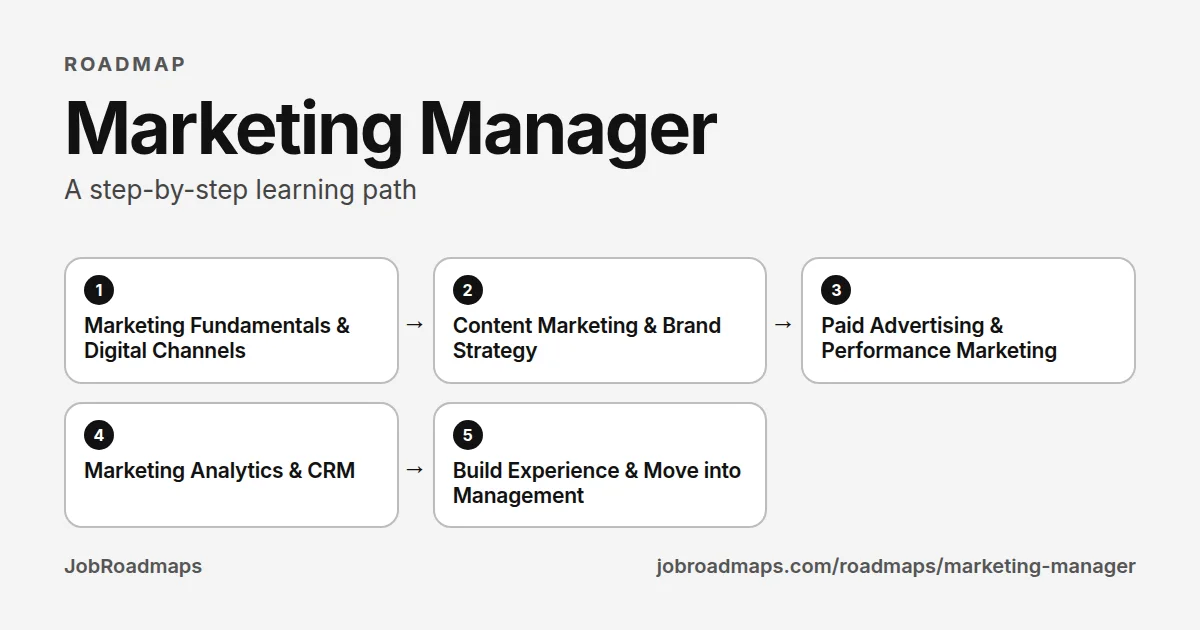
Marketing Manager learning path
Work down the line, one step at a time. Tick each skill as you can do it.
- 1
Marketing Fundamentals & Digital Channels
6–8 weeksLearn the marketing mix (4Ps), buyer personas, and the customer journey. Get foundational knowledge in SEO, SEM, email marketing, social media, and content marketing. Get Google Analytics certified.
Skills to learn
- Marketing Fundamentals
- SEO
- SEM / Google Ads
- Email Marketing
- Social Media
- Google Analytics
Start with
- 2
Content Marketing & Brand Strategy
5–7 weeksUnderstand how to create content that attracts and converts. Learn content calendars, copywriting frameworks (AIDA, PAS), brand voice guidelines, and storytelling for business.
Skills to learn
- Copywriting
- Content Strategy
- Brand Voice
- Content Calendar
- Blog / SEO Writing
- Video Scripts
Start with
- 3
Paid Advertising & Performance Marketing
6–8 weeksLearn to run and optimize paid campaigns on Google Ads and Meta (Facebook/Instagram). Understand bidding strategies, targeting, creative testing, attribution models, and ROAS optimization.
Skills to learn
- Google Ads
- Meta Ads
- PPC
- Audience Targeting
- A/B Testing Ads
- Attribution Modeling
- ROAS
Start with
- 4
Marketing Analytics & CRM
5–6 weeksGet comfortable with data. Learn to build dashboards in Looker Studio, measure campaign ROI, analyze cohorts and LTV, and use a CRM like HubSpot or Salesforce to manage customer lifecycles.
Skills to learn
- Looker Studio
- HubSpot CRM
- Marketing Analytics
- Customer LTV
- Cohort Analysis
- Marketing Automation
Start with
- 5
Build Experience & Move into Management
6–12 monthsStart with internships or coordinator roles. Build a portfolio of campaigns with measurable results. Learn to manage agencies, vendors, and junior team members. Get your Google Ads and HubSpot certifications.
Skills to learn
- Campaign Portfolio
- Budget Management
- Team Leadership
- Agency Management
- Reporting
- Presentations
Start with
jobroadmaps.com/roadmaps/marketing-manager · Pay, demand and employer data for this role are further down the page.
Job Market Insights for Marketing Manager
Data-backed
What do employers actually ask for?
Read from live job postings — how often each credential is named, from rare to almost always.
"Bachelor's degree" is the most common credential named, yet it appears only rarely in what we could read. Postings that state it are the minority, but these counts are a floor, so do not read this as "no one asks".
Our read: a portfolio that proves the skill, and a referral from someone inside the company, usually carry more weight than a credential match on paper. That is judgement, not something these counts measure.
Requirement
How often named
Bachelor's degree
Master's degree
Certification mentioned
Our read: how often a credential is named is not how strictly it is enforced. Equivalent experience, a standout portfolio, or a referral often counts for more than the credential listed.
Data-backed
Which skills appear most in job postings?
Read from live job postings, ranked from most to least often named.
demand generation is the most-named skill. Common, but not universal: many postings do not list it.
Past the fundamentals, 4 specialisation skills (demand generation included) start separating candidates who can do the job from candidates who have done it. The 16 niche skills are named rarely enough that knowing them is upside, not prerequisite.
Skill
How often named
demand generation
partner marketing
product marketing
field marketing
sales enablement
segmentation
lifecycle marketing
customer marketing
brand marketing
account-based marketing
experimentation
event marketing
project management
campaign strategy
performance marketing
go-to-market strategy
content strategy
paid social
marketing automation
localization
Sorted by how often named · JobRoadmaps
Data-backed
Which tools and artifacts appear most in job postings?
Read from live job postings, ranked from most to least often named.
Salesforce is the most-named tool, but no tool is a universal requirement here.
Tool / Artifact
How often named
Salesforce
Segment
Notion
Marketo
Google Ads
Asana
Sorted by how often named · JobRoadmaps
Industry overlay
Targeting a specific industry?
The core roadmap gets you through the door anywhere. The difference between "qualified" and "they hired someone else" often lives in industry-specific context — the norms, the compliance floors, the tools assumed fluent in that sector.
Account-based marketing (ABM)
B2B SaaS growth depends on coordinated multi-channel campaigns aimed at named enterprise accounts, not broad-reach advertising.
Sales-marketing lead scoring alignment
Marketing is measured on pipeline handoff quality, requiring shared MQL/SQL definitions built jointly with sales operations.
Product-led growth funnel tuning
Many SaaS companies convert through free trials or freemium tiers, requiring marketing to optimise in-product upgrade nudges alongside ads.
Analyst relations and category positioning
Gartner and Forrester placement shapes enterprise buyer shortlists, requiring a dedicated analyst relationship function most consumer categories skip.
Long-cycle nurture sequencing
B2B deals can take six to twelve months to close, requiring multi-touch nurture campaigns instead of single-session conversion tactics.
Companies hiring:
HubSpotSalesforceAtlassianAsanaZendeskRegulatory compliance review
Every claim about rates, fees, or guarantees must clear legal and compliance review before launch, slowing campaign velocity most industries do not face.
Trust-building creative strategy
Financial products must overcome skepticism about security and legitimacy, a fundamentally different creative problem than most consumer categories.
Rate-driven campaign timing
Promotional campaigns are often triggered by external rate changes or limited-window APY offers rather than a marketing-only calendar.
Co-brand and affinity partnership management
Many fintech products launch through co-brand deals with airlines or retailers, requiring joint approval workflows across two marketing teams.
Fraud-aware referral program design
Sign-up bonus and referral programs are prime targets for abuse, so marketing must design incentives jointly with fraud and risk teams.
Companies hiring:
ChimeSoFiRobinhoodAmerican ExpressCapital OneIndustry premiums based on aggregated job posting data · Updated quarterly
Interactive
How ready are you right now?
Check the skills you already have to see your current job-market fit.
The most-named skill for this role is demand generation, so a gap there costs you the most. No single skill dominates, but each gap narrows which postings fit you. Check what you already have to see your biggest current gap.
Readiness Check
Check the skills you already have
0/5
base skills
Your biggest gap: demand generation, the most often named of the skills you have not ticked.
Start there, then work down the list.
Books worth reading as a Marketing Manager
Where to start, in order. The full list of 12, grouped by career stage, is on its own page.
Getting started

This Is Marketing: You Can't Be Seen Until You Learn to See
by Seth Godin · 2018
~270 pages~7 hrs to read
Argues for picking a specific audience and serving it, instead of shouting at everyone. A short, readable frame for anyone starting out on how a campaign should begin.
View book →
Contagious: Why Things Catch On
by Jonah Berger · 2013
~240 pages~6 hrs to read
Research-based look at why people pass ideas, products and content along, built around six repeatable principles. Useful when you start planning campaigns and need a checklist for shareability.
View book →
Doing the job
Building a StoryBrand: Clarify Your Message So Customers Will Listen
by Donald Miller · 2017
~240 pages~6 hrs to read
A step-by-step method for turning a company's offer into a clear customer-centred story. Use it when you are rewriting a website, deck or email sequence.
View book →
Obviously Awesome: How to Nail Product Positioning So Customers Get It, Buy It, Love It
by April Dunford · 2019
~200 pages~5 hrs to read
A practical process for defining what a product is, who it is for and why it is different. Best once you own messaging or a launch and need to settle the positioning first.
View book →
Senior and leading

How Brands Grow: What Marketers Don't Know
by Byron Sharp · 2010
~230 pages~6 hrs to read
An evidence-based argument about reach, mental and physical availability and why brands grow by acquiring many light buyers. A strong counterweight for senior marketers setting strategy and defending broad reach.
View book →
Good Strategy Bad Strategy: The Difference and Why It Matters
by Richard P. Rumelt · 2011
~320 pages~8 hrs to read
Explains what a real strategy looks like: a diagnosis, a guiding policy and coherent action. Read it when you are asked to write the marketing plan for a whole year.
View book →
All 12 books for a Marketing Manager →Browse all books →
Some book links are affiliate links: we earn a small commission if you buy, at no cost to you. It does not affect what we list.
Prerequisites & Education
What credentials do employers look for?
These are the most common paths into this role — no single one is required.
Education Level
View list — coming soon- Bachelor's in Marketing, Communications, or Business
- Bachelor's in any discipline — marketing is outcome-driven and relatively degree-flexible
- MBA with Marketing specialisation — useful for Director-level transitions
- No degree with strong campaign portfolio and measurable results
Marketing is heavily portfolio-gated at the practitioner level. Demonstrated campaign results matter more than where you studied.
Certifications
View list — coming soon- Google Analytics 4 (GA4) Certification — listed in most digital marketing JDs
- Google Ads Certification (Search, Display, Video) — expected for paid media roles
- HubSpot Inbound Marketing Certification — widely recognised, free
- Meta Certified Digital Marketing Associate
- Salesforce Marketing Cloud Associate
Google and HubSpot certifications are genuinely listed as requirements in many JDs — these are worth completing early. They renew annually.
Bootcamps & Training
View list — coming soon- Google Digital Marketing & E-commerce Certificate (Coursera) — strong signal
- HubSpot Academy — free courses covering inbound, email, and content strategy
- Reforge Growth Series — respected among growth-focused marketers
- CXL Institute — conversion optimisation and data-driven marketing
Reforge membership signals seriousness in growth marketing specifically. Pair any bootcamp with a real campaign portfolio to demonstrate practical application.
Portfolio & Other
View list — coming soon- Campaign case studies with measurable outcomes (CTR, CAC, ROAS, MQL)
- Content samples — blog posts, ad copy, email sequences
- Analytics dashboard screenshots showing insights you acted on
- Any side project or community you have grown
- LinkedIn profile with quantified achievements ("Grew email list by X%")
Numbers are everything in marketing portfolios. Every project should have a before/after metric. Hiring managers will ask "what moved?" in every interview.
Your Roadmap
5 stepsMarketing Fundamentals & Digital Channels
6–8 weeksLearn the marketing mix (4Ps), buyer personas, and the customer journey. Get foundational knowledge in SEO, SEM, email marketing, social media, and content marketing. Get Google Analytics certified.
Skills to learn
Content Marketing & Brand Strategy
5–7 weeksUnderstand how to create content that attracts and converts. Learn content calendars, copywriting frameworks (AIDA, PAS), brand voice guidelines, and storytelling for business.
Skills to learn
Paid Advertising & Performance Marketing
6–8 weeksLearn to run and optimize paid campaigns on Google Ads and Meta (Facebook/Instagram). Understand bidding strategies, targeting, creative testing, attribution models, and ROAS optimization.
Skills to learn
Marketing Analytics & CRM
5–6 weeksGet comfortable with data. Learn to build dashboards in Looker Studio, measure campaign ROI, analyze cohorts and LTV, and use a CRM like HubSpot or Salesforce to manage customer lifecycles.
Skills to learn
Build Experience & Move into Management
6–12 monthsStart with internships or coordinator roles. Build a portfolio of campaigns with measurable results. Learn to manage agencies, vendors, and junior team members. Get your Google Ads and HubSpot certifications.
Skills to learn
Start here this week
This week: pick one channel — paid search, email, or organic social — and run a real experiment with a real budget. Even $50 on Google Ads teaches you something a course can't. Prove something empirically to yourself before you try to prove it to a hiring manager. The portfolio that gets interviews is the one with results, not certifications.
For structured entry, the Google Marketing Certifications (Ads, Analytics, Search) are the baseline credentials that open doors at most companies running digital programs. HubSpot's content marketing and email certifications are respected in B2B contexts. These are not deep, but they signal baseline competence and are free. Stack them quickly, then move to hands-on work.
Pay
U.S. Department of Labor data for the nearest BLS occupation, Marketing managers. BLS has no occupation for this exact title, so treat these as a benchmark.
Median: U.S. Bureau of Labor Statistics, Occupational Employment and Wage Statistics (median wage, May 2024) and Employment Projections (2024–34). No Level I–IV wages are published for this occupation in our tables.
Job Titles at Each Level
Entry
Marketing Coordinator / Specialist
Mid
Marketing Manager
Senior
Senior Marketing Manager / Director of Marketing / CMO
Steps Overview
- 1
Marketing Fundamentals & Digital Channels
6–8 weeks
- 2
Content Marketing & Brand Strategy
5–7 weeks
- 3
Paid Advertising & Performance Marketing
6–8 weeks
- 4
Marketing Analytics & CRM
5–6 weeks
- 5
Build Experience & Move into Management
6–12 months
Explore more roadmaps
Not sure this is the right path? Browse all business career roadmaps.
View Similar RoadmapsBuilt a project while following this roadmap?
Turn it into a hiring-ready case study in 10 seconds — free.
Ready to explore more?
Browse all career roadmaps across tech, business, and creative fields.