Graphic Designer Career Roadmap
Graphic design is the discipline of giving ideas a body. Typography, color, hierarchy, negative space — each is a decision, and each shapes how someone feels before they've consciously processed a single word. Great graphic designers understand that attention is finite, trust is earned in milliseconds, and the best design is the kind that makes the invisible infrastructure of communication look effortless. That's not an aesthetic preference. That's cognitive science.
Is this the right path for you?
Graphic designers come from art school (formal training in typography, composition, and visual history), from self-taught routes via YouTube, design communities, and obsessive practice, and from adjacent fields like photography and illustration. The formal route teaches vocabulary and history. The self-taught route often produces sharper commercial instincts with gaps in craft fundamentals.
If typography bothers you — if you notice the kerning is off before you notice the content, if other people's visual choices produce a physical reaction — you're already wired for this. Graphic design rewards people who have strong opinions about visual hierarchy and the discipline to execute them systematically.
Freelance and in-house are genuinely different careers that share a portfolio format. Freelance rewards speed, client management, and the ability to sell your work. In-house agency or brand work rewards taste, craft, and the ability to execute within a system. Most designers find out which one they're built for by doing both and noticing which one doesn't exhaust them.
Career Progression
Where does this role lead?
Click any role to explore timeline, key skills and, where the Department of Labor publishes it, pay.
Entry
Junior Designer
~1 yr
Executing briefs accurately and on time matters more than creativity at this stage. Building speed and reliability earns you the trust to explore later.
Key skills
Visual roadmap
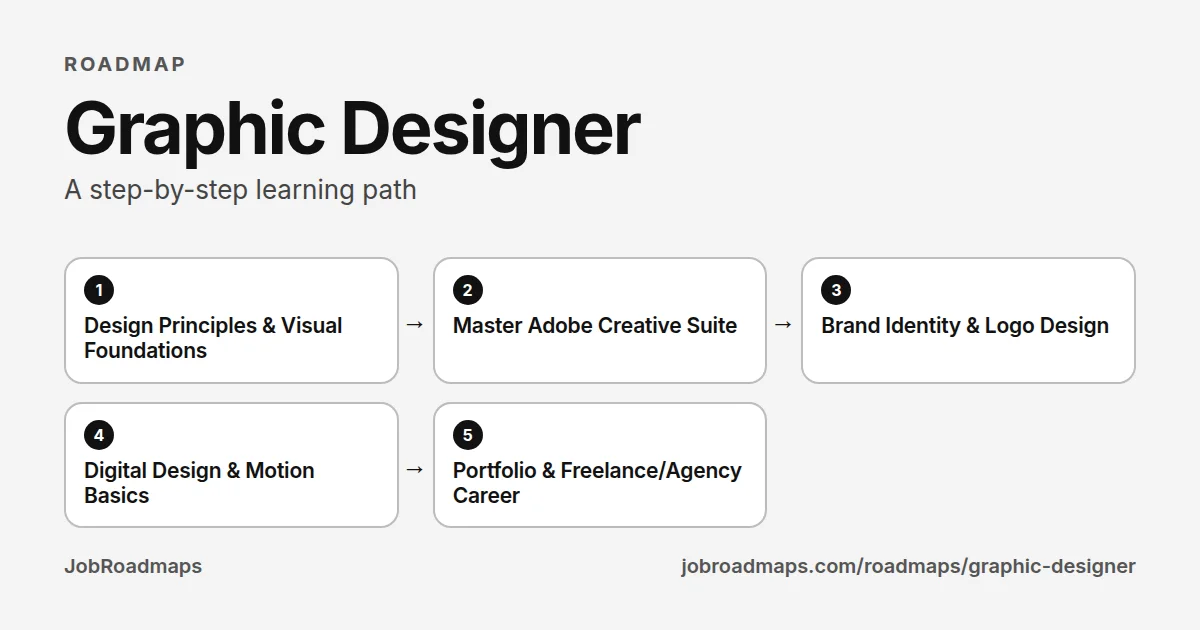
Graphic Designer learning path
Work down the line, one step at a time. Tick each skill as you can do it.
- 1
Design Principles & Visual Foundations
4–6 weeksStudy the fundamentals of good design: hierarchy, balance, contrast, proximity, alignment, and repetition. Learn color theory, typography basics, and the anatomy of typefaces. Analyze great design daily.
Skills to learn
- Design Principles
- Color Theory
- Typography
- Visual Hierarchy
- Composition
- Gestalt Principles
Start with
- 2
Master Adobe Creative Suite
8–12 weeksLearn the industry-standard tools: Illustrator (for vector/logos), Photoshop (for photo editing), and InDesign (for layouts). Spend time on each tool completing real projects and following tutorials.
Skills to learn
- Adobe Illustrator
- Adobe Photoshop
- Adobe InDesign
- Vector Graphics
- Photo Retouching
- Print Layout
Start with
- 3
Brand Identity & Logo Design
6–8 weeksPractice designing complete brand identities: logo systems, color palettes, typography pairs, and brand guidelines documents. Study iconic brands and deconstruct what makes them work.
Skills to learn
- Logo Design
- Brand Identity
- Style Guides
- Icon Design
- Mockup Presentation
- Client Deliverables
Start with
- 4
Digital Design & Motion Basics
4–6 weeksLearn UI design principles for screens, social media design, email templates, and digital ads. Explore basic motion design with After Effects for animated logos and social posts.
Skills to learn
- UI Design Basics
- Social Media Design
- Digital Advertising
- After Effects basics
- Animation Principles
- Figma
Start with
- 5
Portfolio & Freelance/Agency Career
4–8 weeksBuild a portfolio of 8–12 diverse projects across different design disciplines. Host it on Behance, Dribbble, and a personal site. Start freelancing on Fiverr or Upwork to gain real client experience.
Skills to learn
- Portfolio Curation
- Behance/Dribbble
- Client Communication
- Freelancing
- Pricing Work
- Networking
Start with
jobroadmaps.com/roadmaps/graphic-designer · Pay, demand and employer data for this role are further down the page.
Job Market Insights for Graphic Designer
Data-backed
What do employers actually ask for?
Read from live job postings — how often each credential is named, from rare to almost always.
"Bachelor's degree" is the most common credential named, yet it appears only rarely in what we could read. Postings that state it are the minority, but these counts are a floor, so do not read this as "no one asks".
Our read: a portfolio that proves the skill, and a referral from someone inside the company, usually carry more weight than a credential match on paper. That is judgement, not something these counts measure.
Requirement
How often named
Bachelor's degree
Our read: how often a credential is named is not how strictly it is enforced. Equivalent experience, a standout portfolio, or a referral often counts for more than the credential listed.
Data-backed
Which skills appear most in job postings?
Read from live job postings, ranked from most to least often named.
typography is the most-named skill. Common, but not universal: many postings do not list it.
Past the fundamentals, 2 specialisation skills (typography included) start separating candidates who can do the job from candidates who have done it. The 9 niche skills are named rarely enough that knowing them is upside, not prerequisite.
Skill
How often named
typography
storytelling
visual design
design systems
art direction
illustration
brand guidelines
color theory
motion design
data visualization
quality assurance
Sorted by how often named · JobRoadmaps
Data-backed
Which tools and artifacts appear most in job postings?
Read from live job postings, ranked from most to least often named.
Figma is the most-named tool, but no tool is a universal requirement here.
Tool / Artifact
How often named
Sorted by how often named · JobRoadmaps
Industry overlay
Targeting a specific industry?
The core roadmap gets you through the door anywhere. The difference between "qualified" and "they hired someone else" often lives in industry-specific context — the norms, the compliance floors, the tools assumed fluent in that sector.
financial product visualization
Critical to translate complex financial systems, transaction flows, and data-dense information into clear, confidence-inspiring visuals.
security and trust communication
Must visually convey security, reliability, and institutional credibility essential for financial products.
data dashboard design
Important to design clear, at-a-glance reporting interfaces and analytics visualizations for finance users.
Companies hiring:
BrexRampStripeIllustration system design
SaaS marketing sites use custom illustration to humanise abstract software concepts — designers build reusable character and icon systems, not single graphics.
Sales enablement collateral
One-pagers, pitch decks, and case study layouts are recurring requests from sales teams, distinct from consumer marketing work.
Webinar & event branding
B2B demand generation runs on webinars and conferences, requiring fast-turnaround branded slide templates and signage.
Icon systems for product UI
SaaS designers often support product teams with icon sets that must stay legible at small sizes across a dense interface.
Marketing site component libraries
Growth teams ship landing pages weekly, so designers build CMS-ready component kits rather than one-off page designs.
Companies hiring:
HubSpotMailchimpNotionIntercomAsanaIndustry premiums based on aggregated job posting data · Updated quarterly
Interactive
How ready are you right now?
Check the skills you already have to see your current job-market fit.
The most-named skill for this role is typography, so a gap there costs you the most. No single skill dominates, but each gap narrows which postings fit you. Check what you already have to see your biggest current gap.
Readiness Check
Check the skills you already have
0/5
base skills
Your biggest gap: typography, the most often named of the skills you have not ticked.
Start there, then work down the list.
Books worth reading as a Graphic Designer
Where to start, in order. The full list of 12, grouped by career stage, is on its own page.
Getting started

The Non-Designer's Design Book
by Robin Williams · 1994
~240 pages~6 hrs to read
Four principles (contrast, repetition, alignment, proximity) explained with before-and-after examples. The fastest way to stop producing layouts that look off without knowing why.
View book →Thinking with Type: A Critical Guide for Designers, Writers, Editors, and Students
by Ellen Lupton · 2004
~200 pages~5 hrs to read
Letters, text and grids in one compact book, with clear examples of what good and bad typesetting look like. Read it early: type is most of what you will do.
View book →
Doing the job

Designing Brand Identity: An Essential Guide for the Whole Branding Team
by Alina Wheeler · 2003
~320 pages~8 hrs to read
A step-by-step process for researching, designing and rolling out a brand identity, with case studies. Read it before your first logo or brand-system project.
View book →Making and Breaking the Grid: A Graphic Design Layout Workshop
by Timothy Samara · 2002
~260 pages~7 hrs to read
Shows how to build grids for print and screen and then break them on purpose, with annotated layouts. Useful once you can set type and want stronger compositions.
View book →
Senior and leading

The Brand Gap: How to Bridge the Distance Between Business Strategy and Design
by Marty Neumeier · 2003
~210 pages~5 hrs to read
A short, illustrated guide to how brand strategy and design connect. Read it when you start presenting design work to business stakeholders.
View book →
Design Is a Job
by Mike Monteiro · 2012
~140 pages~4 hrs to read
Direct advice on pricing, contracts, presenting work and owning outcomes. Useful when you move from executing briefs to running projects and clients.
View book →
All 12 books for a Graphic Designer →Browse all books →
Some book links are affiliate links: we earn a small commission if you buy, at no cost to you. It does not affect what we list.
Prerequisites & Education
What credentials do employers look for?
These are the most common paths into this role — no single one is required.
Education Level
View list — coming soon- BFA or BA in Graphic Design, Visual Communication, or Fine Arts
- AA in Graphic Design from a community college — common entry path
- Bachelor's in any discipline with a strong design portfolio
- Self-taught — viable with a demonstrably strong, diverse portfolio
Graphic design is almost entirely portfolio-gated. A BFA from a respected art school matters for agency and brand-side roles, less so for in-house junior positions.
Certifications
View list — coming soon- Adobe Certified Professional – Visual Design (Photoshop/Illustrator)
- Adobe Certified Expert (ACE) — advanced certification for specific tools
- Canva Certification — useful for in-house social and content roles
- Google UX Design Certificate — relevant for designers moving toward product
Adobe certifications have moderate signal for agency roles but are rarely gatekeeping. Portfolio quality matters far more.
Bootcamps & Training
View list — coming soon- Shillington College — intensive design education with strong portfolio output
- The Futur (Chris Do) — branding, strategy, and client communication courses
- Coursera Graphic Design Specialization (CalArts)
- Envato Tuts+ and Skillshare — strong supplemental skills training
Shillington is the most agency-respected design bootcamp. The Futur is essential if you plan to freelance or work on branding.
Portfolio & Other
View list — coming soon- Behance or Dribbble profile with 8–12 polished, diverse projects
- Brand identity system — logo, palette, type, and usage guidelines
- Print and digital samples showing layout and typography range
- Personal site as a portfolio showcase — the site design itself is evaluated
- Any live commercial work (client projects, published ads, packaging)
Graphic design portfolios are judged on aesthetic quality, range, and technical precision. Every project should include process context, not just the final deliverable.
Your Roadmap
5 stepsDesign Principles & Visual Foundations
4–6 weeksStudy the fundamentals of good design: hierarchy, balance, contrast, proximity, alignment, and repetition. Learn color theory, typography basics, and the anatomy of typefaces. Analyze great design daily.
Skills to learn
Master Adobe Creative Suite
8–12 weeksLearn the industry-standard tools: Illustrator (for vector/logos), Photoshop (for photo editing), and InDesign (for layouts). Spend time on each tool completing real projects and following tutorials.
Skills to learn
Brand Identity & Logo Design
6–8 weeksPractice designing complete brand identities: logo systems, color palettes, typography pairs, and brand guidelines documents. Study iconic brands and deconstruct what makes them work.
Skills to learn
Digital Design & Motion Basics
4–6 weeksLearn UI design principles for screens, social media design, email templates, and digital ads. Explore basic motion design with After Effects for animated logos and social posts.
Skills to learn
Portfolio & Freelance/Agency Career
4–8 weeksBuild a portfolio of 8–12 diverse projects across different design disciplines. Host it on Behance, Dribbble, and a personal site. Start freelancing on Fiverr or Upwork to gain real client experience.
Skills to learn
Start here this week
This week: redesign one brand identity you think is bad. Doesn't need to be a global brand — a local restaurant, a nonprofit, whatever. Write a one-paragraph rationale explaining what was wrong and what principles guided your redesign. That's your first case study. The rationale matters as much as the visual.
For structured entry, the Interaction Design Foundation has a solid graphic design curriculum that covers fundamentals systematically and issues a respected certificate. Behance and Dribbble presence matters more than credentials in most hiring processes — start building a portfolio there before you have your first job. Three strong projects beat twenty mediocre ones.
Pay
U.S. Department of Labor data for the nearest BLS occupation, Graphic designers. BLS has no occupation for this exact title, so treat these as a benchmark.
Median: U.S. Bureau of Labor Statistics, Occupational Employment and Wage Statistics (median wage, May 2024) and Employment Projections (2024–34). No Level I–IV wages are published for this occupation in our tables.
Job Titles at Each Level
Entry
Junior Graphic Designer
Mid
Graphic Designer / Brand Designer
Senior
Senior Designer / Art Director / Creative Director
Steps Overview
- 1
Design Principles & Visual Foundations
4–6 weeks
- 2
Master Adobe Creative Suite
8–12 weeks
- 3
Brand Identity & Logo Design
6–8 weeks
- 4
Digital Design & Motion Basics
4–6 weeks
- 5
Portfolio & Freelance/Agency Career
4–8 weeks
Explore more roadmaps
Not sure this is the right path? Browse all creative career roadmaps.
View Similar RoadmapsBuilt a project while following this roadmap?
Turn it into a hiring-ready case study in 10 seconds — free.
Ready to explore more?
Browse all career roadmaps across tech, business, and creative fields.