GEO / AEO Specialist Career Roadmap
GEO (Generative Engine Optimisation) and AEO (Answer Engine Optimisation) Specialists optimise content to appear in AI-generated answers — from ChatGPT to Google AI Overviews, Perplexity, and Claude. This role is redefining search marketing as AI replaces traditional blue links.
Is this the right path for you?
GEO/AEO specialists come from SEO practitioners who've watched their traffic attribution change as AI Overviews and LLM-based search expand, from content strategists who've noticed that AI systems describe their domain differently than search engines rank it, and from digital marketers who've been asked to optimize for AI visibility without any established playbook.
If you think about how AI systems represent information rather than how search algorithms rank pages — if the difference between what an LLM says about a topic and what a Google search returns seems like a meaningful gap worth studying — you're already thinking like a GEO specialist. The job is understanding representation in AI-mediated information systems.
This is a genuinely emerging specialty — the practices are less than two years old and the tooling is immature. Being early means building without a playbook, which is both the opportunity and the risk. The people who will define GEO as a discipline are the ones doing the experiments and publishing the findings now. Generic SEO credentials don't transfer automatically.
Career Progression
Where does this role lead?
Click any role to explore timeline, key skills and, where the Department of Labor publishes it, pay.
Entry
SEO Specialist
~1–2 yrs
$40,518 (Level I)
Traditional SEO is the foundation. Learn to drive organic traffic, understand ranking factors, and interpret search data. Most GEO/AEO specialists come from a strong SEO background.
Key skills
Pay shown is the U.S. Department of Labor prevailing wage for Level I (entry), Level III (mid) and Level IV (senior) in the nearest BLS occupation, base wage for the typical metro, wage year 2025, shown for the main track only. It is a benchmark, not an offer; branches and lead, staff and executive stages have no official figure.
Visual roadmap
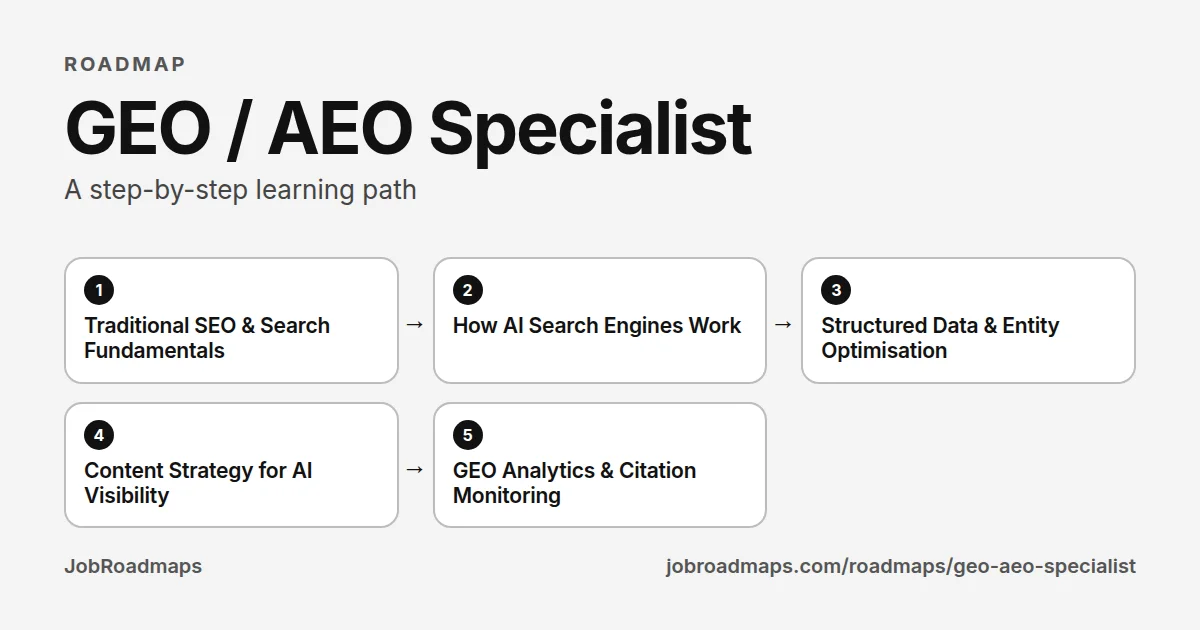
GEO / AEO Specialist learning path
Work down the line, one step at a time. Tick each skill as you can do it.
- 1
Traditional SEO & Search Fundamentals
6–8 weeksBuild a solid SEO foundation before specialising in AI search. Master keyword research, on-page optimisation, technical SEO (Core Web Vitals, crawlability, sitemaps), and link building. Understand E-E-A-T (Experience, Expertise, Authoritativeness, Trustworthiness).
Skills to learn
- Keyword Research
- On-Page SEO
- Technical SEO
- E-E-A-T
- Core Web Vitals
- Link Building Fundamentals
- 2
How AI Search Engines Work
4–6 weeksUnderstand how large language models generate answers: retrieval-augmented generation in search, how Perplexity and Google AI Overviews select citations, and what makes content "trustworthy" to an LLM. Study how training data and context windows affect AI citations.
Skills to learn
- RAG in Search
- AI Overview Mechanics
- LLM Retrieval Patterns
- Citation Selection
- Perplexity Research
- Google AI Overview Analysis
- 3
Structured Data & Entity Optimisation
4–6 weeksImplement structured data (Schema.org JSON-LD) for all content types: FAQPage, HowTo, Article, Product, Organization. Build topical authority by creating entity-dense content that defines your brand as the authoritative source on a topic.
Skills to learn
- Schema.org JSON-LD
- FAQ Schema
- HowTo Schema
- Entity Optimisation
- Knowledge Graph
- Topical Authority Building
- 4
Content Strategy for AI Visibility
4–6 weeksWrite content that AI systems cite: direct answer formats, concise definitions, comparison tables, and authoritative statistics. Design "answer-first" content architecture. Optimise for long-tail conversational queries and zero-click AI answers.
Skills to learn
- Answer-First Writing
- Content Architecture
- Conversational Query Optimisation
- Statistics & Data Sourcing
- Content Freshness
- AI Snippet Optimisation
- 5
GEO Analytics & Citation Monitoring
3–5 weeksBuild measurement frameworks for AI search visibility: track brand mentions in AI answers using tools like Semrush AI Toolkit, BrandMentions, and manual sampling. Run A/B tests on content formats. Report AI visibility alongside traditional SEO KPIs.
Skills to learn
- AI Citation Monitoring
- Semrush AI Toolkit
- Brand Mention Tracking
- GEO A/B Testing
- Visibility Reporting
- Perplexity Pages
jobroadmaps.com/roadmaps/geo-aeo-specialist · Pay, demand and employer data for this role are further down the page.
Job Market Insights for GEO / AEO Specialist
Data-backed
What do employers actually ask for?
Read from live job postings — how often each credential is named, from rare to almost always.
"Bachelor's degree" is the most common credential named, yet it appears only occasionally in what we could read. Postings that state it are the minority, but these counts are a floor, so do not read this as "no one asks".
Our read: a portfolio that proves the skill, and a referral from someone inside the company, usually carry more weight than a credential match on paper. That is judgement, not something these counts measure.
Requirement
How often named
Bachelor's degree
Our read: how often a credential is named is not how strictly it is enforced. Equivalent experience, a standout portfolio, or a referral often counts for more than the credential listed.
Data-backed
Which skills appear most in job postings?
Read from live job postings, ranked from most to least often named.
search engine optimization is the most-named skill. Common, but not universal: many postings do not list it.
Past the fundamentals, 3 specialisation skills (search engine optimization among them) appear in a minority of postings. Not universal, but the kind of depth that makes a hiring manager stop skimming.
Skill
How often named
search engine optimization
content strategy
technical seo
Sorted by how often named · JobRoadmaps
Data-backed
Which tools and artifacts appear most in job postings?
Read from live job postings, ranked from most to least often named.
WPP Open is the most-named tool, but no tool is a universal requirement here.
Tool / Artifact
How often named
WPP Open
ChatGPT
Perplexity
Gemini
YouTube
Sorted by how often named · JobRoadmaps
Industry overlay
Targeting a specific industry?
The core roadmap gets you through the door anywhere. The difference between "qualified" and "they hired someone else" often lives in industry-specific context — the norms, the compliance floors, the tools assumed fluent in that sector.
B2B content GEO
B2B buyers increasingly use AI search for vendor research — appearing in AI-generated answers for comparison queries ("best CRM for startups") drives high-intent traffic.
Product-led SEO and GEO integration
SaaS companies can integrate product data (templates, tools, calculators) into AI search answers — GEO specialists who understand product-led content strategy earn a premium.
Companies hiring:
HubSpotSemrushAhrefsMozSurfer SEOclient strategy development
Agency roles require defining go-to-market strategies and content roadmaps tailored to client goals.
multi channel campaign execution
Agencies coordinate creative, paid, organic, and earned across platforms; holistic channel orchestration is core.
freelancer and vendor management
Senior roles oversee contractors, production partners, and external agencies; coordination and quality control required.
Companies hiring:
Wunderman ThompsonIndustry premiums based on aggregated job posting data · Updated quarterly
Interactive
How ready are you right now?
Check the skills you already have to see your current job-market fit.
The most-named skill for this role is search engine optimization, so a gap there costs you the most. No single skill dominates, but each gap narrows which postings fit you. Check what you already have to see your biggest current gap.
Readiness Check
Check the skills you already have
0/3
base skills
Your biggest gap: search engine optimization, the most often named of the skills you have not ticked.
Start there, then work down the list.
Books worth reading as a GEO / AEO Specialist
Where to start, in order. The full list of 11, grouped by career stage, is on its own page.
Getting started

The Art of SEO: Mastering Search Engine Optimization
by Eric Enge, Stephan Spencer, Jessie Stricchiola · 2009
~990 pages~25 hrs to read
The long reference on technical SEO, keyword research, content, link building and measurement. Read the early chapters first, then use the rest as the shelf book for audits.
View book →
Co-Intelligence: Living and Working with AI
by Ethan Mollick · 2024
A professor's practical look at what current AI systems do well and badly, and how to work with them. A good, non-technical start for anyone whose job now depends on how AI tools find and summarise content.
View book →
Doing the job

Introduction to Information Retrieval
by Christopher D. Manning, Prabhakar Raghavan, Hinrich Schütze · 2008
~480 pages~12 hrs to read
The standard university text on indexing, ranking and search evaluation. Heavy going in places, but it shows how search systems find and rank documents, which grounds both SEO and AI-search work.
View book →AI-Powered Search
by Trey Grainger, Doug Turnbull, Max Irwin · 2023
~520 pages~13 hrs to read
Explains how modern search combines keyword ranking, embeddings, LLMs and user signals. Use it to understand how the systems behind answer engines retrieve what they cite.
View book →
Senior and leading

Product-Led SEO: The Why Behind Building Your Organic Growth Strategy
by Eli Schwartz · 2021
~260 pages~7 hrs to read
Treats organic search as a growth channel tied to the product, with advice on strategy, programmatic pages and working with other teams. Fits SEO managers who have to set direction, not just run audits.
View book →
Good Strategy Bad Strategy: The Difference and Why It Matters
by Richard P. Rumelt · 2011
~320 pages~8 hrs to read
Explains what a real strategy looks like: a diagnosis, a guiding policy and coherent action. Read it when you are asked to write the marketing plan for a whole year.
View book →
All 11 books for a GEO / AEO Specialist →Browse all books →
Some book links are affiliate links: we earn a small commission if you buy, at no cost to you. It does not affect what we list.
Prerequisites & Education
What credentials do employers look for?
These are the most common paths into this role — no single one is required.
Education
View list — coming soon- BA in Marketing, Communications, or Journalism — writing and research fundamentals are the foundation
- No formal degree — most successful GEO specialists come from practical SEO experience, not formal education
- Background in technical SEO or content strategy — the most common entry path into GEO specialisation
GEO / AEO is experience-gated, not degree-gated. A few years of hands-on SEO work and demonstrable AI search experiments matter far more than formal education.
Certifications
View list — coming soon- Google Analytics 4 Certification (Google Skillshop) — foundational measurement credential; free, 5 hours
- Semrush SEO Toolkit Certification (Semrush Academy) — practical tooling cert; Semrush leads GEO analysis tooling; free, 3 hours
- HubSpot Content Marketing Certification (HubSpot Academy) — content strategy foundation; free, 6 hours
- Google Search Essentials certification — updated guidelines increasingly relevant to GEO optimisation; free
GEO certifications barely exist yet — the field is too new. Stack traditional SEO certifications and complement with original research and public experimentation.
Bootcamps & Self-Study Paths
View list — coming soon- Practical SEO courses (Moz, Ahrefs Academy) — SEO fundamentals that underpin GEO work; mostly free
- Schema.org documentation + JSON-LD implementation practice — the technical foundation for GEO
- Perplexity / ChatGPT experiment logs — documenting your own brand citation tests is the best GEO education available
The best GEO education is running experiments, documenting results, and publishing findings publicly. The field is young enough that original research builds a reputation no course can replicate.
Portfolio
View list — coming soon- Before/after case study showing organic traffic growth or AI citation improvement from a structured data implementation
- GEO audit of a real website with recommendations for improving AI search visibility
- Sample of content written in "answer-first" format with Schema.org JSON-LD implementation
- Dashboard tracking brand citations in ChatGPT, Perplexity, and Google AI Overviews over time
GEO is new enough that original research and published experiments carry outsized weight. Documenting what actually works in a public blog or newsletter builds reputation faster than any certification.
Your Roadmap
5 stepsTraditional SEO & Search Fundamentals
6–8 weeksBuild a solid SEO foundation before specialising in AI search. Master keyword research, on-page optimisation, technical SEO (Core Web Vitals, crawlability, sitemaps), and link building. Understand E-E-A-T (Experience, Expertise, Authoritativeness, Trustworthiness).
Skills to learn
How AI Search Engines Work
4–6 weeksUnderstand how large language models generate answers: retrieval-augmented generation in search, how Perplexity and Google AI Overviews select citations, and what makes content "trustworthy" to an LLM. Study how training data and context windows affect AI citations.
Skills to learn
Structured Data & Entity Optimisation
4–6 weeksImplement structured data (Schema.org JSON-LD) for all content types: FAQPage, HowTo, Article, Product, Organization. Build topical authority by creating entity-dense content that defines your brand as the authoritative source on a topic.
Skills to learn
Content Strategy for AI Visibility
4–6 weeksWrite content that AI systems cite: direct answer formats, concise definitions, comparison tables, and authoritative statistics. Design "answer-first" content architecture. Optimise for long-tail conversational queries and zero-click AI answers.
Skills to learn
GEO Analytics & Citation Monitoring
3–5 weeksBuild measurement frameworks for AI search visibility: track brand mentions in AI answers using tools like Semrush AI Toolkit, BrandMentions, and manual sampling. Run A/B tests on content formats. Report AI visibility alongside traditional SEO KPIs.
Skills to learn
Start here this week
This week: pick a topic you know well — your domain, your industry, whatever you have enough knowledge to evaluate critically. Run the same query in ChatGPT, Perplexity, Google AI Overviews, and Claude. Document the differences: what each cites, how each describes the topic, where they agree and disagree, and where they're factually wrong. That audit is your first GEO deliverable.
For structured entry, the field doesn't have formal certifications yet — which means the portfolio is the credential. Seomoz/Moz, Search Engine Land, and the GEO-specific research coming out of academia (the GEO paper from Princeton, Perplexity's own documentation) are the primary learning resources. Build a body of audit work and publish it. That's how practitioners in this field are establishing credibility.
Pay
U.S. Department of Labor data for the nearest BLS occupation, Market research analysts and marketing specialists. BLS has no occupation for this exact title, so treat these as a benchmark.
Median: U.S. Bureau of Labor Statistics, Occupational Employment and Wage Statistics (median wage, May 2024) and Employment Projections (2024–34). Levels: U.S. Department of Labor Office of Foreign Labor Certification prevailing wage levels (wage year 2025, typical metro), a base-wage benchmark for the metro in the middle of 527 areas, not an offer. See every metro.
Job Titles at Each Level
Entry
SEO Specialist / Content Strategist
Mid
GEO/AEO Specialist / AI Search Strategist
Senior
Head of AI Search / VP of Growth & AI Visibility
Steps Overview
- 1
Traditional SEO & Search Fundamentals
6–8 weeks
- 2
How AI Search Engines Work
4–6 weeks
- 3
Structured Data & Entity Optimisation
4–6 weeks
- 4
Content Strategy for AI Visibility
4–6 weeks
- 5
GEO Analytics & Citation Monitoring
3–5 weeks
Explore more roadmaps
Not sure this is the right path? Browse all business career roadmaps.
View Similar RoadmapsBuilt a project while following this roadmap?
Turn it into a hiring-ready case study in 10 seconds — free.
Ready to explore more?
Browse all career roadmaps across tech, business, and creative fields.