Developer Advocate (DevRel) Career Roadmap
A developer advocate is the public face of a technology company to the developers who use it. You build sample apps and tutorials, give talks and run workshops, write and record content, take part in the community and carry what developers struggle with back to the product and engineering teams. Postings also call the job developer relations engineer, technical evangelist, developer education lead or developer community manager. It is not a marketer's job (campaigns), not a technical writer's (documentation as the main output) and not a support engineer's (a case queue), though it borrows from all three.
Is this the right path for you?
The routes in are mostly from engineering. Software engineers who like explaining. Support and solutions engineers who want a public audience. Technical writers and community managers who build. We track 45 postings with developer-relations titles across 22 companies, led by Databricks (7), Supabase (4), Datadog (4) and Anthropic (4), followed by Snowflake, Asana, Storyblok, PagerDuty, Modal Labs, Mistral AI, Linear and ClickHouse. None of them is written for an entry-level seat, and 15 carry senior-level words, so expect to arrive with real engineering experience and a public portfolio.
The temperament is a teaching builder who is comfortable in public. You enjoy explaining a hard idea simply, you can build a working demo on short notice and you take criticism from developers without defensiveness. If you want to ship product code every day, an engineering role fits better; if you want to run campaigns, a marketing role does. This job sits between the two: you represent developers to the company and the company to developers.
Honest note: the title is used for several jobs, so read each posting. Of the 45 titles, 15 carry senior-level words and 3 are manager or head roles. In the stored text, 42 mention content, 40 mention samples, demos or tutorials, 39 mention community, 39 mention AI or language models, 31 mention conferences, talks or speaking, 28 mention video, 24 mention feedback, 23 mention open source, 20 mention documentation and 20 mention metrics or adoption, while only 4 mention travel and 10 name a specific language. Our sample leans toward infrastructure, data and AI companies, so seats in other industries will read differently.
Career Progression
Where does this role lead?
Click any role to explore timeline, key skills and, where the Department of Labor publishes it, pay.
Entry
Developer Relations Engineer / Associate Advocate
~0–2 yrs
Entry-level seats are rare, so many people arrive from engineering, support or community roles. In an early seat you build samples, write tutorials and answer developers, with a lead setting the direction.
Key skills
Visual roadmap
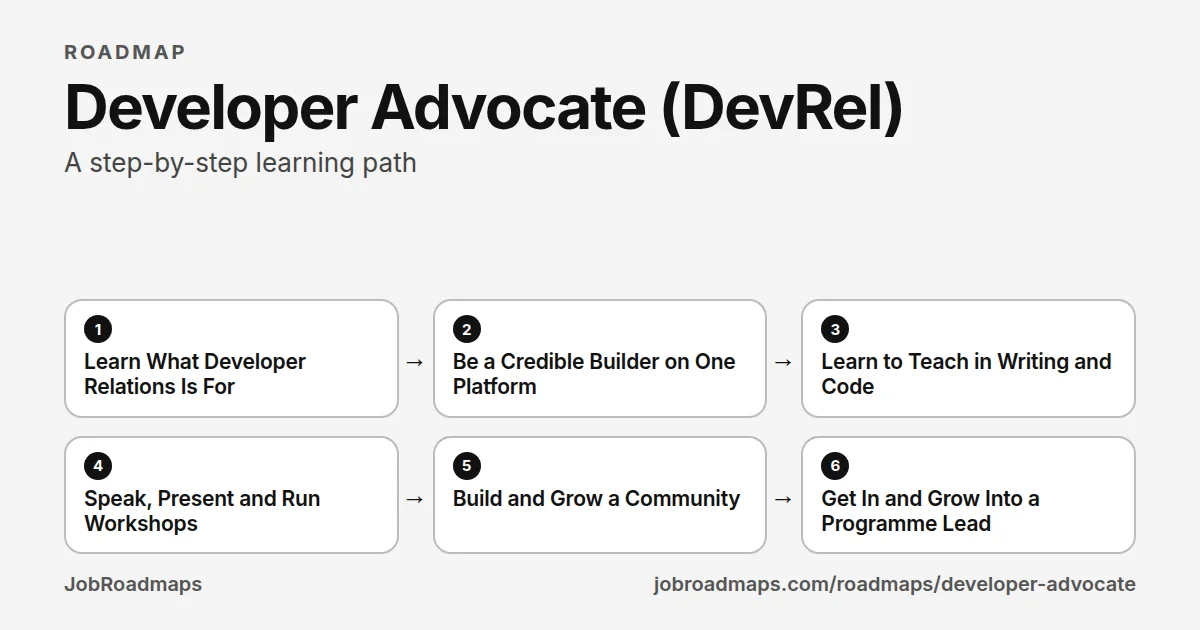
Developer Advocate learning path
Work down the line, one step at a time. Tick each skill as you can do it.
- 1
Learn What Developer Relations Is For
1–2 weeksStart with the purpose, because the title covers different jobs. Developer relations exists to help developers succeed with a product, and to carry what they say back to the company. Read postings from companies you like and note the balance: some stress content and talks, some stress samples and engineering, some stress community programmes. Learn how the work is measured, since adoption and feedback matter more than follower counts.
Skills to learn
- Developer relations versus marketing, support and documentation
- Developer journey from first visit to production use
- Advocacy, education and community as three strands
- How DevRel work is measured
- Reading a posting for the real mix of work
Start with
- 2
Be a Credible Builder on One Platform
8–12 weeksDevelopers trust advocates who build. Pick the product category you want to represent (data, infrastructure, AI, identity, developer tools) and get good enough to build real things with it in public: a sample app, an integration, a tool. Be fluent in Git and GitHub, in one or two languages and in how the platform's API and documentation work. You should be able to answer a developer's question from your own experience, not from a script.
Skills to learn
- One or two languages, usually Python, JavaScript or TypeScript
- Git and GitHub workflows
- Reading and using an API and its docs
- Building sample apps and integrations
- One product category in depth
- Debugging in front of an audience
Start with
- 3
Learn to Teach in Writing and Code
6–10 weeksWritten explanation is the daily output: tutorials, guides, sample code and blog posts. Learn to write for a beginner, to scope a tutorial so the reader finishes it and to keep sample code simple and correct. Study how documentation is organised so that your content fits next to it instead of competing with it. Publish regularly, because a public body of work is how most advocates are hired.
Skills to learn
- Clear technical writing
- Tutorials, how-to guides, reference and explanation as different kinds of content
- Sample code that demonstrates one idea
- Markdown and docs tooling
- Editing your own work
- Using language models as a drafting aid, with review
Start with
- 4
Speak, Present and Run Workshops
6–10 weeksMany postings name conference talks, meetups and workshops. Start small: a meetup talk, a lightning talk, a live-coding stream or a recorded walkthrough. Learn to structure a talk around one idea, to run a live demo that survives failure and to run a workshop where people actually build something. Record your talks and share the links, as employers will watch them.
Skills to learn
- Structuring a talk around one idea
- Live demos and recovering from failures
- Workshop design and facilitation
- Video and livestream basics
- Handling questions and hostile audiences
- Travel and event planning
Start with
- 5
Build and Grow a Community
6–10 weeksCommunity appears in most postings. Learn how open-source communities work: welcoming contributors, setting a code of conduct, answering issues, recognising contributors and avoiding burnout. Take part in a real community before you try to lead one, whether an open-source project, a forum or a Discord server. Learn to turn community feedback into something the product team can act on, with examples and numbers.
Skills to learn
- Open-source contribution and maintainership
- Welcoming contributors and codes of conduct
- Community channels and moderation
- Turning feedback into product input
- Community metrics
- Working with open-source licences
Start with
- 6
Get In and Grow Into a Programme Lead
6–12 monthsEntry seats are rare, so most people arrive from software engineering, technical support, solutions engineering, technical writing or community roles, bringing a public portfolio. Show a handful of posts, a recorded talk, a sample app and an open-source contribution, each with an outcome (people used it, a bug was fixed, a feature changed). Later steps lead to senior and staff advocate, to managing a team, and to head or vice-president of developer relations.
Skills to learn
- Entry routes: engineering, support, solutions, technical writing, community
- A public portfolio with outcomes
- Choosing between content, community and engineering strands
- Managing advocates and programmes
- Developer strategy at company level
Start with
jobroadmaps.com/roadmaps/developer-advocate · Pay, demand and employer data for this role are further down the page.
Books worth reading as a Developer Advocate
Where to start, in order. The full list of 12, grouped by career stage, is on its own page.
Getting started

Show Your Work!: 10 Ways to Share Your Creativity and Get Discovered
by Austin Kleon · 2014
~220 pages~6 hrs to read
Short chapters on sharing your work in public: show process, teach what you know and let people find you. It is the habit that DevRel hiring depends on, and it is easy to start this week.
View book →
Made to Stick
by Chip Heath, Dan Heath · 2007
~300 pages~8 hrs to read
A framework for ideas that people understand and remember. Useful for tutorials, talks and launch posts, where the aim is for a developer to retain one idea and act on it.
View book →
Doing the job

Wired for Story: The Writer's Guide to Using Brain Science to Hook Readers from the Very First Sentence
by Lisa Cron · 2012
~260 pages~7 hrs to read
How stories hold attention, drawn from brain science. Use it to shape a talk or a case study so that developers stay with the point and the example.
View book →
Crossing the Chasm
by Geoffrey A. Moore · 1991
~270 pages~7 hrs to read
Explains how technology products cross from early adopters to the wider market. It helps you see where your developer audience sits and what they need in order to adopt.
View book →
Senior and leading

Radical Candor
by Kim Scott · 2017
~270 pages~7 hrs to read
A framework for direct, caring feedback. Advocates give honest feedback to product teams and to community members, and managers use it to coach their teams.
View book →
The Manager's Path
by Camille Fournier · 2017
~240 pages~6 hrs to read
A level-by-level guide from technical lead to executive. Read it when you are asked to lead advocates or run a programme and need to know how the job changes.
View book →
All 12 books for a Developer Advocate →Browse all books →
Some book links are affiliate links: we earn a small commission if you buy, at no cost to you. It does not affect what we list.
Courses and certifications for a Developer Advocate
8 courses, tutorials and certifications, each read on the provider's own page. One from each stage to start; the full list, with a guide to choosing, is on its own page.
Getting started · Hands-on tutorial
GitHub Skills
GitHub
Doing the job · Course
Technical Writing Two
Google for Developers
Prerequisites & Education
What credentials do employers look for?
These are the most common paths into this role — no single one is required.
Education Level
View list — coming soon- Bachelor's in computer science, software engineering or a related field: the usual signal for credibility with developers
- Bachelor's in any field plus a strong public record of building and teaching: a common route for career changers
- Associate degree or self-taught with a visible body of work (code, posts, talks, community): possible when the work is public and good
- Experience as a software engineer, support engineer, solutions engineer, technical writer or community manager: how most people actually move in
Postings rarely insist on a degree. They look for proof that you can build, teach and engage developers, and for public work that shows it.
Certifications
View list — coming soon- There is no recognised developer-relations certification: the field is judged on public work
- The employer's own product certification: useful product knowledge, and sometimes a signal for platform-specific roles
- Cloud or platform certifications (for example AWS or Google Cloud): helpful when the role is about a cloud service
- Open-source foundation training (for example from the Linux Foundation): useful for open-source-heavy seats
Certificates matter little here. A portfolio of talks, tutorials, samples and community work carries more weight than any badge.
Bootcamps & Training
View list — coming soon- Google Technical Writing courses: free, from the course Google engineers take
- Write the Docs guide and Diátaxis: free references on how documentation is organised
- Open Source Guides: free guides on community, maintainers and metrics
- The platform's own docs and academy: the fastest way to the depth the role demands
A paid bootcamp is rarely needed. Free resources plus a steady stream of public work are a stronger path.
Portfolio & Other
View list — coming soon- A tutorial with working code, tested on a real beginner, and a note on what changed after their feedback
- A sample application or integration with a clear README and a short walkthrough video
- A recorded talk or workshop, even at a small meetup
- An open-source contribution or maintainership with a short write-up of what you learned
- A community post that turned developer feedback into a specific product request
This job is judged in public. Link the work, describe its effect (people used it, a bug was fixed, a feature changed) and keep it current.
Your Roadmap
6 stepsLearn What Developer Relations Is For
1–2 weeksStart with the purpose, because the title covers different jobs. Developer relations exists to help developers succeed with a product, and to carry what they say back to the company. Read postings from companies you like and note the balance: some stress content and talks, some stress samples and engineering, some stress community programmes. Learn how the work is measured, since adoption and feedback matter more than follower counts.
Skills to learn
Be a Credible Builder on One Platform
8–12 weeksDevelopers trust advocates who build. Pick the product category you want to represent (data, infrastructure, AI, identity, developer tools) and get good enough to build real things with it in public: a sample app, an integration, a tool. Be fluent in Git and GitHub, in one or two languages and in how the platform's API and documentation work. You should be able to answer a developer's question from your own experience, not from a script.
Skills to learn
Learn to Teach in Writing and Code
6–10 weeksWritten explanation is the daily output: tutorials, guides, sample code and blog posts. Learn to write for a beginner, to scope a tutorial so the reader finishes it and to keep sample code simple and correct. Study how documentation is organised so that your content fits next to it instead of competing with it. Publish regularly, because a public body of work is how most advocates are hired.
Skills to learn
Speak, Present and Run Workshops
6–10 weeksMany postings name conference talks, meetups and workshops. Start small: a meetup talk, a lightning talk, a live-coding stream or a recorded walkthrough. Learn to structure a talk around one idea, to run a live demo that survives failure and to run a workshop where people actually build something. Record your talks and share the links, as employers will watch them.
Skills to learn
Build and Grow a Community
6–10 weeksCommunity appears in most postings. Learn how open-source communities work: welcoming contributors, setting a code of conduct, answering issues, recognising contributors and avoiding burnout. Take part in a real community before you try to lead one, whether an open-source project, a forum or a Discord server. Learn to turn community feedback into something the product team can act on, with examples and numbers.
Skills to learn
Get In and Grow Into a Programme Lead
6–12 monthsEntry seats are rare, so most people arrive from software engineering, technical support, solutions engineering, technical writing or community roles, bringing a public portfolio. Show a handful of posts, a recorded talk, a sample app and an open-source contribution, each with an outcome (people used it, a bug was fixed, a feature changed). Later steps lead to senior and staff advocate, to managing a team, and to head or vice-president of developer relations.
Skills to learn
Start here this week
This week: pick a product you like and build one small thing with it, such as a script, a sample app or an integration. Then write a 600-word tutorial that a beginner could follow in thirty minutes, test it on a friend and publish it with the code. That one loop (build, explain, test, publish) is the daily work of the job and gives you your first portfolio piece.
For structure: spend the first month on one platform and Git, the next two on writing and one meetup talk, then contribute to an open-source project and keep a public log of what you shipped. Aim for six pieces of public work in a clear theme, since employers will look at them before they read your CV.
Job Titles at Each Level
Entry
Developer Relations Engineer / Associate Developer Advocate
Mid
Developer Advocate / Developer Relations Engineer
Senior
Senior Developer Advocate / Staff Developer Advocate / Head of Developer Relations
Steps Overview
- 1
Learn What Developer Relations Is For
1–2 weeks
- 2
Be a Credible Builder on One Platform
8–12 weeks
- 3
Learn to Teach in Writing and Code
6–10 weeks
- 4
Speak, Present and Run Workshops
6–10 weeks
- 5
Build and Grow a Community
6–10 weeks
- 6
Get In and Grow Into a Programme Lead
6–12 months
Explore more roadmaps
Not sure this is the right path? Browse all tech career roadmaps.
View Similar RoadmapsBuilt a project while following this roadmap?
Turn it into a hiring-ready case study in 10 seconds — free.
Ready to explore more?
Browse all career roadmaps across tech, business, and creative fields.