Database Administrator Career Roadmap
Companies can survive a bad website, a slow app, even a security scare. They cannot survive losing their data — and the DBA is the person standing between the business and that extinction event. This is a discipline of paranoid preparation: backups tested before they're needed, indexes tuned before queries crawl, failovers rehearsed before hardware dies. The cloud renamed the job more than it replaced it; someone still has to know why the query planner chose the wrong index at 2 AM, and that person bills accordingly.
Is this the right path for you?
DBAs rarely start as DBAs. The common on-ramps: help desk and sysadmin people who kept getting handed the database problems, report writers and analysts who outgrew read-only access, and developers who discovered they liked the data layer more than the app. If you're already in IT support or an analyst role, this is a lateral move that Department of Labor wage data supports (median wage $104,620 for database administrators against $60,340 for computer user support specialists, May 2024) — and the SQL you'd learn is transferable to data engineering and analytics if you later change course.
The temperament is care over speed. Databases punish improvisation: a careless UPDATE without a WHERE clause is a resume-generating event. The people who thrive here read before they type, test restores nobody asked them to test, and get genuine satisfaction from a maintenance window that ends early because everything was rehearsed. If 'measured and slightly paranoid' describes you, that's the profile.
Honest note: the classic on-prem DBA headcount is shrinking as managed cloud services absorb the routine work — but the interesting work concentrated rather than disappeared. BLS projects database administrators to shrink 0.7% from 2024 to 2034 and database architects, whose median wage is $135,980, to grow 8.7%; companies still need people who can tune queries, design recovery strategies, and control a five-figure monthly RDS bill. The pure 'backup babysitter' role is dying; the cloud-fluent database engineer role is not. Aim at the second one from day one and the shrinking-market statistics don't apply to you.
Career Progression
Where does this role lead?
Click any role to explore timeline, key skills and, where the Department of Labor publishes it, pay.
Entry
Junior DBA
~0–2 yrs
$65,957 (Level I)
Backups are the job. You will be judged on whether you can restore, not whether you can back up — practice recovery until it's boring.
Key skills
Pay shown is the U.S. Department of Labor prevailing wage for Level I (entry), Level III (mid) and Level IV (senior) in the nearest BLS occupation, base wage for the typical metro, wage year 2025, shown for the main track only. It is a benchmark, not an offer; branches and lead, staff and executive stages have no official figure.
Visual roadmap
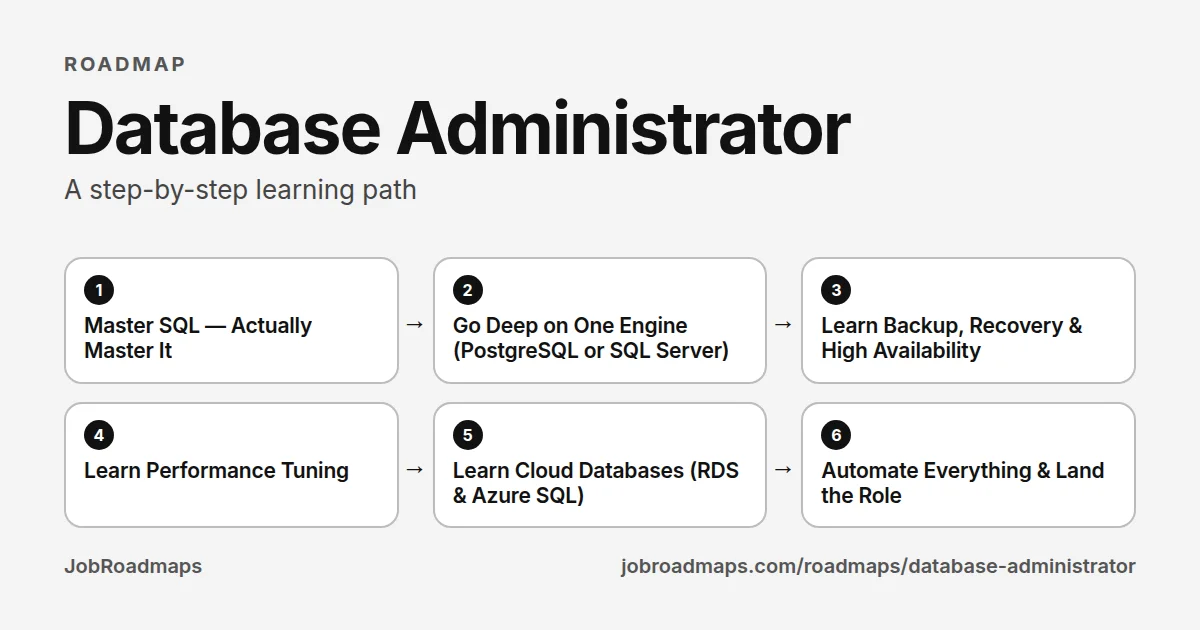
Database Administrator learning path
Work down the line, one step at a time. Tick each skill as you can do it.
- 1
Master SQL — Actually Master It
5–7 weeksEveryone claims SQL on their resume; almost nobody can write a correlated subquery or explain a window function. Go past SELECT: joins in every flavor, aggregation, CTEs, window functions, and transactions. This is the language of the entire career — fluency here compounds forever.
Skills to learn
- SELECT, JOINs (inner, outer, self)
- GROUP BY & Aggregate Functions
- Subqueries & CTEs
- Window Functions
- Transactions & ACID
- Data Types & NULL Semantics
- Views & Materialized Views
- DDL (CREATE, ALTER, constraints)
- Normalization (1NF–3NF)
Start with
- 2
Go Deep on One Engine (PostgreSQL or SQL Server)
6–8 weeksPick one engine and learn it to the bones. PostgreSQL dominates startups and open-source stacks; SQL Server dominates the enterprise and pairs with the DP-300 cert. Learn the architecture: processes, memory, storage layout, WAL/transaction logs, and the system catalogs where the truth lives.
Skills to learn
- PostgreSQL or SQL Server Architecture
- Installation & Configuration
- Memory & Storage Internals (buffers, WAL/transaction log)
- User Management & Permissions
- System Catalogs / DMVs
- Vacuum / Index Maintenance Jobs
- Logging & Error Diagnostics
- psql or SSMS Fluency
Start with
- 3
Learn Backup, Recovery & High Availability
4–6 weeksThis is the actual job. A DBA is paid for the day the disk dies, the intern drops the production table, or ransomware hits — and the recovery either works or the company makes the news. Learn backup strategies, point-in-time recovery, replication, and failover, and practice restores until they bore you.
Skills to learn
- Backup Types (full, differential, incremental)
- Point-in-Time Recovery (PITR)
- pg_dump / pg_basebackup or native SQL Server backups
- RPO / RTO Planning
- Streaming Replication / Always On Availability Groups
- Failover & Switchover Drills
- Backup Verification & Restore Testing
- Disaster Recovery Runbooks
Start with
- 4
Learn Performance Tuning
5–7 weeksPerformance tuning is where DBAs earn their reputation. Learn to read execution plans, design indexes that the planner actually uses, and find the one query eating 80% of the server. This skill alone — making a slow system fast — is worth more in interviews than any certification.
Skills to learn
- Reading Execution Plans (EXPLAIN ANALYZE)
- Index Design (B-tree, composite, partial, covering)
- Query Rewriting & Anti-Patterns
- Statistics & the Query Planner
- Locking, Blocking & Deadlocks
- Connection Pooling (pgBouncer)
- Monitoring (pg_stat_statements, Query Store)
- Server Configuration Tuning
Start with
- 5
Learn Cloud Databases (RDS & Azure SQL)
4–6 weeksMost new databases are born in the cloud, and the DBA role has shifted from racking servers to choosing instance classes, tuning parameter groups, and controlling costs. Learn Amazon RDS/Aurora or Azure SQL Database — provisioning, scaling, backups, and what the managed service does and does not do for you.
Skills to learn
- Amazon RDS & Aurora (provisioning, parameter groups)
- Azure SQL Database & Managed Instance
- Automated Backups & Snapshots in Cloud
- Read Replicas & Multi-AZ Failover
- Cloud Database Security (IAM, encryption, VPC)
- Cost Optimization (instance sizing, storage tiers)
- Migration Tools (DMS, Azure DMA)
- Monitoring (CloudWatch, Azure Monitor)
Start with
- 6
Automate Everything & Land the Role
4–8 weeksModern DBAs script their jobs: health checks in Python or PowerShell, schema migrations in version control, infrastructure in Terraform. Build a portfolio lab — a replicated PostgreSQL cluster with automated, tested backups — and document it publicly. Then target junior DBA, database analyst, and application support roles that touch databases; many DBAs enter sideways through support or reporting jobs.
Skills to learn
- Python or PowerShell for DBA Tasks
- Scheduled Jobs (cron, SQL Agent)
- Schema Migration Tools (Flyway, Liquibase)
- Infrastructure as Code Basics (Terraform)
- Git for Database Code
- Monitoring & Alerting Setup
- Runbook & Documentation Writing
- DBA Interview Scenarios (recovery, tuning war stories)
Start with
jobroadmaps.com/roadmaps/database-administrator · Pay, demand and employer data for this role are further down the page.
Job Market Insights for Database Administrator
Data-backed
Which skills appear most in job postings?
Read from live job postings, ranked from most to least often named.
high availability leads the list and is named almost always. If you are only going to learn one thing before applying, the postings say start here.
The 4 base skills sit at the top of the scale, appearing across company sizes and seniority levels. Treat them as the baseline an application is read against.
Past the fundamentals, 9 specialisation skills (replication among them) appear in a minority of postings. Not universal, but the kind of depth that makes a hiring manager stop skimming.
Skill
How often named
high availability
disaster recovery
automation
replication
indexing
data architecture
NoSQL
schema design
query optimization
PL/SQL
stored procedures
on-call rotation
Sorted by how often named · JobRoadmaps
Data-backed
Which tools and artifacts appear most in job postings?
Read from live job postings, ranked from most to least often named.
PostgreSQL is the most-named tool, but no tool is a universal requirement here.
Tool / Artifact
How often named
Sorted by how often named · JobRoadmaps
Industry overlay
Targeting a specific industry?
The core roadmap gets you through the door anywhere. The difference between "qualified" and "they hired someone else" often lives in industry-specific context — the norms, the compliance floors, the tools assumed fluent in that sector.
Multi-tenant architecture
One schema serving thousands of customers changes everything — noisy-neighbor isolation and per-tenant data safety are constant design pressures.
Cloud-managed databases
The estate is RDS, Aurora, and Cloud SQL rather than racked servers — the job shifts from installation to configuration, scaling, and cost.
Infrastructure as code
Database changes ship via Terraform and migration pipelines, so DBAs who cannot work in Git become bottlenecks.
Performance at scale
Billions of rows and unpredictable tenant workloads make indexing strategy and query analysis a continuous engineering effort.
Cloud cost optimisation
Database spend is often the largest infrastructure line item, and right-sizing instances and storage is now a DBA deliverable.
Companies hiring:
SalesforceWorkdayServiceNowDatadogMongoDBSTIG database hardening
Every database instance must pass DISA STIG checklists, and remediating findings is a recurring, documented duty.
Security clearance
Cleared DBAs are scarce — a Secret clearance frequently matters more to getting hired than an extra certification.
Oracle depth
Government runs some of the largest legacy Oracle estates anywhere, keeping OCP skills valuable long after the commercial market shifted.
FedRAMP cloud environments
Agency migrations to AWS GovCloud and Azure Government add compliance constraints ordinary cloud DBAs never encounter.
Backup compliance evidence
It is not enough to take backups — you must produce documented proof of tested restores for auditors and inspectors.
Companies hiring:
LeidosCACIGeneral Dynamics ITMITREPeratonIndustry premiums based on aggregated job posting data · Updated quarterly
Interactive
How ready are you right now?
Check the skills you already have to see your current job-market fit.
The most-named skill for this role is high availability, so a gap there costs you the most. Skills at the top of the scale appear across most postings, so a single gap there narrows your options more than a gap in a rarer skill. Check what you already have to see your biggest current gap.
Readiness Check
Check the skills you already have
0/8
base skills
Your biggest gap: high availability, the most often named of the skills you have not ticked.
Start there, then work down the list.
Books worth reading as a Database Administrator
Where to start, in order. The full list of 12, grouped by career stage, is on its own page.
Getting started

Learning SQL: Generate, Manipulate, and Retrieve Data
by Alan Beaulieu · 2005
~380 pages~10 hrs to read
Teaches queries, joins, grouping, subqueries and data modification from scratch with clear examples. SQL is the daily language of the job, so work through it early.
View book →Database Design for Mere Mortals, 4th Edition
by Michael J. Hernandez · 1996
A database-agnostic method for turning business requirements into tables, keys and relationships. Read it before you take over any schema, because bad design is the root of many later performance problems.
View book →
Doing the job

Mastering PostgreSQL 15
by Hans-Jürgen Schönig · 2023
~520 pages~13 hrs to read
Covers indexing, query planning, transactions, replication, backup and security in PostgreSQL. Read it when you are responsible for a production Postgres instance.
View book →
High Performance MySQL: Optimization, Backups, and Replication, 4th Edition
by Silvia Botros, Jeremy Tinley · 2004
~550 pages~14 hrs to read
Covers schema and index design, query tuning, replication, backups and operations on MySQL at scale. Read it when you are tuning real workloads.
View book →
Senior and leading

Database Reliability Engineering: Designing and Operating Resilient Database Systems
by Laine Campbell, Charity Majors · 2017
~290 pages~7 hrs to read
Applies reliability engineering to databases: service levels, infrastructure, automation, backup and recovery, and migrations. Read it when you move from tending servers to designing how they are run.
View book →
Database Internals: A Deep Dive into How Distributed Data Systems Work
by Alex Petrov · 2019
~280 pages~7 hrs to read
Explains storage engines, B-trees and LSM trees, then distributed concerns such as replication, consensus and transactions. Read it when you choose or design database platforms.
View book →
All 12 books for a Database Administrator →Browse all books →
Some book links are affiliate links: we earn a small commission if you buy, at no cost to you. It does not affect what we list.
Prerequisites & Education
What credentials do employers look for?
These are the most common paths into this role — no single one is required.
Education Level
View list — coming soon- Bachelor's in computer science, information systems, or related field — the most common background
- Associate's degree plus vendor certifications — a viable route via help desk or sysadmin roles
- Bachelor's in any field with strong SQL skills — analysts frequently transition into DBA work
- No degree — rarer than in development roles, but achievable with certs and demonstrable recovery skills
DBA roles skew slightly more traditional than developer roles on education, but production experience with backups and recovery trumps everything once you have your first role.
Certifications
View list — coming soon- Microsoft DP-300 (Azure Database Administrator Associate) — the strongest current SQL Server credential
- Oracle Database SQL Certified Associate, then OCP — still the gold standard in Oracle shops
- EDB PostgreSQL Associate — the closest thing to an official credential in the Postgres ecosystem
- AWS Solutions Architect Associate — signals cloud database competence now that most estates run on RDS/Aurora
Pick the cert that matches your target stack — SQL Server, Oracle, and Postgres shops are distinct job markets. DP-300 has the broadest current demand.
Bootcamps & Training
View list — coming soon- Microsoft Learn DP-300 path — free, official, and maps directly to the exam
- Oracle University learning subscriptions — the standard route in Oracle environments
- Brent Ozar and SQLskills training — the practitioner-respected names for SQL Server performance
- PostgreSQL community resources — official docs, PGExercises, and Planet PostgreSQL are free and deep
There are no meaningful DBA bootcamps. Vendor learning paths plus a home lab where you deliberately break and restore databases is the training that counts.
Portfolio & Other
View list — coming soon- Backup and recovery runbooks — documented, tested restore procedures are the single best DBA artifact
- Home lab with replication — a primary/replica Postgres or SQL Server setup you can explain under failure
- Query tuning writeups — before/after execution plans with the reasoning behind each change
- Restore drill logs — proof you have actually restored from backup, not just scheduled backups
- Sysadmin or data analyst experience — the two most common feeder roles into DBA positions
Every DBA interview eventually asks: "walk me through recovering from a failed disk at 2am." A tested runbook you wrote yourself is the most convincing possible answer.
Your Roadmap
6 stepsMaster SQL — Actually Master It
5–7 weeksEveryone claims SQL on their resume; almost nobody can write a correlated subquery or explain a window function. Go past SELECT: joins in every flavor, aggregation, CTEs, window functions, and transactions. This is the language of the entire career — fluency here compounds forever.
Skills to learn
Go Deep on One Engine (PostgreSQL or SQL Server)
6–8 weeksPick one engine and learn it to the bones. PostgreSQL dominates startups and open-source stacks; SQL Server dominates the enterprise and pairs with the DP-300 cert. Learn the architecture: processes, memory, storage layout, WAL/transaction logs, and the system catalogs where the truth lives.
Skills to learn
Learn Backup, Recovery & High Availability
4–6 weeksThis is the actual job. A DBA is paid for the day the disk dies, the intern drops the production table, or ransomware hits — and the recovery either works or the company makes the news. Learn backup strategies, point-in-time recovery, replication, and failover, and practice restores until they bore you.
Skills to learn
Learn Performance Tuning
5–7 weeksPerformance tuning is where DBAs earn their reputation. Learn to read execution plans, design indexes that the planner actually uses, and find the one query eating 80% of the server. This skill alone — making a slow system fast — is worth more in interviews than any certification.
Skills to learn
Learn Cloud Databases (RDS & Azure SQL)
4–6 weeksMost new databases are born in the cloud, and the DBA role has shifted from racking servers to choosing instance classes, tuning parameter groups, and controlling costs. Learn Amazon RDS/Aurora or Azure SQL Database — provisioning, scaling, backups, and what the managed service does and does not do for you.
Skills to learn
Automate Everything & Land the Role
4–8 weeksModern DBAs script their jobs: health checks in Python or PowerShell, schema migrations in version control, infrastructure in Terraform. Build a portfolio lab — a replicated PostgreSQL cluster with automated, tested backups — and document it publicly. Then target junior DBA, database analyst, and application support roles that touch databases; many DBAs enter sideways through support or reporting jobs.
Skills to learn
Start here this week
This week: install PostgreSQL on your own machine (free, ten minutes), work through SQLBolt end to end, then start the exercises at pgexercises.com. Load a real dataset — your city's open data portal has plenty — and break something on purpose: delete rows, then practice restoring from a backup you took first. That restore, not the SELECT statements, is your first real DBA experience.
For a structured path, take CS50 SQL (free, Harvard) or the PostgreSQL for Everybody specialization on Coursera as your spine, then aim at Microsoft's DP-300 certification as the credential — it's the most recognized DBA cert that maps to actual junior job postings. Give the sequence six months of steady evenings. You don't need to be brilliant; you need to be the applicant who has actually performed a point-in-time recovery.
Pay
U.S. Department of Labor data for the nearest BLS occupation, Database administrators. BLS has no occupation for this exact title, so treat these as a benchmark.
Median: U.S. Bureau of Labor Statistics, Occupational Employment and Wage Statistics (median wage, May 2024) and Employment Projections (2024–34). Levels: U.S. Department of Labor Office of Foreign Labor Certification prevailing wage levels (wage year 2025, typical metro), a base-wage benchmark for the metro in the middle of 223 areas, not an offer. See every metro.
Job Titles at Each Level
Entry
Junior DBA
Mid
Database Administrator
Senior
Senior DBA / Database Architect
Steps Overview
- 1
Master SQL — Actually Master It
5–7 weeks
- 2
Go Deep on One Engine (PostgreSQL or SQL Server)
6–8 weeks
- 3
Learn Backup, Recovery & High Availability
4–6 weeks
- 4
Learn Performance Tuning
5–7 weeks
- 5
Learn Cloud Databases (RDS & Azure SQL)
4–6 weeks
- 6
Automate Everything & Land the Role
4–8 weeks
Explore more roadmaps
Not sure this is the right path? Browse all tech career roadmaps.
View Similar RoadmapsBuilt a project while following this roadmap?
Turn it into a hiring-ready case study in 10 seconds — free.
Ready to explore more?
Browse all career roadmaps across tech, business, and creative fields.