Customer Success Manager (CSM) Career Roadmap
A customer success manager owns what happens after the contract is signed. You get a book of business-software customers live, make sure they use the product well enough to see the result they bought it for, spot the accounts drifting toward the exit, and help the healthy ones renew and grow. It is not support, which answers tickets as they arrive, and it is not account management in the pure sales sense, where the job is the next transaction. It is a proactive, relationship-and-data job. Some seats carry a renewal or expansion target; some do not. Read the posting. (CSM here means customer success manager, not the Certified ScrumMaster credential.)
Is this the right path for you?
Few people start as a CSM. In the live job postings we track, 230 have "customer success" in the title across 44 companies, and only 9 carry early-career wording. The realistic routes in are support or technical support at a software company, account coordination, implementation or onboarding, a sales development seat, or teaching and consulting that has you managing people through a change. Anthropic (38), Datadog (27), Braze (19), Stripe (16) and MongoDB (15) lead the counts, so a lot of this demand sits with AI, infrastructure and SaaS companies selling to technical buyers.
The temperament is steady rather than loud. You like being the person a customer trusts, you read a quiet account as a signal and not as good news, and you can tell a customer something unwelcome without losing the relationship. You are comfortable owning an outcome you only partly control: the customer's team, your product and your own company all have to cooperate. People who need every day to finish with a closed ticket or a signed deal often find it diffuse. People who avoid conflict struggle with escalations and renewals.
Honest note: the market shape matters. Our postings come from roughly a hundred tech-company job boards, skewed to AI, infrastructure and SaaS scale-ups, so they show how those employers hire and not every industry. In them, about 51 titles carry the word senior against 9 with early-career wording. The rungs above entry dominate, so customer success is an uncommon first title in these postings. Expect to arrive through an adjacent role and to show real customer outcomes in interviews, not only enthusiasm.
Career Progression
Where does this role lead?
Click any role to explore timeline, key skills and, where the Department of Labor publishes it, pay.
Entry
Support / Onboarding / Implementation Specialist
~1–2 yrs
The usual way in. You learn the product, the customer vocabulary and what an unhappy account sounds like. Make your customer-outcome work visible; it is your CS evidence.
Key skills
What the postings say you’ll do
Lines copied word for word from live Customer Success Manager postings we track, read September 30, 2026. They show how employers word the job, not what every Customer Success Manager does. Postings change and expire.
“Partner with Professional Services to onboard customers, develop and maintain Mutual Account Plans, lead success reviews, and ensure success plan development and delivery against customer goals by leveraging tools and analytics”
“Drive feature adoption by building a shared Success Plan with your customers, providing strategic guidance, enablement, and day-to-day advice to help them hit their objectives with Braze”
“Execute on all phases of the customer journey, including deployment design and execution, change management consulting, workflow design, business performance reviews, roadmap advisory, and renewal touch points”
“Monitor usage health signals proactively—identifying risks, opportunities, and expansion paths; drive intervention where needed.”
“Become a trusted advisor; develop consultative relationships (particularly with the Mid-Market and Enterprise segments) by delivering value, sharing best practices and acting as the voice of customers internally”
“Conduct regular executive business reviews with senior stakeholders, demonstrating ROI, impact, and strategic value.”
“Keep Account Directors informed ahead of renewals, flag at-risk accounts early, and surface upsell opportunities for them to run with.”
Who is hiring right now
Drawn from live postings across many employers today. Employers with live postings we tag to this roadmap, counted today. The sample is about a hundred tech-company job boards, tilted toward AI, data and infrastructure companies, so agencies, consultancies and most non-tech employers are not represented.
| Employer | Live postings | Early-career titles | Most common title |
|---|---|---|---|
| Anthropic | 38 | 0 | Customer Success Manager |
| Datadog | 24 | 6 | Customer Success Associate |
| Harvey | 24 | 0 | Customer Success Leader, Southern Europe & DACH |
| Samsara | 19 | 0 | Enterprise Customer Success Manager |
| Stripe | 16 | 0 | Customer Success Manager, Enterprise |
| MongoDB | 15 | 0 | Senior Customer Success Manager |
| Braze | 14 | 0 | Senior Customer Success Manager |
| Notion | 13 | 0 | Commercial Outcomes Architect (Customer Success) |
| Anaplan | 12 | 0 | Customer Success Business Partner |
| Veeva Systems | 12 | 2 | Customer Success Manager - Commercial Content |
| NICE | 11 | 0 | Director, Customer Success |
| Crusoe | 9 | 0 | Customer Success Manager |
“Early-career titles” are roles whose title signals an entry-level or new-graduate position. Top 12 of 60 employers shown.
Look-alike roles, compared
Neighbouring titles read very differently once you open the posting. One line from a real posting for each, with how many live postings we track under that title and how many carry early-career wording.
Customer Success Manager
212 live postings · 44 employers · 3 with early-career wording
“Drive feature adoption by building a shared Success Plan with your customers, providing strategic guidance, enablement, and day-to-day advice to help them hit their objectives with Braze”
Braze · Customer Success Manager II posting
Support Engineer
216 live postings · 59 employers · 7 with early-career wording
“Be a key source of knowledge on the Adyen platform and APIs, the underlying web-stack technologies, and industry-standard integration methods and best practices.”
Adyen · Technical Support Engineer posting
Account Manager
247 live postings · 50 employers · 9 with early-career wording
“Present and negotiate renewal proposals, structure multi-year options, and manage contract value through strategic account management.”
PagerDuty · Account Manager posting
Technical Account Manager
56 live postings · 18 employers · 1 with early-career wording
“Serve as a strategic technical advisor for enterprise customers, helping them adopt and scale Figma in alignment with their business and technical goals”
Figma · Technical Account Manager posting
Quotes read September 30, 2026, from the live postings we track.
Visual roadmap
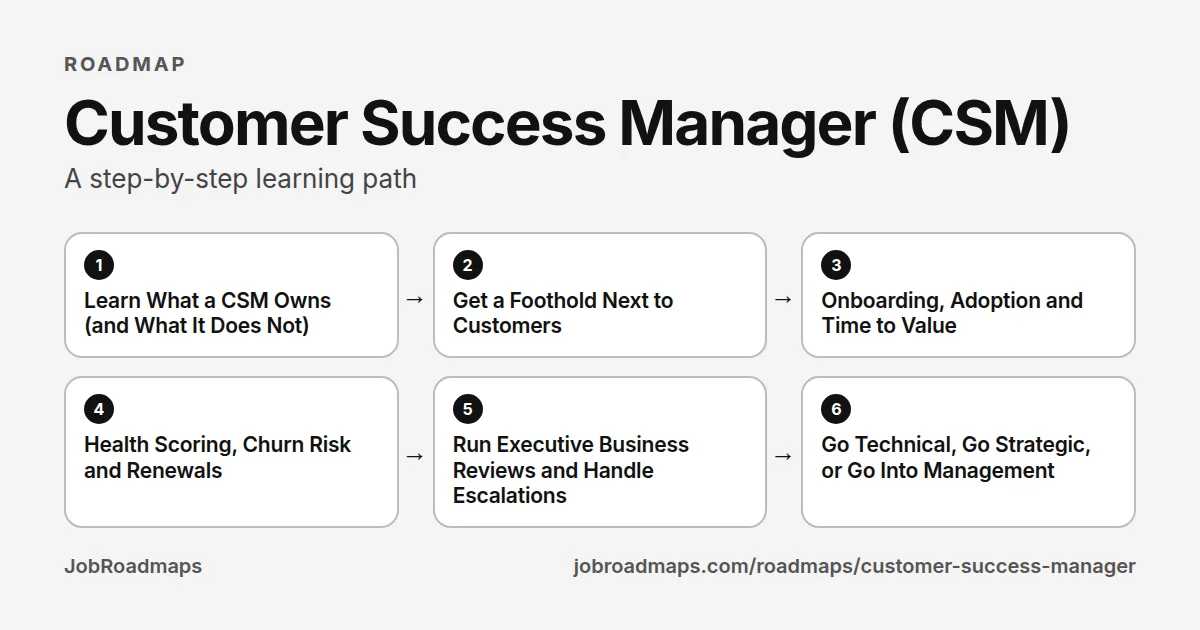
Customer Success Manager learning path
Work down the line, one step at a time. Tick each skill as you can do it.
- 1
Learn What a CSM Owns (and What It Does Not)
2–4 weeksStart with the shape of the job, because titles blur. Support resolves a problem the customer brings you. An account manager or account executive is measured on the next deal. A CSM is responsible for the customer reaching the outcome they bought the product for, which is why adoption, retention, renewal and expansion all land on the role in some form. The line varies by company: at some a CSM carries a renewal number, at others renewals belong to a sales-side team and the CSM owns the relationship and the result. Learn the recurring-revenue vocabulary (renewal, churn, gross and net revenue retention, expansion, onboarding, time to value) as concepts before you chase any tool.
Skills to learn
- CSM vs support vs account management
- Subscription and recurring-revenue basics
- Customer lifecycle stages
- Retention and expansion as concepts (GRR, NRR)
- Pooled vs named-account coverage models
- How CS fits with sales, support and product
Start with
- 2
Get a Foothold Next to Customers
3–9 months to land a foothold roleThis is how people actually get in. In the live job postings we track, entry-level customer success titles are scarce, so most CSMs arrive from somewhere that already puts them in front of customers: support or technical support at a software company, account coordination, implementation or onboarding, an SDR or BDR seat, or teaching and consulting, where you already manage people through a change. Each route carries something CS wants. Support brings product depth and calm under escalation. Implementation brings onboarding craft. SDRs bring outreach discipline. Teachers and consultants bring facilitation. Pick the route closest to you and make the CS parts of your current job visible.
Skills to learn
- Customer communication in writing and live
- Troubleshooting and escalation basics
- Onboarding and implementation project work
- Documenting customer requests clearly
- Prioritising a queue of competing asks
- Translating a past role into CS evidence
Start with
- 3
Onboarding, Adoption and Time to Value
1–3 monthsThe first weeks decide the account. A good onboarding gets the customer from signed contract to first real use of the product quickly, against a written success plan: what they bought it for, how you will both know it worked, who on their side is accountable. After launch the work becomes adoption: which features matter for their goal, who is not logging in, what training or workflow change would help. Practise writing a success plan for a product you know. Learn what an effortless experience looks like from the customer's side, because customers leave over friction more often than over missing features.
Skills to learn
- Kickoff and onboarding plans
- Success plans and defined outcomes
- Time to first value
- Product adoption coaching
- Customer training and enablement
- Stakeholder and champion mapping
- Reducing customer effort
Start with
- 4
Health Scoring, Churn Risk and Renewals
2–4 months, then continuousThis is where the role earns its keep. A health score combines signals such as product usage, support history, stakeholder engagement, sentiment and contract timing into an early warning. Learn what each signal can and cannot tell you, and why a green score on a silent account deserves suspicion. Then the renewal motion: start early, confirm the value delivered, find out who actually signs, handle the objections, and know when to pull in the account executive for commercial terms. Gross retention measures what you kept; net retention also counts expansion. Spreadsheet fluency matters: you will build account views, renewal trackers and health models before any platform hands them to you. SQL helps on teams where you can query usage data yourself.
Skills to learn
- Customer health scoring
- Churn-risk signals and save plays
- Renewal forecasting
- Expansion and cross-sell identification
- GRR and NRR as concepts
- Spreadsheet account modelling
- Usage data analysis
- Renewal negotiation basics
Start with
- 5
Run Executive Business Reviews and Handle Escalations
3–6 months, then continuousThe executive business review (EBR, or QBR when it is quarterly) is your main stage: you show an executive sponsor what the product has delivered against their stated goals, where it has not, and what happens next. Build it from their goals, not your feature list. Bad news belongs in it too. Escalations are the other test: a customer is angry, engineering is busy and your own account executive wants the renewal. Own the communication, set honest expectations, keep one thread of truth between product, support and the customer, and follow up after the crisis ends. Learn to teach the customer something they did not know, not just report on them.
Skills to learn
- Executive business review design
- Presenting to executive sponsors
- Escalation management
- Delivering bad news honestly
- Working with product and engineering on customer issues
- Handoffs with account executives and support
- Negotiation under pressure
Start with
- 6
Go Technical, Go Strategic, or Go Into Management
OngoingAfter a year or two the ladder forks. Many of the companies in our postings sell to engineers, data teams and security buyers, and for those customers a technical flavour counts: some employers hire customer success engineers or technical account roles that blend CS with hands-on integration help. That is a different hiring bar, so do not assume a CSM can slide across without technical proof. The strategic route is fewer, larger accounts with longer relationships and multi-stakeholder reviews. The management route trades your own accounts for coaching, coverage design and CS operations. Work in the tools your target employers name (CS platforms such as Gainsight, CRMs such as Salesforce, help desks such as Zendesk and Intercom) and add cloud fundamentals if you serve developers.
Skills to learn
- Technical product fluency
- APIs and integrations at a conceptual level
- CS platform and CRM workflow
- Strategic account planning
- Coverage and segmentation models
- Coaching and team leadership
- Cross-functional influence
Start with
jobroadmaps.com/roadmaps/customer-success-manager · Pay, demand and employer data for this role are further down the page.
Job Market Insights for Customer Success Manager
Data-backed
What do employers actually ask for?
Read from live job postings — how often each credential is named, from rare to almost always.
"Bachelor's degree" is the most common credential named, yet it appears only rarely in what we could read. Postings that state it are the minority, but these counts are a floor, so do not read this as "no one asks".
Our read: a portfolio that proves the skill, and a referral from someone inside the company, usually carry more weight than a credential match on paper. That is judgement, not something these counts measure.
Requirement
How often named
Bachelor's degree
Certification mentioned
Our read: how often a credential is named is not how strictly it is enforced. Equivalent experience, a standout portfolio, or a referral often counts for more than the credential listed.
Data-backed
Which skills appear most in job postings?
Read from live job postings, ranked from most to least often named.
onboarding is the most-named skill. Common, but not universal: many postings do not list it.
Past the fundamentals, 3 specialisation skills (onboarding included) start separating candidates who can do the job from candidates who have done it. The 12 niche skills are named rarely enough that knowing them is upside, not prerequisite.
Skill
How often named
onboarding
value realization
product adoption
change management
customer advocacy
business acumen
communication
quarterly business reviews
escalation management
upsell and cross-sell
technical knowledge
account planning
customer success strategy
data analysis
scaled customer success
Sorted by how often named · JobRoadmaps
Data-backed
Which tools and artifacts appear most in job postings?
Read from live job postings, ranked from most to least often named.
No tool dominates. The most-named, Salesforce, is still rare; postings for this role rarely list tools by name.
Tool / Artifact
How often named
Salesforce
Notion
Intercom
Asana
Zoom
Jira
Sorted by how often named · JobRoadmaps
Industry overlay
Targeting a specific industry?
The core roadmap gets you through the door anywhere. The difference between "qualified" and "they hired someone else" often lives in industry-specific context — the norms, the compliance floors, the tools assumed fluent in that sector.
Adoption and onboarding design
Subscription products are renewed only if they are used. Getting a customer from contract to first value, and then to habit, is the core of the work.
Health scoring and renewal forecasting
Managers inspect the book for risk before a renewal date. You need defensible signals, not a gut feel.
Executive business reviews
Renewals are decided by sponsors who see the product from a distance. A review that ties usage to their stated goals is how you keep that support.
Security and procurement awareness
Identity, email security and analytics tools touch company data, so renewals can involve security reviews and vendor questionnaires.
Companies hiring:
BrazeOktaIntercomSimilarwebAbnormal SecurityElevenLabsSpeaking to finance and technical owners together
Payment and spend products often have a finance buyer and a technical implementer. Success plans must satisfy both.
Compliance and risk literacy
Customers ask about data handling, controls and policy early. You need to know when to bring in a specialist.
Implementation and rollout management
Replacing a payments or expense system touches many teams. A well-run rollout is often what decides the first renewal.
Companies hiring:
StripeNavanIndustry premiums based on aggregated job posting data · Updated quarterly
Interactive
How ready are you right now?
Check the skills you already have to see your current job-market fit.
The most-named skill for this role is onboarding, so a gap there costs you the most. No single skill dominates, but each gap narrows which postings fit you. Check what you already have to see your biggest current gap.
Readiness Check
Check the skills you already have
0/5
base skills
Your biggest gap: onboarding, the most often named of the skills you have not ticked.
Start there, then work down the list.
Books worth reading as a Customer Success Manager
Where to start, in order. The full list of 12, grouped by career stage, is on its own page.
Getting started
Customer Success: How Innovative Companies Are Reducing Churn and Growing Recurring Revenue
by Nick Mehta, Dan Steinman, Lincoln Murphy · 2016
~240 pages~6 hrs to read
Explains why recurring revenue makes retention the business and how a customer success function is organized. A solid first read if you are moving into a CSM seat.
View book →The Customer Success Professional's Handbook
by Ashvin Vaidyanathan, Ruben Rabago · 2020
~290 pages~7 hrs to read
A practitioner guide to the CSM job itself, from onboarding and adoption through renewals. Read it in your first months to build a working playbook for your own accounts.
View book →
Doing the job

Never Lose a Customer Again
by Joey Coleman · 2018
~370 pages~9 hrs to read
Focuses on the period right after purchase, when customers decide whether they made the right call. Useful for CSMs designing onboarding and early-adoption touchpoints.
View book →
Crucial Conversations: Tools for Talking When Stakes Are High
by Kerry Patterson, Joseph Grenny, Ron McMillan, Al Switzler · 2001
~300 pages~8 hrs to read
Teaches how to stay constructive when a conversation turns tense. Helpful for CSMs handling escalations, missed expectations and pushback from a frustrated sponsor.
View book →
Senior and leading
The Customer Success Economy
by Nick Mehta, Allison Pickens · 2020
~380 pages~10 hrs to read
Argues that customer outcomes should shape how the whole company operates, not only the CS team. Useful for senior CSMs and CS leaders making the case to executives.
View book →
Chief Customer Officer 2.0
by Jeanne Bliss · 2015
~270 pages~7 hrs to read
Written for the executive responsible for customer experience across a company. Read it when you move into CS leadership and need to work across product, sales and support.
View book →
All 12 books for a Customer Success Manager →Browse all books →
Some book links are affiliate links: we earn a small commission if you buy, at no cost to you. It does not affect what we list.
Prerequisites & Education
What credentials do employers look for?
These are the most common paths into this role — no single one is required.
Education Level
View list — coming soon- Bachelor's in business, communications or any field — customer success hiring is not tied to a specific major
- Degree in a technical or analytical field — useful when the product is sold to developers, data teams or security buyers
- Background in teaching, consulting or project work — change management and facilitation transfer directly
- No degree — a support, onboarding or implementation record at a software company is the more common credential
Customer success is hired on evidence of customer outcomes and communication, not on transcripts. Read the requirements on the specific postings you want.
Certifications
View list — coming soon- HubSpot Academy Service Hub Software Certification — free course; earning the certification involves practical exercises that require a paid HubSpot subscription tier
- Certified Customer Success Manager Level I (University of San Francisco Executive Education with SuccessCOACHING) — a paid program for first-time job seekers, career changers and new CSMs
- AWS Certified Cloud Practitioner or Google Cloud Cloud Digital Leader — foundational cloud credentials, useful if you serve technical buyers
- Google Project Management Professional Certificate — relevant to onboarding and implementation-heavy routes in
No single certification is required or recognised everywhere. Treat them as structured learning and a sign of initiative early on, not a substitute for customer results.
Bootcamps & Training
View list — coming soon- HubSpot Academy Customer Support Course — free and short, a quick grounding in support skills, SLAs and metrics
- SuccessCOACHING Customer Success Foundations Training — paid training from a company focused on customer success teams
- Trailhead — Salesforce's free learning platform, including a short customer success strategy module and CRM fundamentals
- Harvard Business School Online Negotiation Mastery — a paid course for renewals and commercial conversations
Be sceptical of any paid program that promises a job. Ask what the outcome data actually covers and compare against a route where you are paid to learn, such as a support or onboarding seat.
Portfolio & Other
View list — coming soon- A one-page success plan for a product you know — customer goal, success measures, risks, first ninety days
- A mock executive business review deck built around a customer's stated goals, including one thing that is not going well
- A spreadsheet health-score and renewal tracker for a fictional or anonymised book of accounts, with your reasoning for each signal
- A write-up of an onboarding or adoption project you ran in a prior role — what changed for the customer and how you know
- A short escalation write-up: what went wrong, what you told the customer, what you changed afterwards
CS candidates rarely have a public portfolio, so anything that shows how you think about a customer stands out. Never publish confidential customer or employer data.
Your Roadmap
6 stepsLearn What a CSM Owns (and What It Does Not)
2–4 weeksStart with the shape of the job, because titles blur. Support resolves a problem the customer brings you. An account manager or account executive is measured on the next deal. A CSM is responsible for the customer reaching the outcome they bought the product for, which is why adoption, retention, renewal and expansion all land on the role in some form. The line varies by company: at some a CSM carries a renewal number, at others renewals belong to a sales-side team and the CSM owns the relationship and the result. Learn the recurring-revenue vocabulary (renewal, churn, gross and net revenue retention, expansion, onboarding, time to value) as concepts before you chase any tool.
Skills to learn
Get a Foothold Next to Customers
3–9 months to land a foothold roleThis is how people actually get in. In the live job postings we track, entry-level customer success titles are scarce, so most CSMs arrive from somewhere that already puts them in front of customers: support or technical support at a software company, account coordination, implementation or onboarding, an SDR or BDR seat, or teaching and consulting, where you already manage people through a change. Each route carries something CS wants. Support brings product depth and calm under escalation. Implementation brings onboarding craft. SDRs bring outreach discipline. Teachers and consultants bring facilitation. Pick the route closest to you and make the CS parts of your current job visible.
Skills to learn
Onboarding, Adoption and Time to Value
1–3 monthsThe first weeks decide the account. A good onboarding gets the customer from signed contract to first real use of the product quickly, against a written success plan: what they bought it for, how you will both know it worked, who on their side is accountable. After launch the work becomes adoption: which features matter for their goal, who is not logging in, what training or workflow change would help. Practise writing a success plan for a product you know. Learn what an effortless experience looks like from the customer's side, because customers leave over friction more often than over missing features.
Skills to learn
Health Scoring, Churn Risk and Renewals
2–4 months, then continuousThis is where the role earns its keep. A health score combines signals such as product usage, support history, stakeholder engagement, sentiment and contract timing into an early warning. Learn what each signal can and cannot tell you, and why a green score on a silent account deserves suspicion. Then the renewal motion: start early, confirm the value delivered, find out who actually signs, handle the objections, and know when to pull in the account executive for commercial terms. Gross retention measures what you kept; net retention also counts expansion. Spreadsheet fluency matters: you will build account views, renewal trackers and health models before any platform hands them to you. SQL helps on teams where you can query usage data yourself.
Skills to learn
Run Executive Business Reviews and Handle Escalations
3–6 months, then continuousThe executive business review (EBR, or QBR when it is quarterly) is your main stage: you show an executive sponsor what the product has delivered against their stated goals, where it has not, and what happens next. Build it from their goals, not your feature list. Bad news belongs in it too. Escalations are the other test: a customer is angry, engineering is busy and your own account executive wants the renewal. Own the communication, set honest expectations, keep one thread of truth between product, support and the customer, and follow up after the crisis ends. Learn to teach the customer something they did not know, not just report on them.
Skills to learn
Go Technical, Go Strategic, or Go Into Management
OngoingAfter a year or two the ladder forks. Many of the companies in our postings sell to engineers, data teams and security buyers, and for those customers a technical flavour counts: some employers hire customer success engineers or technical account roles that blend CS with hands-on integration help. That is a different hiring bar, so do not assume a CSM can slide across without technical proof. The strategic route is fewer, larger accounts with longer relationships and multi-stakeholder reviews. The management route trades your own accounts for coaching, coverage design and CS operations. Work in the tools your target employers name (CS platforms such as Gainsight, CRMs such as Salesforce, help desks such as Zendesk and Intercom) and add cloud fundamentals if you serve developers.
Skills to learn
Start here this week
This week: pick one software product you know well and write a one-page success plan for an imaginary customer. Name what they bought it for, how you would measure that it is working, the three signals you would watch for trouble, and what you would say in a first call. Then finish HubSpot Academy's free Customer Support course, which takes about an hour. That page is the seed of an interview answer and shows you already think in outcomes.
For a structured route: take the nearest foothold role (support, onboarding, coordination or sales development at a software company) and treat it as your CS apprenticeship. Ask to join customer calls and renewal conversations, volunteer for onboarding projects, and keep a record of accounts you helped adopt, save or expand. Learn the vocabulary from the Wiley customer success books, practise a mock business review, and build a simple health and renewal tracker in a spreadsheet. Then ask your manager how internal moves to customer success work, and apply externally with those documented outcomes. A paid program such as the University of San Francisco's Certified Customer Success Manager Level I is optional; it is not a licence, so weigh the cost against what you can show from real work.
Job Titles at Each Level
Entry
Associate Customer Success Manager / Customer Success Associate
Mid
Customer Success Manager
Senior
Senior Customer Success Manager / Director of Customer Success
Steps Overview
- 1
Learn What a CSM Owns (and What It Does Not)
2–4 weeks
- 2
Get a Foothold Next to Customers
3–9 months to land a foothold role
- 3
Onboarding, Adoption and Time to Value
1–3 months
- 4
Health Scoring, Churn Risk and Renewals
2–4 months, then continuous
- 5
Run Executive Business Reviews and Handle Escalations
3–6 months, then continuous
- 6
Go Technical, Go Strategic, or Go Into Management
Ongoing
Explore more roadmaps
Not sure this is the right path? Browse all business career roadmaps.
View Similar RoadmapsBuilt a project while following this roadmap?
Turn it into a hiring-ready case study in 10 seconds — free.
Ready to explore more?
Browse all career roadmaps across tech, business, and creative fields.