Conversational AI Designer Career Roadmap
Conversational AI Designers craft the language, personality, and dialogue flows of AI assistants, chatbots, and voice interfaces. They sit at the intersection of UX writing, linguistics, and AI engineering — making AI feel natural, trustworthy, and useful.
Is this the right path for you?
Conversational AI designers come from UX design (the research and flow instincts apply directly), from dialogue and screenwriting backgrounds (the conversational naturalism), from chatbot building experience at agencies and product companies, and from voice UX roles that predate LLMs. The hybrid of design instinct and AI literacy is rare, which is why the role is underserved relative to demand.
If you think about what a conversation feels like rather than just what information it conveys — if you notice when a chatbot's response is technically correct but socially wrong — you're already thinking like a conversational designer. The job is designing for the experience of exchange, not just the exchange of information.
The barrier to entry is lower than it appears. Most companies building conversational AI have engineers without design instincts and designers without AI literacy. The rare person who has both is genuinely valuable — more valuable than someone with either skill alone. You don't need to be an engineer to be a conversational AI designer, but you need enough AI literacy to design for what the system can actually do.
Career Progression
Where does this role lead?
Click any role to explore timeline, key skills and, where the Department of Labor publishes it, pay.
Entry
UX Writer
~1–2 yrs
UX writing is the natural entry point. You're learning how words shape user experience — the same skill that makes a great conversation designer. Getting exposure to chatbot copy or voice interfaces at this stage is a strong advantage.
Key skills
Visual roadmap
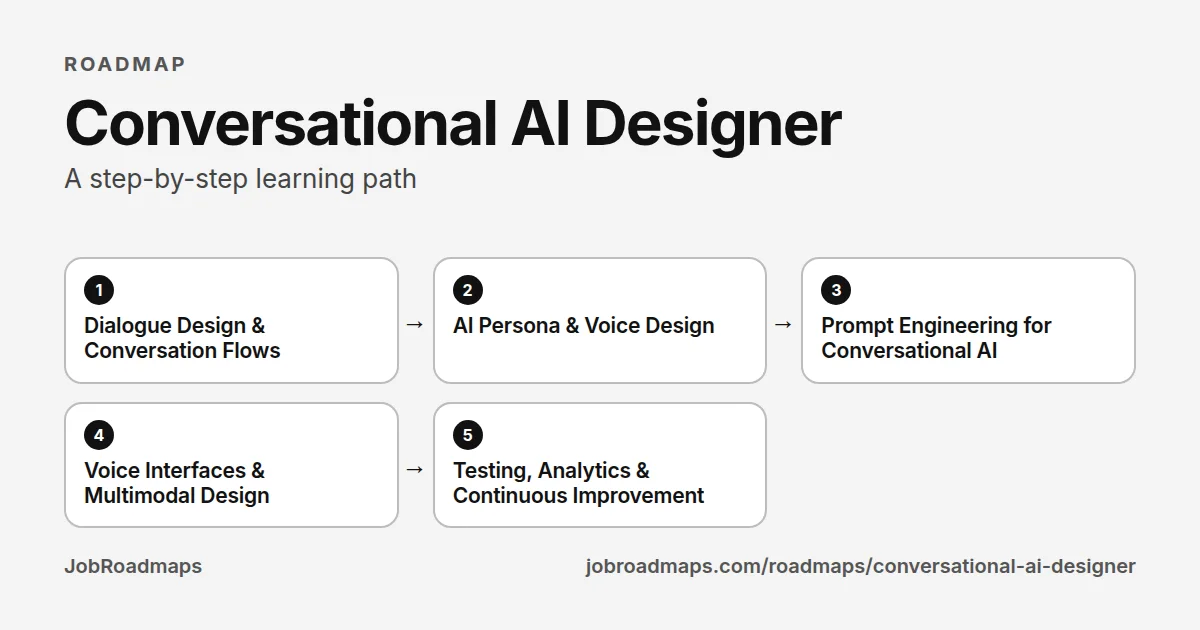
Conversational AI Designer learning path
Work down the line, one step at a time. Tick each skill as you can do it.
- 1
Dialogue Design & Conversation Flows
4–6 weeksLearn the fundamentals of conversation design: happy paths, error handling, fall-back utterances, and re-prompting strategies. Map dialogue flows using tools like Voiceflow or Botmock. Study linguistic concepts: speech acts, turn-taking, and implicature.
Skills to learn
- Dialogue Flow Design
- Voiceflow
- Happy Path Mapping
- Error Handling Design
- Fallback Utterances
- Linguistic Pragmatics
- 2
AI Persona & Voice Design
4–5 weeksCraft AI personas with consistent personality, tone, and values. Define voice characteristics: formality level, humour, empathy triggers, and cultural sensitivity. Write persona guidelines that survive edge cases and adversarial user behaviour.
Skills to learn
- Persona Design
- Tone of Voice Guidelines
- Brand Voice
- Cultural Sensitivity
- Emotional Design
- Persona Stress-Testing
- 3
Prompt Engineering for Conversational AI
5–7 weeksWrite and iterate system prompts that reliably produce the desired tone, scope, and behaviour from LLMs. Use few-shot examples, role definitions, and output constraints. Understand how context window management affects multi-turn conversation quality.
Skills to learn
- System Prompt Writing
- Few-Shot Prompting
- Context Management
- Output Constraints
- Multi-Turn Conversation Design
- Prompt Testing
- 4
Voice Interfaces & Multimodal Design
4–5 weeksDesign for voice: SSML markup, prosody, pausing, and natural speech patterns. Understand the differences between text and voice conversation design. Explore multimodal AI interfaces that combine voice, vision, and text — the emerging frontier.
Skills to learn
- SSML
- Voice UX Principles
- Alexa Skills / Google Actions
- Multimodal Design
- Voice Prototyping
- Accessibility in Voice
- 5
Testing, Analytics & Continuous Improvement
4–5 weeksBuild conversation testing frameworks: intent accuracy testing, edge case libraries, and automated regression testing. Analyse conversation logs for abandonment points, confusion patterns, and NPS signals. Run iterative improvement cycles with data-driven decisions.
Skills to learn
- Conversation Analytics
- Intent Testing
- Confusion Detection
- A/B Testing Dialogues
- User Feedback Integration
- Conversation Metrics
jobroadmaps.com/roadmaps/conversational-ai-designer · Pay, demand and employer data for this role are further down the page.
Job Market Insights for Conversational AI Designer
Data-backed
Which skills appear most in job postings?
Read from live job postings, ranked from most to least often named.
UX writing leads the list and is named frequent. If you are only going to learn one thing before applying, the postings say start here.
The 4 base skills sit at the top of the scale, appearing across company sizes and seniority levels. Treat them as the baseline an application is read against.
Skill
How often named
UX writing
content strategy
systems design
storytelling
Sorted by how often named · JobRoadmaps
Industry overlay
Targeting a specific industry?
The core roadmap gets you through the door anywhere. The difference between "qualified" and "they hired someone else" often lives in industry-specific context — the norms, the compliance floors, the tools assumed fluent in that sector.
Customer support conversation design
Support chatbots handle millions of conversations — designers who understand support intent taxonomy, escalation patterns, and CSAT optimisation create measurable business impact.
LLM-native conversation design
Rules-based chatbot design skills don't transfer directly to LLM systems — designers who understand how to craft system prompts and constrain LLM behaviour are in high demand.
Companies hiring:
IntercomZendeskHubSpotSalesforceDriftShopping intent detection
Conversational commerce requires detecting where users are in the buying journey — browsing, comparing, or ready to purchase — and adapting the conversation accordingly.
Returns and complaints handling design
High-frustration conversations (order issues, returns, complaints) require careful dialogue design to de-escalate and resolve without agent handoff.
Companies hiring:
ShopifyAmazonASOSSephoraH&MIndustry premiums based on aggregated job posting data · Updated quarterly
Interactive
How ready are you right now?
Check the skills you already have to see your current job-market fit.
The most-named skill for this role is UX writing, so a gap there costs you the most. Skills at the top of the scale appear across most postings, so a single gap there narrows your options more than a gap in a rarer skill. Check what you already have to see your biggest current gap.
Readiness Check
Check the skills you already have
0/4
base skills
Your biggest gap: UX writing, the most often named of the skills you have not ticked.
Start there, then work down the list.
Books worth reading as a Conversational AI Designer
Where to start, in order. The full list of 11, grouped by career stage, is on its own page.
Getting started

Conversational Design
by Erika Hall · 2018
A short book on applying the principles of human conversation to interface design. The best first read for anyone moving from visual UX or writing into dialogue design.
View book →
Designing Voice User Interfaces: Principles of Conversational Experiences
by Cathy Pearl · 2016
~280 pages~7 hrs to read
Walks through designing voice assistants end to end: personas, dialog flows, error handling and testing. A solid foundation even if you work mostly with text chatbots.
View book →
Doing the job
Conversational UX Design: A Practitioner's Guide to the Natural Conversation Framework
by Robert J. Moore, Raphael Arar · 2019
~320 pages~8 hrs to read
Introduces a pattern-based framework drawn from the study of human conversation for designing dialogue. Read it when you want a systematic way to handle repair, openings, closings and side sequences.
View book →Strategic Writing for UX: Drive Engagement, Conversion, and Retention with Every Word
by Torrey Podmajersky · 2019
~190 pages~5 hrs to read
A method for writing interface text that supports user and business goals, with a framework for voice and content. Handy for scripting and reviewing bot copy.
View book →
Senior and leading
Designing Human-Centric AI Experiences: Applied UX Design for Artificial Intelligence
by Akshay Kore · 2022
Covers designing AI products around trust, explanations, feedback loops and failure handling. Read it when you are setting AI interaction standards for a team.
View book →
Human-Centered AI
by Ben Shneiderman · 2022
~300 pages~8 hrs to read
Argues for AI systems that keep people in control, with frameworks for reliable, safe and trustworthy design. Read it when you are responsible for setting product principles.
View book →
All 11 books for a Conversational AI Designer →Browse all books →
Some book links are affiliate links: we earn a small commission if you buy, at no cost to you. It does not affect what we list.
Prerequisites & Education
What credentials do employers look for?
These are the most common paths into this role — no single one is required.
Education
View list — coming soon- BA in Linguistics, Psychology, HCI, or Communication — deep understanding of how humans communicate is the core foundation
- BA in UX Design or Interaction Design — strong design thinking framework that conversation designers apply to dialogue
- Self-taught with linguistics autodidact approach — viable with a strong portfolio of designed dialogue flows
Linguistic and cognitive psychology backgrounds provide a strong theoretical foundation. However, portfolio work demonstrating dialogue design skill is the primary hiring signal.
Certifications
View list — coming soon- Certified Conversation Designer (CCD, Conversation Design Institute) — the industry's primary professional credential; most respected in the community (€995, 3 months)
- Google UX Design Certificate (Coursera) — solid UX foundation and design thinking framework ($49/mo, 6 months)
- Voiceflow Certification — platform-specific but Voiceflow is the dominant tool; shows practical fluency (free, 4 weeks)
CDI certification is the most recognised credential in conversation design. Pair it with Voiceflow fluency for the strongest combination of theoretical and practical credentials.
Bootcamps & Self-Study Paths
View list — coming soon- Conversation Design Institute courses — the most respected training in the field; covers persona design, dialogue mapping, and error handling
- Voiceflow University — free platform-specific training; Voiceflow is used by the majority of conversation designers
- Dialogflow / Amazon Lex documentation — technical platform knowledge needed for implementation-adjacent roles
The conversation design community is small and tight-knit. The CDI blog, Conversational AI Summit, and LinkedIn are where practitioners share work and build reputation.
Portfolio
View list — coming soon- 2–3 complete dialogue flow designs with sample scripts, error handling paths, and persona guidelines
- System prompt portfolio showing different AI persona designs for distinct brand voices
- Conversation analytics report with user drop-off analysis and improvement recommendations
- Voice interface design sample with SSML markup and annotated design rationale
The conversation design community is small and tight-knit. Contributing to the CDI blog, speaking at the Conversational AI Summit, and sharing design work on LinkedIn builds the profile that leads to the best roles.
Your Roadmap
5 stepsDialogue Design & Conversation Flows
4–6 weeksLearn the fundamentals of conversation design: happy paths, error handling, fall-back utterances, and re-prompting strategies. Map dialogue flows using tools like Voiceflow or Botmock. Study linguistic concepts: speech acts, turn-taking, and implicature.
Skills to learn
AI Persona & Voice Design
4–5 weeksCraft AI personas with consistent personality, tone, and values. Define voice characteristics: formality level, humour, empathy triggers, and cultural sensitivity. Write persona guidelines that survive edge cases and adversarial user behaviour.
Skills to learn
Prompt Engineering for Conversational AI
5–7 weeksWrite and iterate system prompts that reliably produce the desired tone, scope, and behaviour from LLMs. Use few-shot examples, role definitions, and output constraints. Understand how context window management affects multi-turn conversation quality.
Skills to learn
Voice Interfaces & Multimodal Design
4–5 weeksDesign for voice: SSML markup, prosody, pausing, and natural speech patterns. Understand the differences between text and voice conversation design. Explore multimodal AI interfaces that combine voice, vision, and text — the emerging frontier.
Skills to learn
Testing, Analytics & Continuous Improvement
4–5 weeksBuild conversation testing frameworks: intent accuracy testing, edge case libraries, and automated regression testing. Analyse conversation logs for abandonment points, confusion patterns, and NPS signals. Run iterative improvement cycles with data-driven decisions.
Skills to learn
Start here this week
This week: identify one thing you find genuinely hard to do with a chatbot today — something that should work but doesn't. Design a conversation flow that would fix it. Document the specific failure modes of the current system and what your design does differently. That's a portfolio piece, and it demonstrates the analytical instinct the role requires.
For structured entry, Google's Conversational Design certification and the Voice UX resources from Nielsen Norman Group cover the foundational principles. Anthropic's and OpenAI's documentation on prompt design is essential technical context. The Chatbot Design Figma community has templates and case studies. The portfolio matters more than credentials — build three case studies before you start applying.
Job Titles at Each Level
Entry
Conversation Designer / UX Writer
Mid
Senior Conversation Designer / AI UX Designer
Senior
Principal Conversation Designer / Head of AI Product Experience
Steps Overview
- 1
Dialogue Design & Conversation Flows
4–6 weeks
- 2
AI Persona & Voice Design
4–5 weeks
- 3
Prompt Engineering for Conversational AI
5–7 weeks
- 4
Voice Interfaces & Multimodal Design
4–5 weeks
- 5
Testing, Analytics & Continuous Improvement
4–5 weeks
Explore more roadmaps
Not sure this is the right path? Browse all creative career roadmaps.
View Similar RoadmapsBuilt a project while following this roadmap?
Turn it into a hiring-ready case study in 10 seconds — free.
Ready to explore more?
Browse all career roadmaps across tech, business, and creative fields.