Content Creator Career Roadmap
Content creation sounds like a modern invention. It's actually one of the oldest jobs: storytelling, audience-building, trust, persuasion — just compressed into upload schedules, SEO metadata, and analytics dashboards. The creators building durable audiences understand they're not making content; they're cultivating a specific relationship with a specific kind of person who doesn't find what they need anywhere else. That specificity is the entire strategy.
Is this the right path for you?
Content creators come from literally everywhere — writers, videographers, teachers, subject-matter experts, people who've been creating for fun for years without monetizing it. The barrier to entry is lower than almost any other career on this list, which means the competitive density is higher. Everyone with a smartphone and an opinion is a potential competitor.
If you have a point of view and the discipline to express it consistently — if you find yourself creating when no one's watching, not just when it might pay off — you're already built for this. The creators who compound are the ones who publish when growth is flat. The ones who quit are the ones who needed the feedback loop to stay motivated.
Most people who try content creation quit in the first 90 days. Growth is slow at the beginning, the algorithm is opaque, and the emotional cost of creating into silence is higher than people anticipate. Consistency over quality, especially at the start — a mediocre post published beats a great post in drafts. The creators who are still going at month six are in a materially smaller competitive pool.
Career Progression
Where does this role lead?
Click any role to explore timeline, key skills and, where the Department of Labor publishes it, pay.
Entry
Content Writer
~1 yr
Consistent output and meeting briefs on time matters more than crafting masterpieces. Building a body of work quickly is how you get better and get noticed.
Key skills
Visual roadmap
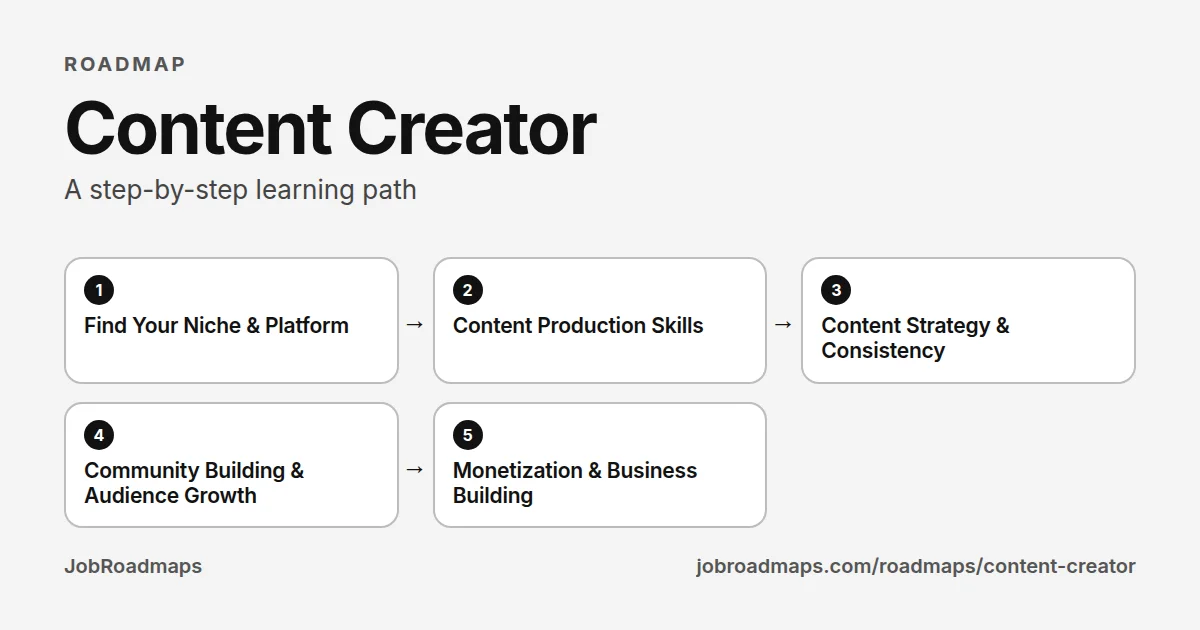
Content Creator learning path
Work down the line, one step at a time. Tick each skill as you can do it.
- 1
Find Your Niche & Platform
2–3 weeksDefine your content niche by intersecting your passions, expertise, and audience demand. Research which platform best fits your content style: long-form (YouTube, podcasts), short-form (TikTok/Reels), or written (newsletter, blog). Study your competitors.
Skills to learn
- Niche Research
- Platform Strategy
- Audience Analysis
- Competitor Research
- Content Positioning
- Personal Branding
Start with
- 2
Content Production Skills
6–8 weeksLearn the technical skills to produce quality content. For video: lighting, audio, camera settings, and editing with CapCut or Premiere Pro. For written: storytelling structure, SEO writing, and newsletter formats. For audio: recording and editing with Audacity or Descript.
Skills to learn
- Video Editing
- CapCut / Premiere Pro
- Scripting
- Lighting & Audio
- Thumbnail Design
- Copywriting
Start with
- 3
Content Strategy & Consistency
4–6 weeks (ongoing)Build a content calendar and commit to a posting schedule. Learn platform algorithms. Study what hooks work, why some content goes viral, and how to structure a content funnel from top-of-funnel awareness to community building.
Skills to learn
- Content Calendar
- Hook Writing
- SEO for YouTube/Blogs
- Storytelling Frameworks
- Batch Production
- Analytics
Start with
- 4
Community Building & Audience Growth
3–6 months (ongoing)Engage with your audience through comments, DMs, and live streams. Learn to build a community (Discord, Circle, Patreon). Study cross-promotion, collabs, and how to leverage other creators' audiences to grow faster.
Skills to learn
- Community Management
- Engagement Strategy
- Collabs & Cross-Promotion
- Discord / Circle
- Live Streaming
- Email List Building
Start with
- 5
Monetization & Business Building
6–12 months (ongoing)Diversify revenue: ad revenue, brand deals, digital products (courses, e-books), affiliate marketing, and memberships. Learn to pitch and negotiate brand partnerships. Build a media business with scalable income streams.
Skills to learn
- Brand Partnerships
- Sponsorship Negotiation
- Affiliate Marketing
- Digital Products
- Ad Revenue
- Media Business
Start with
jobroadmaps.com/roadmaps/content-creator · Pay, demand and employer data for this role are further down the page.
Job Market Insights for Content Creator
Data-backed
Which skills appear most in job postings?
Read from live job postings, ranked from most to least often named.
storytelling is the most-named skill. Common, but not universal: many postings do not list it.
Past the fundamentals, 1 specialisation skill (storytelling among them) appear in a minority of postings. Not universal, but the kind of depth that makes a hiring manager stop skimming.
Skill
How often named
storytelling
Sorted by how often named · JobRoadmaps
Data-backed
Which tools and artifacts appear most in job postings?
Read from live job postings, ranked from most to least often named.
Instagram tops the list and is named frequent. That is not a preference, it is what this market has standardised on.
Several tools sit at the top of the scale. At that level it is less a differentiator than a prerequisite, and a gap shows up in first-round screens.
Tool / Artifact
How often named
TikTok
YouTube
Sorted by how often named · JobRoadmaps
Industry overlay
Targeting a specific industry?
The core roadmap gets you through the door anywhere. The difference between "qualified" and "they hired someone else" often lives in industry-specific context — the norms, the compliance floors, the tools assumed fluent in that sector.
creative briefs
Agency work begins with client briefs that must be interpreted precisely.
brand guidelines
Global clients enforce strict brand systems across markets.
localization
Multi-market campaigns need adaptation to local culture and language.
stakeholder communication
Concepts are presented and revised with client and account teams.
Companies hiring:
WPPWunderman Thompsoninfluencer marketing
The core business is planning and managing creator partnerships.
content analytics
Campaigns are evaluated on engagement and purchase data.
trend monitoring
Creator formats shift quickly, so trend fluency drives relevance.
user generated content
Creator-made assets are a primary deliverable for brands.
Companies hiring:
LaterIndustry premiums based on aggregated job posting data · Updated quarterly
Interactive
How ready are you right now?
Check the skills you already have to see your current job-market fit.
The most-named skill for this role is storytelling, so a gap there costs you the most. No single skill dominates, but each gap narrows which postings fit you. Check what you already have to see your biggest current gap.
Readiness Check
Check the skills you already have
0/1
base skills
Your biggest gap: storytelling, the most often named of the skills you have not ticked.
Start there, then work down the list.
Books worth reading as a Content Creator
Where to start, in order. The full list of 11, grouped by career stage, is on its own page.
Getting started

Show Your Work!: 10 Ways to Share Your Creativity and Get Discovered
by Austin Kleon · 2014
~220 pages~6 hrs to read
A short guide to sharing your process in public so an audience can find you. A sensible first read if you are about to start posting regularly.
View book →
Steal Like an Artist: 10 Things Nobody Told You About Being Creative
by Austin Kleon · 2012
~160 pages~4 hrs to read
Short, illustrated advice on drawing influence from others and turning it into your own voice. Good for the first months, when you are still finding a style.
View book →
Doing the job

Wired for Story: The Writer's Guide to Using Brain Science to Hook Readers from the Very First Sentence
by Lisa Cron · 2012
~260 pages~7 hrs to read
Uses brain science to explain why stories hold attention and how to build one around a character's goal. Useful when you move from posting clips to scripting videos and series.
View book →
Storyworthy: Engage, Teach, Persuade, and Change Your Life through the Power of Storytelling
by Matthew Dicks · 2018
~350 pages~9 hrs to read
A practical method for finding and shaping true personal stories, with attention to openings and endings. Helps you make talking-head and long-form content more memorable.
View book →
Senior and leading

Content Inc.: How Entrepreneurs Use Content to Build Massive Audiences and Create Radically Successful Businesses
by Joe Pulizzi · 2016
~370 pages~9 hrs to read
Lays out a path from picking a niche to building an audience first and then monetising it. For creators who want to turn an audience into a business with more than one revenue line.
View book →
Company of One: Why Staying Small Is the Next Big Thing for Business
by Paul Jarvis · 2019
~270 pages~7 hrs to read
Makes the case for keeping a business small and profitable rather than chasing scale. A thoughtful read for full-time creators deciding how large to grow.
View book →
All 11 books for a Content Creator →Browse all books →
Some book links are affiliate links: we earn a small commission if you buy, at no cost to you. It does not affect what we list.
Prerequisites & Education
What credentials do employers look for?
These are the most common paths into this role — no single one is required.
Education Level
View list — coming soon- Bachelor's in Communications, Journalism, Marketing, or Media Studies
- Bachelor's in any discipline — content creation is almost entirely outcome-gated
- Film, photography, or audio production training or degree
- No degree — audience size and engagement metrics matter far more
Content creation is the most portfolio-gated career on this site. A 50k engaged audience on YouTube outweighs any degree in most monetisation conversations.
Certifications
View list — coming soon- HubSpot Content Marketing Certification — useful for agency or brand roles
- Google Digital Marketing Basics
- Meta Content Marketing Associate
- YouTube Creator Academy completions — free, signals platform commitment
Certifications matter very little for independent content creators. For corporate content roles (social media manager, content strategist), HubSpot and Google certs are mentioned.
Bootcamps & Training
View list — coming soon- Think Media YouTube Strategy courses — practical, platform-specific
- Creator Science / Jay Clouse — newsletter and audience growth
- Descript Academy — video and podcast editing workflow
- Canva Design School — visual content creation for non-designers
Practical platform-specific training (Think Media, Creator Science) provides more immediate ROI than broad marketing courses for independent creators.
Portfolio & Other
View list — coming soon- Active channel, newsletter, or social profile with consistent publishing history
- Audience and engagement metrics — subscriber count, open rate, average views
- Media kit showing demographics, reach, and partnership history
- Published brand deal or sponsored content examples
- Analytics screenshots demonstrating growth trajectory
For creators, the portfolio IS the channel. Consistent publishing history and an engaged (not just large) audience is the primary hiring signal.
Your Roadmap
5 stepsFind Your Niche & Platform
2–3 weeksDefine your content niche by intersecting your passions, expertise, and audience demand. Research which platform best fits your content style: long-form (YouTube, podcasts), short-form (TikTok/Reels), or written (newsletter, blog). Study your competitors.
Skills to learn
Content Production Skills
6–8 weeksLearn the technical skills to produce quality content. For video: lighting, audio, camera settings, and editing with CapCut or Premiere Pro. For written: storytelling structure, SEO writing, and newsletter formats. For audio: recording and editing with Audacity or Descript.
Skills to learn
Content Strategy & Consistency
4–6 weeks (ongoing)Build a content calendar and commit to a posting schedule. Learn platform algorithms. Study what hooks work, why some content goes viral, and how to structure a content funnel from top-of-funnel awareness to community building.
Skills to learn
Community Building & Audience Growth
3–6 months (ongoing)Engage with your audience through comments, DMs, and live streams. Learn to build a community (Discord, Circle, Patreon). Study cross-promotion, collabs, and how to leverage other creators' audiences to grow faster.
Skills to learn
Monetization & Business Building
6–12 months (ongoing)Diversify revenue: ad revenue, brand deals, digital products (courses, e-books), affiliate marketing, and memberships. Learn to pitch and negotiate brand partnerships. Build a media business with scalable income streams.
Skills to learn
Start here this week
This week: publish something. One post, one video, one piece. The platform matters less than the habit — wherever your target audience actually is. Don't wait until it's perfect. Don't wait until you have a strategy. Publish and observe. The first ten pieces are research, not output.
For structured entry, YouTube Creator Academy and LinkedIn Learning's content strategy courses provide frameworks. But the real structured path in content creation is a publishing schedule you can actually maintain. Decide on a frequency you could sustain if you were exhausted and sick, not your aspirational pace. Then do that for 60 days and iterate.
Job Titles at Each Level
Entry
Content Creator / Influencer (Nano/Micro)
Mid
Mid-tier Creator / Brand Partnerships
Senior
Full-time Creator / Media Brand / Agency Owner
Steps Overview
- 1
Find Your Niche & Platform
2–3 weeks
- 2
Content Production Skills
6–8 weeks
- 3
Content Strategy & Consistency
4–6 weeks (ongoing)
- 4
Community Building & Audience Growth
3–6 months (ongoing)
- 5
Monetization & Business Building
6–12 months (ongoing)
Explore more roadmaps
Not sure this is the right path? Browse all creative career roadmaps.
View Similar RoadmapsBuilt a project while following this roadmap?
Turn it into a hiring-ready case study in 10 seconds — free.
Ready to explore more?
Browse all career roadmaps across tech, business, and creative fields.