Chief AI Officer (CAIO) Career Roadmap
The Chief AI Officer defines and executes an organisation's AI strategy at the highest level — owning AI governance, investment allocation, talent strategy, and risk management. The CAIO sits in the C-suite, reporting to the CEO, and is responsible for AI-driven competitive advantage.
Is this the right path for you?
Chief AI Officers arrive from CTO, CDO, and CPO roles at companies where AI became central to the product or operations strategy, from VP of AI or VP of Data roles that expanded in scope, and from senior consulting or research positions at AI-heavy organizations. This is a C-suite role that most people are 5–15 years away from when they first consider it.
If you can talk credibly to the board about AI investment risk and to the engineering team about what's technically feasible — in the same day, in different registers — you're already thinking like a CAIO. The role requires both technical credibility and executive presence. The ones who stick are the ones who have both and don't pretend otherwise.
This is a genuinely new C-suite role at most companies, which means there's significant title inflation. Many people with 'Chief AI Officer' on their LinkedIn are effectively director-level AI leads who got a C-title at a company that wanted to signal AI seriousness. The ones with actual organizational authority and board access are fewer. Build real AI delivery track record and executive presence, not just the title.
Career Progression
Where does this role lead?
Click any role to explore timeline, key skills and, where the Department of Labor publishes it, pay.
Entry
AI Strategy Director
8–12 yrs exp
The entry point to the CAIO path requires already being a senior leader. Most CAIOs come from Director/VP roles in ML engineering, AI product, or AI strategy — with a strong combination of technical credibility and business impact.
Key skills
Visual roadmap
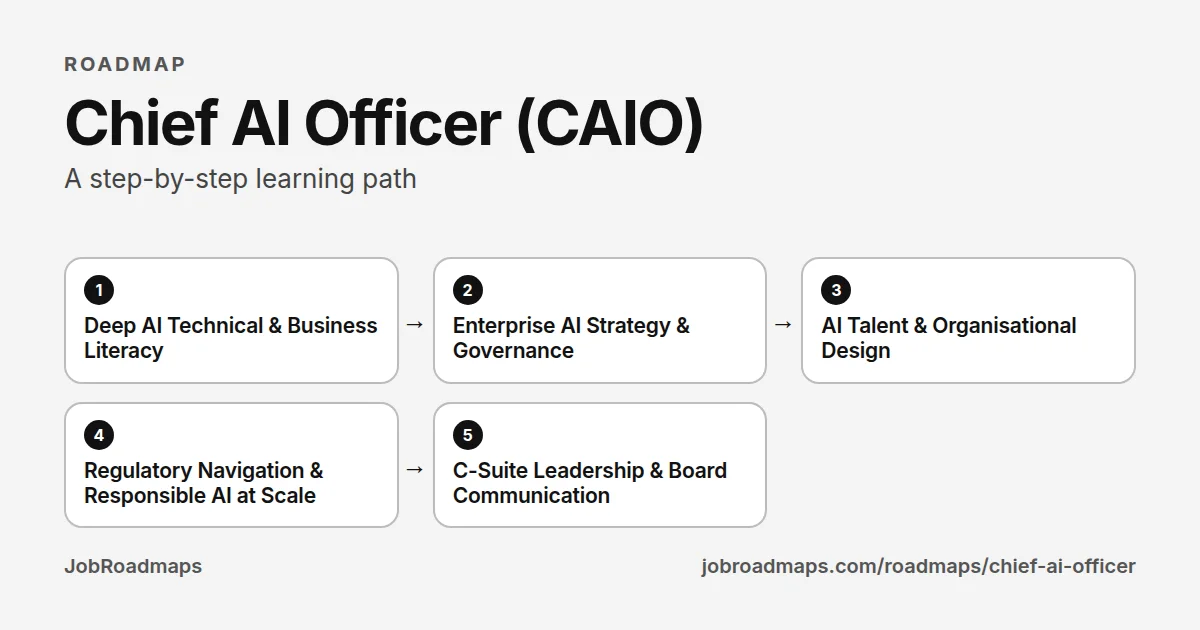
Chief AI Officer (CAIO) learning path
Work down the line, one step at a time. Tick each skill as you can do it.
- 1
Deep AI Technical & Business Literacy
6–12 monthsDevelop the dual fluency that separates great CAIOs: technical depth to evaluate AI capabilities and limitations, and business acumen to translate AI into P&L outcomes. Read research papers, run experiments, but also study AI's economic and competitive dynamics.
Skills to learn
- LLM Architecture
- ML Systems
- AI Economics
- Competitive Intelligence
- Technology Trajectory
- Technical Due Diligence
- 2
Enterprise AI Strategy & Governance
6–12 monthsBuild experience designing enterprise AI strategies: AI portfolio prioritisation, build-vs-buy-vs-partner decisions, AI governance frameworks, and risk management. Learn to design AI centres of excellence and manage AI investment portfolios with quantified ROI.
Skills to learn
- AI Portfolio Strategy
- Build vs Buy Frameworks
- AI Governance
- AI Risk Management
- Investment Prioritisation
- AI Centre of Excellence
- 3
AI Talent & Organisational Design
6–12 monthsLead the AI talent strategy: define AI roles and career ladders, build AI teams from scratch, partner with HR on AI compensation benchmarking, and create the culture needed to attract top AI talent. Design the org structure for AI: centralised vs. federated AI teams.
Skills to learn
- AI Talent Strategy
- Org Design for AI
- AI Career Ladders
- Recruiting AI Talent
- AI Culture Building
- Compensation Benchmarking
- 4
Regulatory Navigation & Responsible AI at Scale
4–6 monthsOwn AI governance at the enterprise level: board reporting on AI risks, regulatory compliance across jurisdictions (EU AI Act, US NIST AI RMF), AI audit processes, and crisis management for AI failures. Build the trust infrastructure for responsible AI at scale.
Skills to learn
- Board-Level AI Reporting
- Multi-Jurisdiction Compliance
- AI Audit Frameworks
- AI Incident Crisis Management
- Responsible AI Leadership
- External Stakeholder Communication
- 5
C-Suite Leadership & Board Communication
4–6 monthsDevelop executive presence for AI: translate technical AI roadmaps into board narratives, manage AI investment conversations with CFOs, and build the credibility to drive AI transformation against organisational resistance. Speak at external events to build thought leadership.
Skills to learn
- Board Narrative Development
- CFO Conversations on AI
- Executive Presence
- AI Thought Leadership
- Media Communication
- Stakeholder Trust Building
jobroadmaps.com/roadmaps/chief-ai-officer · Pay, demand and employer data for this role are further down the page.
Job Market Insights for Chief AI Officer (CAIO)
Data-backed
Which skills appear most in job postings?
Read from live job postings, ranked from most to least often named.
AI operations leads the list and is named almost always. If you are only going to learn one thing before applying, the postings say start here.
The 6 base skills sit at the top of the scale, appearing across company sizes and seniority levels. Treat them as the baseline an application is read against.
Skill
How often named
AI operations
maturity model
vector search
documentation
enablement
operating cadence
Sorted by how often named · JobRoadmaps
Data-backed
Which tools and artifacts appear most in job postings?
Read from live job postings, ranked from most to least often named.
Supabase tops the list and is named almost always. That is not a preference, it is what this market has standardised on.
One tool sits at the top of the scale. At that level it is less a differentiator than a prerequisite, and a gap shows up in first-round screens.
Tool / Artifact
How often named
Supabase
Sorted by how often named · JobRoadmaps
Industry overlay
Targeting a specific industry?
The core roadmap gets you through the door anywhere. The difference between "qualified" and "they hired someone else" often lives in industry-specific context — the norms, the compliance floors, the tools assumed fluent in that sector.
AI product strategy
Technology company CAIOs must drive AI into the product roadmap — the ability to identify which AI capabilities create durable competitive advantage vs. commodity features is the core strategic judgment.
AI talent magnet leadership
Top AI researchers and engineers choose their next role based on the CAIO's technical reputation and research agenda. The CAIO's credibility directly affects talent acquisition at the highest levels.
Companies hiring:
SalesforceMicrosoftGoogleSAPOraclePostgreSQL
The core product is a database, so operational leaders must understand the data layer.
vector search
Platform features for embeddings and retrieval are part of the product line.
AI agents
Agents are used both as product capability and as internal operating method.
TypeScript
Platform tooling is written in TypeScript, so reviewing it matters for technical credibility.
Companies hiring:
SupabaseIndustry premiums based on aggregated job posting data · Updated quarterly
Interactive
How ready are you right now?
Check the skills you already have to see your current job-market fit.
The most-named skill for this role is AI operations, so a gap there costs you the most. Skills at the top of the scale appear across most postings, so a single gap there narrows your options more than a gap in a rarer skill. Check what you already have to see your biggest current gap.
Readiness Check
Check the skills you already have
0/6
base skills
Your biggest gap: AI operations, the most often named of the skills you have not ticked.
Start there, then work down the list.
Books worth reading as a Chief AI Officer (CAIO)
Where to start, in order. The full list of 12, grouped by career stage, is on its own page.
Getting started

Prediction Machines: The Simple Economics of Artificial Intelligence
by Ajay Agrawal, Joshua Gans, Avi Goldfarb · 2018
~250 pages~6 hrs to read
Frames AI as cheaper prediction and works through what that changes for decisions, jobs and strategy. A clear base for deciding where AI belongs in a business.
View book →
Human + Machine: Reimagining Work in the Age of AI
by Paul R. Daugherty, H. James Wilson · 2018
~250 pages~6 hrs to read
Draws on company examples to show how processes are redesigned around people and AI working together. Useful early for thinking about AI in terms of operations, not just models.
View book →
Doing the job

Power and Prediction: The Disruptive Economics of Artificial Intelligence
by Ajay Agrawal, Joshua Gans, Avi Goldfarb · 2022
Argues that the large gains come when whole systems are redesigned around AI, not when it is dropped into existing workflows. Helps when you need to scope transformation beyond pilots.
View book →
The Technology Fallacy: How People Are the Real Key to Digital Transformation
by Gerald C. Kane, Anh Nguyen Phillips, Jonathan R. Copulsky, Garth R. Andrus · 2019
~280 pages~7 hrs to read
Research-based look at why digital transformation depends on culture, talent and leadership more than on tools. A reminder that an AI programme succeeds or fails on people.
View book →
Senior and leading

The Age of AI: And Our Human Future
by Henry A. Kissinger, Eric Schmidt, Daniel Huttenlocher · 2021
~270 pages~7 hrs to read
A high-level look at how AI affects security, economies and human decision-making. Good preparation for board and government conversations about where AI is heading.
View book →The Coming Wave: Technology, Power, and the Twenty-first Century's Greatest Dilemma
by Mustafa Suleyman, Michael Bhaskar · 2023
Written by a co-founder of DeepMind, it covers AI and synthetic biology and the question of containing them. Read it to sharpen your view of risk, regulation and long-term obligations.
View book →
All 12 books for a Chief AI Officer (CAIO) →Browse all books →
Some book links are affiliate links: we earn a small commission if you buy, at no cost to you. It does not affect what we list.
Prerequisites & Education
What credentials do employers look for?
These are the most common paths into this role — no single one is required.
Education
View list — coming soon- PhD in Computer Science, ML, or Cognitive Science — common at research-driven companies (Anthropic, Google DeepMind, OpenAI); signals technical depth
- MBA from a top-10 programme — business leadership credential for CAIOs from technical or product backgrounds demonstrating C-suite readiness
- MS in Computer Science or Engineering combined with executive leadership experience — viable combination at enterprise companies
CAIO is the most senior AI leadership role. Both PhD + deep AI experience and MBA + AI transformation track record are viable educational foundations. What matters is the demonstrated outcome history.
Certifications
View list — coming soon- USAII Certified Artificial Intelligence Scientist (CAIS) — $1,195, entry-level AI cert for directors, CXOs, and senior leaders; requires 4+ years of AI-adjacent experience and a master's degree
- PMI Certified Professional in Managing AI (PMI-CPMAI) — $699–$899, validates ability to manage AI programmes and align technical and business teams; credible PMI-backed credential
- EC-Council Certified AI Program Manager (CAIPM) — $450, enterprise AI programme management covering adoption, security, and governance; suited to CAIOs coming from tech leadership
- MIT Sloan Executive Education – AI Leadership — board-level communication readiness and strategic framework depth ($3,500, 6 weeks)
- Stanford HAI Executive Programme – AI Strategy — academic network and research literacy that distinguish a CAIO from a VP of AI (variable cost)
- Certified AI Governance Professional (AIGP, IAPP) — increasingly required as EU AI Act assigns personal liability to C-suite AI leaders ($550, 2 months)
At the CAIO level, executive education from MIT or Stanford carries credential weight. AIGP governance cert is becoming a regulatory expectation. CAIS ($1,195) is the most accessible formal AI credential for senior non-technical leaders.
Alternative Paths
View list — coming soon- Chief AI Officer community networks (CAIO Forum, LinkedIn communities) — peer learning at this level is as valuable as formal programmes
- Board advisory roles on AI governance — practical experience that simultaneously builds credentials and reputation
- Corporate AI governance committee participation — route to CAIO from legal, compliance, or risk backgrounds
CAIO roles are almost never filled through external hiring for first-time CAIOs. The path typically runs through VP of AI, Head of AI Strategy, or equivalent senior roles with measurable enterprise AI outcomes.
Portfolio
View list — coming soon- Published AI strategy white paper, Harvard Business Review article, or comparable thought leadership
- Board presentation deck on AI investment strategy and risk posture (anonymised)
- Enterprise AI governance framework document demonstrating programme design at organisational scale
- Track record: measurable AI transformation outcomes from previous roles with quantified business impact
At the CAIO level, your portfolio is your career history, published writing, and external reputation — not a project portfolio. You're evaluated on who you've influenced, what you've published, and what measurable AI outcomes you've delivered at organisational scale.
Your Roadmap
5 stepsDeep AI Technical & Business Literacy
6–12 monthsDevelop the dual fluency that separates great CAIOs: technical depth to evaluate AI capabilities and limitations, and business acumen to translate AI into P&L outcomes. Read research papers, run experiments, but also study AI's economic and competitive dynamics.
Skills to learn
Enterprise AI Strategy & Governance
6–12 monthsBuild experience designing enterprise AI strategies: AI portfolio prioritisation, build-vs-buy-vs-partner decisions, AI governance frameworks, and risk management. Learn to design AI centres of excellence and manage AI investment portfolios with quantified ROI.
Skills to learn
AI Talent & Organisational Design
6–12 monthsLead the AI talent strategy: define AI roles and career ladders, build AI teams from scratch, partner with HR on AI compensation benchmarking, and create the culture needed to attract top AI talent. Design the org structure for AI: centralised vs. federated AI teams.
Skills to learn
Regulatory Navigation & Responsible AI at Scale
4–6 monthsOwn AI governance at the enterprise level: board reporting on AI risks, regulatory compliance across jurisdictions (EU AI Act, US NIST AI RMF), AI audit processes, and crisis management for AI failures. Build the trust infrastructure for responsible AI at scale.
Skills to learn
C-Suite Leadership & Board Communication
4–6 monthsDevelop executive presence for AI: translate technical AI roadmaps into board narratives, manage AI investment conversations with CFOs, and build the credibility to drive AI transformation against organisational resistance. Speak at external events to build thought leadership.
Skills to learn
Start here this week
If you're reading this as someone currently 2–3 levels below C-suite: focus on building AI delivery track record at scale — systems that shipped, teams you led, measurable business outcomes. The CAIO path runs through VP of AI, CDO, or senior strategy roles with AI ownership. The credential that matters at this level is a portfolio of organizational impact, not a course certificate.
For structured preparation, MIT Sloan's executive AI programs and the Stanford Executive Program in AI cover the strategic and organizational dimensions at the right level for senior leaders. Reading the primary literature (Anthropic's alignment research, OpenAI's governance papers, the EU AI Act) rather than summaries is how you build the technical credibility that distinguishes serious CAIOs from title holders.
Job Titles at Each Level
Entry
AI Strategy Director / Head of AI
Mid
VP of AI / Chief Data & AI Officer
Senior
Chief AI Officer (CAIO)
Steps Overview
- 1
Deep AI Technical & Business Literacy
6–12 months
- 2
Enterprise AI Strategy & Governance
6–12 months
- 3
AI Talent & Organisational Design
6–12 months
- 4
Regulatory Navigation & Responsible AI at Scale
4–6 months
- 5
C-Suite Leadership & Board Communication
4–6 months
Explore more roadmaps
Not sure this is the right path? Browse all business career roadmaps.
View Similar RoadmapsBuilt a project while following this roadmap?
Turn it into a hiring-ready case study in 10 seconds — free.
Ready to explore more?
Browse all career roadmaps across tech, business, and creative fields.