AI Strategist Career Roadmap
AI Strategists advise organisations on how to deploy AI to achieve competitive advantage. They conduct AI readiness assessments, identify high-value use cases, design transformation roadmaps, and measure the business impact of AI investments — bridging C-suite strategy with technical execution.
Is this the right path for you?
AI strategists come from management consulting, corporate strategy teams, and technology strategy roles at companies where AI is a transformation lever rather than a product feature. The role exists across a spectrum from deeply analytical (modeling AI investment cases) to deeply political (building organizational consensus for AI adoption) — and the versions at consultancies vs. internal corporate teams are genuinely different jobs.
If you think about AI as a business transformation lever rather than a technology decision — if your first instinct when evaluating an AI capability is 'what business outcome does this change and by how much' — you're already thinking like an AI strategist. The role rewards the ability to quantify impact in terms that business stakeholders can act on.
'AI strategist' means wildly different things at a McKinsey, a Fortune 500 transformation team, and a startup. The consulting version is heavily analytical and presentation-driven. The corporate version is more cross-functional and politically complex. The startup version is often a single person figuring out AI bets with limited information. Decide which context you're targeting before you build toward it.
Career Progression
Where does this role lead?
Click any role to explore timeline, key skills and, where the Department of Labor publishes it, pay.
Entry
AI Strategy Analyst
~1–2 yrs
$51,667 (Level I)
You're doing the research and analysis that informs AI strategy decisions. Management consulting firms, AI startups, and large enterprise strategy teams are all valid entry points.
Key skills
Pay shown is the U.S. Department of Labor prevailing wage for Level I (entry), Level III (mid) and Level IV (senior) in the nearest BLS occupation, base wage for the typical metro, wage year 2025, shown for the main track only. It is a benchmark, not an offer; branches and lead, staff and executive stages have no official figure.
Visual roadmap
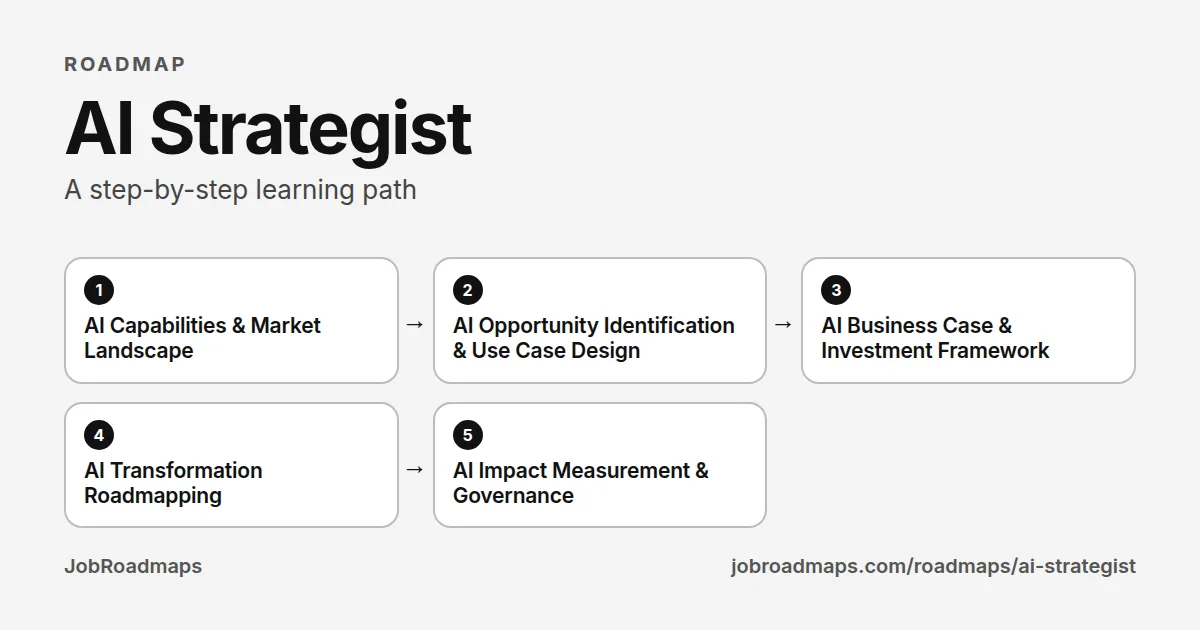
AI Strategist learning path
Work down the line, one step at a time. Tick each skill as you can do it.
- 1
AI Capabilities & Market Landscape
4–6 weeksBuild a working knowledge of AI capabilities across the major domains: generative AI (text, image, code, video), predictive ML, computer vision, and NLP. Map the competitive landscape of AI vendors, platforms, and open-source alternatives. Understand capability trajectories.
Skills to learn
- Generative AI Capabilities
- Predictive ML Use Cases
- AI Vendor Landscape
- Technology Trajectory Analysis
- Open vs Closed Models
- AI Benchmark Literacy
- 2
AI Opportunity Identification & Use Case Design
5–7 weeksDevelop frameworks for identifying AI opportunities: value chain analysis, process pain mapping, and competitive benchmarking. Qualify use cases by feasibility, data availability, ROI potential, and risk profile. Build use case scorecards and prioritisation matrices.
Skills to learn
- Value Chain Analysis
- AI Use Case Identification
- Feasibility Assessment
- ROI Estimation
- Use Case Prioritisation
- Pilot Scoping
- 3
AI Business Case & Investment Framework
4–6 weeksBuild AI business cases that get approved: quantify productivity gains, revenue uplift, and risk reduction. Model AI investment scenarios with sensitivity analysis. Understand AI economics: model costs, data infrastructure investment, and the long-term value of data flywheels.
Skills to learn
- Business Case Development
- NPV/ROI Modelling
- Sensitivity Analysis
- AI Cost Modelling
- Data Flywheel Economics
- Executive Presentation
- 4
AI Transformation Roadmapping
4–6 weeksDesign AI transformation roadmaps: sequencing initiatives by value and dependency, managing quick wins vs. foundational investments, and aligning roadmaps with organisational capability building. Understand the change management requirements for AI adoption.
Skills to learn
- Transformation Roadmap Design
- Initiative Sequencing
- Capability Building Plans
- Change Management
- Organisational Design for AI
- AI Centre of Excellence
- 5
AI Impact Measurement & Governance
3–5 weeksDefine success metrics for AI initiatives: productivity KPIs, quality metrics, and business outcomes. Build AI governance structures: steering committees, decision rights, and investment review processes. Measure and communicate AI ROI to the board.
Skills to learn
- AI KPI Framework
- Impact Attribution
- AI Governance Design
- Board-Level Reporting
- AI Portfolio Management
- Continuous Improvement Loops
jobroadmaps.com/roadmaps/ai-strategist · Pay, demand and employer data for this role are further down the page.
Job Market Insights for AI Strategist
Data-backed
Which skills appear most in job postings?
Read from live job postings, ranked from most to least often named.
digital transformation is the most-named skill. Common, but not universal: many postings do not list it.
Past the fundamentals, 1 specialisation skill (digital transformation included) start separating candidates who can do the job from candidates who have done it. The 3 niche skills are named rarely enough that knowing them is upside, not prerequisite.
Skill
How often named
digital transformation
enterprise technology
business strategy
executive briefings
Sorted by how often named · JobRoadmaps
Data-backed
Which tools and artifacts appear most in job postings?
Read from live job postings, ranked from most to least often named.
Claude is the most-named tool, but no tool is a universal requirement here.
Tool / Artifact
How often named
Sorted by how often named · JobRoadmaps
Industry overlay
Targeting a specific industry?
The core roadmap gets you through the door anywhere. The difference between "qualified" and "they hired someone else" often lives in industry-specific context — the norms, the compliance floors, the tools assumed fluent in that sector.
C-suite negotiation
Enterprise roles demand ability to engage CEOs, boards, and senior executives with credible strategic advice; sales cycles and stakeholder dynamics are complex.
enterprise procurement
Understanding how large organizations evaluate, approve, and budget for AI infrastructure and transformation initiatives.
multi-region strategy
Anthropic role explicitly emphasizes European markets with distinct regulatory, competitive, and organizational contexts.
Companies hiring:
DatabricksAnthropicGitLabEnterprise AI adoption strategy
Technology companies need AI strategists who can help enterprise customers adopt their AI products — the sales and success cycle for AI is fundamentally different from traditional software.
AI competitive differentiation
As every SaaS product adds AI features, AI strategists who can articulate what makes an AI capability genuinely defensible vs commodity are central to product strategy and investor narratives.
Companies hiring:
SalesforceMicrosoftGoogleIBMAccentureIndustry premiums based on aggregated job posting data · Updated quarterly
Interactive
How ready are you right now?
Check the skills you already have to see your current job-market fit.
The most-named skill for this role is digital transformation, so a gap there costs you the most. No single skill dominates, but each gap narrows which postings fit you. Check what you already have to see your biggest current gap.
Readiness Check
Check the skills you already have
0/4
base skills
Your biggest gap: digital transformation, the most often named of the skills you have not ticked.
Start there, then work down the list.
Books worth reading as a AI Strategist
Where to start, in order. The full list of 12, grouped by career stage, is on its own page.
Getting started

Prediction Machines: The Simple Economics of Artificial Intelligence
by Ajay Agrawal, Joshua Gans, Avi Goldfarb · 2018
~250 pages~6 hrs to read
Frames AI as cheaper prediction and shows how that changes decisions and business models. A solid first book for building business cases around AI use cases.
View book →
Artificial Intelligence: A Guide for Thinking Humans
by Melanie Mitchell · 2019
~340 pages~9 hrs to read
A computer scientist explains what current AI systems can and cannot do, and why the hype often outruns the results. Helps you judge vendor claims and feasibility.
View book →
Doing the job
The AI Playbook: Mastering the Rare Art of Machine Learning Deployment
by Eric Siegel · 2024
A step-by-step framework for taking machine learning projects from idea to deployment in a business. Helps you test whether a use case has a plan for the operational change it needs.
View book →
Competing in the Age of AI: Strategy and Leadership When Algorithms and Networks Run the World
by Marco Iansiti, Karim R. Lakhani · 2020
~290 pages~7 hrs to read
Describes the operating models of data-driven firms and what traditional companies must change. Good source for diagnosing an organisation's AI readiness.
View book →
Senior and leading

Power and Prediction: The Disruptive Economics of Artificial Intelligence
by Ajay Agrawal, Joshua Gans, Avi Goldfarb · 2022
Argues that the large gains from AI come from redesigning whole systems. Read it when advising leaders on transformation that goes beyond isolated pilots.
View book →
Good Strategy, Bad Strategy: The Difference and Why It Matters
by Richard P. Rumelt · 2011
~320 pages~8 hrs to read
Separates real strategy from slogans and goal lists, with a clear diagnosis-policy-action structure. A check to apply to your own recommendations.
View book →
All 12 books for a AI Strategist →Browse all books →
Some book links are affiliate links: we earn a small commission if you buy, at no cost to you. It does not affect what we list.
Prerequisites & Education
What credentials do employers look for?
These are the most common paths into this role — no single one is required.
Education
View list — coming soon- MBA from a top-10 programme — signals C-suite business credibility for AI strategy work; top-tier MBA + technical background is the highest-value combination
- MS in Management, Engineering, or Data Science — strong foundation for analytically rigorous AI strategy roles
- BS in Computer Science or Engineering with business self-study — viable path for technically-grounded strategists
AI Strategist is a senior role. It is almost always reached through 10+ years of combined technology and business experience, not through entry-level hiring. Credentials signal intent; track record signals capability.
Certifications
View list — coming soon- MIT Sloan Executive Education – AI Strategy & Transformation — executive education from MIT; signals senior leadership commitment ($3,500, 6 weeks)
- Stanford HAI Executive Programme – AI Strategy — Stanford network and research-oriented AI strategy credential (variable cost)
- Certified AI Governance Professional (AIGP, IAPP) — governance literacy increasingly expected of AI strategists ($550, 2 months)
- AI For Everyone (Coursera / Andrew Ng) — foundational vocabulary for business professionals new to AI; free to audit
At the AI Strategist level, executive education from MIT or Stanford carries more weight than professional certifications. The network is often as valuable as the programme itself.
Alternative Paths
View list — coming soon- McKinsey / BCG AI practice publications — required reading for competitive context and framework vocabulary
- Harvard Business School Online – Disruptive Strategy — business strategy foundation that supports AI strategy work ($1,750)
- Reforge Strategy programmes — practitioner-led strategy training respected in tech company environments
AI strategy reputation is built through public writing and speaking. A LinkedIn newsletter, Substack, or published case studies in MIT Sloan Management Review or HBR carry far more weight than any certification.
Portfolio
View list — coming soon- AI opportunity assessment document for a real organisation (with permission) or detailed anonymised case study
- AI transformation roadmap with prioritisation matrix, dependency mapping, and success KPIs
- AI business case with ROI model, sensitivity analysis, and risk register
- Published article or presentation demonstrating original AI strategy thinking
AI strategy reputation is built through public writing and speaking. A LinkedIn newsletter, Substack, or published case studies in MIT Sloan Management Review or Harvard Business Review carry far more weight than certifications at this level.
Your Roadmap
5 stepsAI Capabilities & Market Landscape
4–6 weeksBuild a working knowledge of AI capabilities across the major domains: generative AI (text, image, code, video), predictive ML, computer vision, and NLP. Map the competitive landscape of AI vendors, platforms, and open-source alternatives. Understand capability trajectories.
Skills to learn
AI Opportunity Identification & Use Case Design
5–7 weeksDevelop frameworks for identifying AI opportunities: value chain analysis, process pain mapping, and competitive benchmarking. Qualify use cases by feasibility, data availability, ROI potential, and risk profile. Build use case scorecards and prioritisation matrices.
Skills to learn
AI Business Case & Investment Framework
4–6 weeksBuild AI business cases that get approved: quantify productivity gains, revenue uplift, and risk reduction. Model AI investment scenarios with sensitivity analysis. Understand AI economics: model costs, data infrastructure investment, and the long-term value of data flywheels.
Skills to learn
AI Transformation Roadmapping
4–6 weeksDesign AI transformation roadmaps: sequencing initiatives by value and dependency, managing quick wins vs. foundational investments, and aligning roadmaps with organisational capability building. Understand the change management requirements for AI adoption.
Skills to learn
AI Impact Measurement & Governance
3–5 weeksDefine success metrics for AI initiatives: productivity KPIs, quality metrics, and business outcomes. Build AI governance structures: steering committees, decision rights, and investment review processes. Measure and communicate AI ROI to the board.
Skills to learn
Start here this week
This week: write a two-page AI opportunity assessment for an industry you know well. Identify three specific use cases, estimate the business value of each with rough numbers, and describe what would make each one fail — the data requirements, the change management challenges, the regulatory risks. That document is what the role produces. It also shows you where your analytical gaps are.
For structured entry, McKinsey, BCG, and Bain all have AI practices that recruit from MBA programs — that's the consulting path. For internal strategy roles, building a track record of AI project delivery (even at small scale) matters more than credentials. The Stanford AI Professional Program and MIT Sloan Executive Education AI programs are the most recognized non-degree credentials for strategy audiences.
Pay
U.S. Department of Labor data for the nearest BLS occupation, Management analysts. BLS has no occupation for this exact title, so treat these as a benchmark.
Median: U.S. Bureau of Labor Statistics, Occupational Employment and Wage Statistics (median wage, May 2024) and Employment Projections (2024–34). Levels: U.S. Department of Labor Office of Foreign Labor Certification prevailing wage levels (wage year 2025, typical metro), a base-wage benchmark for the metro in the middle of 499 areas, not an offer. See every metro.
Job Titles at Each Level
Entry
AI Strategy Analyst / Management Consultant (AI)
Mid
AI Strategist / AI Transformation Lead
Senior
Principal AI Strategist / Head of AI Strategy
Steps Overview
- 1
AI Capabilities & Market Landscape
4–6 weeks
- 2
AI Opportunity Identification & Use Case Design
5–7 weeks
- 3
AI Business Case & Investment Framework
4–6 weeks
- 4
AI Transformation Roadmapping
4–6 weeks
- 5
AI Impact Measurement & Governance
3–5 weeks
Explore more roadmaps
Not sure this is the right path? Browse all business career roadmaps.
View Similar RoadmapsBuilt a project while following this roadmap?
Turn it into a hiring-ready case study in 10 seconds — free.
Ready to explore more?
Browse all career roadmaps across tech, business, and creative fields.