AI Researcher Career Roadmap
AI Researchers advance the state of the art in machine learning — publishing papers, proposing new model architectures, and running large-scale experiments. They work at AI labs, research universities, and industry R&D teams pushing the boundaries of what AI can do.
Is this the right path for you?
AI research is staffed almost entirely through PhD programs and strong undergraduate pipelines into top labs. Anthropic, OpenAI, DeepMind, Meta FAIR, and Google Brain recruit from PhD programs with strong publication records or from exceptional undergraduates who've demonstrated research capacity. The 'self-taught AI researcher' path exists but is genuinely narrow — it requires either extraordinary publications or a direct relationship with a lab that can evaluate non-credentialed work.
If you want to understand why things work, not just that they work — if a published result that you can't reproduce makes you want to dig in rather than move on — you're already thinking like a researcher. The job is structured curiosity: formulating hypotheses, designing experiments, failing informatively, and writing clearly about what you found.
The research track is long and the competition is real. A PhD in ML or CS typically takes 4–6 years. Publication record, advisor relationship, and lab affiliation matter enormously in hiring. The people who succeed here have usually been doing research-like work — reproducing papers, implementing models from scratch, working in university labs — for years before the formal credential.
Career Progression
Where does this role lead?
Click any role to explore timeline, key skills and, where the Department of Labor publishes it, pay.
Entry
Research Intern
~0–1 yr
$94,286 (Level I)
Summer internships at AI labs (Anthropic, OpenAI, Google DeepMind, Meta FAIR) are the highest-leverage move at this stage. One good intern project can lead to a return offer or a first publication.
Key skills
Pay shown is the U.S. Department of Labor prevailing wage for Level I (entry), Level III (mid) and Level IV (senior) in the nearest BLS occupation, base wage for the typical metro, wage year 2025, shown for the main track only. It is a benchmark, not an offer; branches and lead, staff and executive stages have no official figure.
Visual roadmap
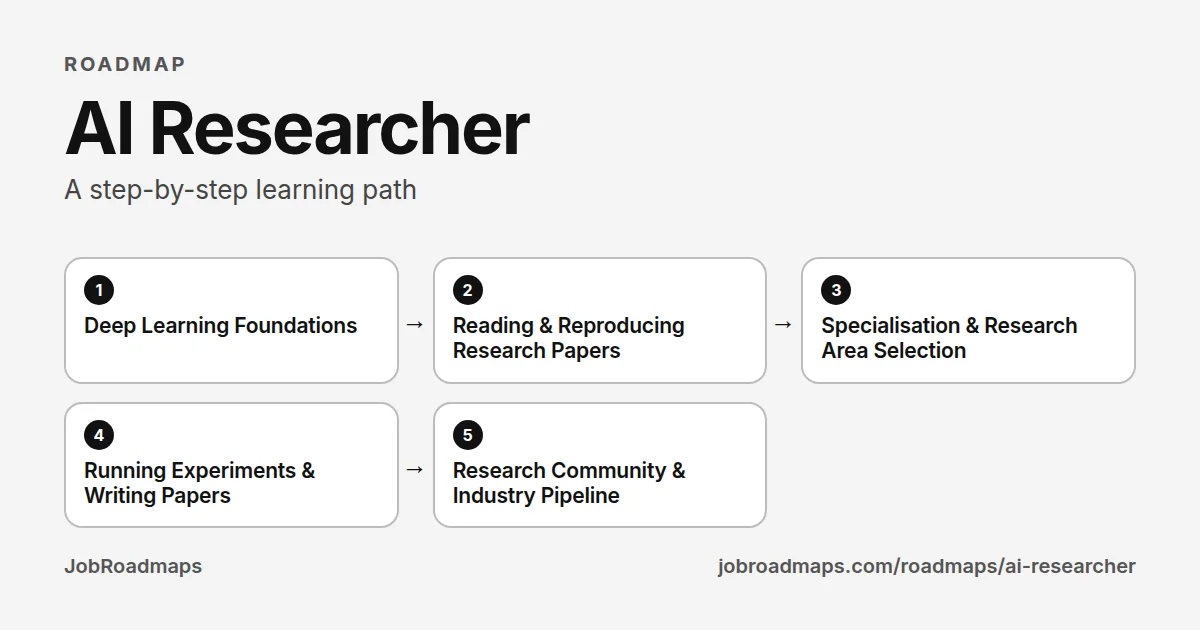
AI Researcher learning path
Work down the line, one step at a time. Tick each skill as you can do it.
- 1
Deep Learning Foundations
3–6 monthsMaster the mathematical foundations: linear algebra, probability theory, information theory, and optimisation. Implement core architectures from scratch: CNNs, RNNs, attention mechanisms, and transformers. Understand backpropagation deeply.
Skills to learn
- Linear Algebra
- Probability Theory
- PyTorch
- Transformer Architecture
- Backpropagation
- Optimisation Algorithms
- 2
Reading & Reproducing Research Papers
3–6 monthsDevelop the skill of reading ML papers efficiently: understand problem formulation, experimental design, and ablation studies. Reproduce 3–5 landmark papers (Attention Is All You Need, RLHF, LoRA) to build intuition for what actually works.
Skills to learn
- Paper Reading Methodology
- PyTorch Implementation
- Ablation Studies
- Benchmark Datasets
- arXiv Research
- Code Reproduction
- 3
Specialisation & Research Area Selection
3–6 monthsChoose a research focus: NLP/LLMs, computer vision, reinforcement learning, multimodal learning, AI safety, or interpretability. Survey the literature in your area, identify open problems, and find a research advisor or collaborator.
Skills to learn
- Literature Survey
- Research Problem Identification
- Research Proposal Writing
- Baseline Implementation
- Hypothesis Generation
- Related Work Analysis
- 4
Running Experiments & Writing Papers
6–12 monthsLearn rigorous experimental methodology: statistical significance testing, hyperparameter sweeps, ablations, and compute-efficient baselines. Write research papers following NeurIPS/ICML/ICLR structure. Submit to workshops before main tracks.
Skills to learn
- Experimental Design
- Statistical Significance
- Weights & Biases
- LaTeX
- Paper Writing
- Peer Review Process
- 5
Research Community & Industry Pipeline
6–12 monthsPresent at conferences and workshops. Engage with the research community on X/Twitter and arXiv. Build a Google Scholar profile. Apply to research internships at AI labs (Anthropic, OpenAI, Google DeepMind, Meta FAIR, Microsoft Research).
Skills to learn
- Conference Presentations
- Research Networking
- Open Source Research Code
- Research Blogging
- Lab Internship Applications
- Research Portfolio
jobroadmaps.com/roadmaps/ai-researcher · Pay, demand and employer data for this role are further down the page.
Job Market Insights for AI Researcher
Data-backed
What do employers actually ask for?
Read from live job postings — how often each credential is named, from rare to almost always.
"PhD / doctorate" is the most common credential named, yet it appears only occasionally in what we could read. Postings that state it are the minority, but these counts are a floor, so do not read this as "no one asks".
Some postings say outright that equivalent experience or a self-taught route is accepted. That wording is worth reading closely when you see it.
Our read: a portfolio that proves the skill, and a referral from someone inside the company, usually carry more weight than a credential match on paper. That is judgement, not something these counts measure.
Requirement
How often named
PhD / doctorate
Computer Science background
Master's degree
Equivalent experience accepted
Bachelor's degree
Our read: how often a credential is named is not how strictly it is enforced. Equivalent experience, a standout portfolio, or a referral often counts for more than the credential listed.
Data-backed
Which skills appear most in job postings?
Read from live job postings, ranked from most to least often named.
Evaluation leads the list and is named frequent. If you are only going to learn one thing before applying, the postings say start here.
Past the fundamentals, 4 specialisation skills (Evaluation included) start separating candidates who can do the job from candidates who have done it. The 16 niche skills are named rarely enough that knowing them is upside, not prerequisite.
Skill
How often named
Evaluation
Reinforcement Learning
Agents
Large Language Models
Fine-tuning
Distributed training
JAX
RLHF
Tool use
Code generation
Data curation
Multimodal models
Reward modeling
Model optimization
Information retrieval
Embedding models
Sorted by how often named · JobRoadmaps
Data-backed
Which tools and artifacts appear most in job postings?
Read from live job postings, ranked from most to least often named.
Kubernetes is the most-named tool, but no tool is a universal requirement here.
Tool / Artifact
How often named
CUDA
Modal
Ray
vLLM
Sorted by how often named · JobRoadmaps
Industry overlay
Targeting a specific industry?
The core roadmap gets you through the door anywhere. The difference between "qualified" and "they hired someone else" often lives in industry-specific context — the norms, the compliance floors, the tools assumed fluent in that sector.
Large-scale distributed systems
Building training and inference infrastructure that handles massive models across clusters; core to research execution.
Post-training methodology
SFT, RLHF, and reward modeling are central to frontier model development at this tier.
Hardware optimization and co-design
Maximizing GPU utilization and working with specialized hardware for efficient training.
Companies hiring:
AnthropicOpenAICohereTogether AIModal LabsScale AIDomain adaptation and fine-tuning
Tailoring models to enterprise verticals (finance, security, data) requires deep domain knowledge.
Production deployment and monitoring
Shipping research to production with reliability, observability, and performance constraints.
Security and abuse detection
Identifying misuse vectors and building safeguards specific to financial, security, and payment domains.
Companies hiring:
DatabricksDatadogStripeComposioMongoDBSnowflakeAdyenBlockIndustry premiums based on aggregated job posting data · Updated quarterly
Interactive
How ready are you right now?
Check the skills you already have to see your current job-market fit.
The most-named skill for this role is Evaluation, so a gap there costs you the most. Skills at the top of the scale appear across most postings, so a single gap there narrows your options more than a gap in a rarer skill. Check what you already have to see your biggest current gap.
Readiness Check
Check the skills you already have
0/5
base skills
Your biggest gap: Evaluation, the most often named of the skills you have not ticked.
Start there, then work down the list.
Books worth reading as a AI Researcher
Where to start, in order. The full list of 12, grouped by career stage, is on its own page.
Getting started

Mathematics for Machine Learning
by Marc Peter Deisenroth, A. Aldo Faisal, Cheng Soon Ong · 2020
~370 pages~9 hrs to read
Covers the linear algebra, calculus, probability and optimisation behind machine learning, then applies them to regression, PCA, density estimation and SVMs. Read it first if your maths needs refreshing.
View book →
Dive into Deep Learning
by Aston Zhang, Zachary C. Lipton, Mu Li · 2023
Interactive-style textbook that pairs each deep learning idea with runnable code, from MLPs to attention and transformers. A good way to implement the basics yourself early on.
View book →
Doing the job
Understanding Deep Learning
by Simon J. D. Prince · 2023
A modern, well-illustrated textbook covering transformers, diffusion models, reinforcement learning and the theory of why deep networks generalise. Read it after the basics to see current architectures explained clearly.
View book →
Probabilistic Machine Learning: An Introduction
by Kevin P. Murphy · 2022
~850 pages~21 hrs to read
A broad, up-to-date treatment of machine learning through a probabilistic lens, from linear models to deep learning. Use it as the reference you keep open while reading papers.
View book →
Senior and leading

The Craft of Research
by Wayne C. Booth, Gregory G. Colomb, Joseph M. Williams · 1995
~310 pages~8 hrs to read
Covers finding a research question, building an argument from evidence and presenting it. Read it when you start framing your own projects instead of taking them from a supervisor.
View book →
The Scientist's Guide to Writing
by Stephen B. Heard · 2016
~310 pages~8 hrs to read
Practical advice on structuring papers, writing clearly and handling submission and review. Useful before your first paper and every time you lead one.
View book →
All 12 books for a AI Researcher →Browse all books →
Some book links are affiliate links: we earn a small commission if you buy, at no cost to you. It does not affect what we list.
Prerequisites & Education
What credentials do employers look for?
These are the most common paths into this role — no single one is required.
Education
View list — coming soon- PhD in Computer Science, ML, or Statistics — required for most Research Scientist roles at top AI labs; the degree provides lab internship access
- MS in Machine Learning or Data Science — minimum for Research Engineer roles; some industry Research Scientists have only an MS with strong publications
- BS in Computer Science or Mathematics — sufficient to enter research engineering tracks with exceptional project work
Research is the most degree-gated career in this list. A PhD from a recognised ML group opens doors that nothing else does. However, exceptional open-source research contributions occasionally substitute at industry labs.
Courses & Self-Study
View list — coming soon- Deep Learning Specialization (Coursera / Andrew Ng) — the standard ML foundation for researchers from non-CS backgrounds ($49/mo)
- CS224N: NLP with Deep Learning (Stanford, free audit) — the most respected NLP/LLM foundation course
- Fast.ai Practical Deep Learning — bottom-up approach valued by practitioners; strong open-source community
Certifications carry almost no weight in research. Publications, citations, and internship history at top labs are the only credentials that matter for Research Scientist roles.
Alternative Paths
View list — coming soon- AI residency programmes (Google, Microsoft, Meta) — competitive but provide lab-equivalent research experience without a PhD
- Redwood Research MATS / Alignment Forum — routes into AI safety research for those with strong technical foundations
- OpenAI Scholars Programme — structured research programme for underrepresented researchers
Residency programmes are the most viable alternative to a PhD for entering top AI research labs. Acceptance is competitive but does not require prior publication history.
Portfolio
View list — coming soon- Published or pre-print paper on arXiv (even a workshop paper or NeurIPS/ICML/ICLR poster counts)
- Clean, documented code repository reproducing a landmark paper from scratch
- Google Scholar profile with publications, citation count, and h-index
- Technical blog or write-up demonstrating deep understanding of a specific research area
Research is a reputation economy. Your paper acceptance record, citation count, and which labs you've interned at carry more weight than any certification. One strong NeurIPS/ICML/ICLR paper opens more doors than five years of experience.
Your Roadmap
5 stepsDeep Learning Foundations
3–6 monthsMaster the mathematical foundations: linear algebra, probability theory, information theory, and optimisation. Implement core architectures from scratch: CNNs, RNNs, attention mechanisms, and transformers. Understand backpropagation deeply.
Skills to learn
Reading & Reproducing Research Papers
3–6 monthsDevelop the skill of reading ML papers efficiently: understand problem formulation, experimental design, and ablation studies. Reproduce 3–5 landmark papers (Attention Is All You Need, RLHF, LoRA) to build intuition for what actually works.
Skills to learn
Specialisation & Research Area Selection
3–6 monthsChoose a research focus: NLP/LLMs, computer vision, reinforcement learning, multimodal learning, AI safety, or interpretability. Survey the literature in your area, identify open problems, and find a research advisor or collaborator.
Skills to learn
Running Experiments & Writing Papers
6–12 monthsLearn rigorous experimental methodology: statistical significance testing, hyperparameter sweeps, ablations, and compute-efficient baselines. Write research papers following NeurIPS/ICML/ICLR structure. Submit to workshops before main tracks.
Skills to learn
Research Community & Industry Pipeline
6–12 monthsPresent at conferences and workshops. Engage with the research community on X/Twitter and arXiv. Build a Google Scholar profile. Apply to research internships at AI labs (Anthropic, OpenAI, Google DeepMind, Meta FAIR, Microsoft Research).
Skills to learn
Start here this week
This week: pick one seminal paper — 'Attention Is All You Need,' 'RLHF' (Instruct GPT), or Anthropic's Constitutional AI paper — and reproduce the core experiment. You won't reproduce it exactly. That's the point. Document every place you got stuck, every assumption in the paper that wasn't explicit, every choice you had to make. That document is research practice.
For structured entry, the formal path is a strong undergraduate research record that leads to a PhD program at a top institution. CS PhD programs at MIT, Stanford, CMU, Berkeley, and Washington are the primary pipelines into top research labs. If you're earlier in that path, working as a research assistant (RA) at a university lab while completing a strong undergraduate program is how you build the application profile that matters.
Pay
U.S. Department of Labor data for the nearest BLS occupation, Computer and information research scientists. BLS has no occupation for this exact title, so treat these as a benchmark.
Median: U.S. Bureau of Labor Statistics, Occupational Employment and Wage Statistics (median wage, May 2024) and Employment Projections (2024–34). Levels: U.S. Department of Labor Office of Foreign Labor Certification prevailing wage levels (wage year 2025, typical metro), a base-wage benchmark for the metro in the middle of 77 areas, not an offer. See every metro.
Job Titles at Each Level
Entry
Research Engineer / Research Intern
Mid
Research Scientist / AI Researcher
Senior
Senior Research Scientist / Research Lead / Principal Scientist
Steps Overview
- 1
Deep Learning Foundations
3–6 months
- 2
Reading & Reproducing Research Papers
3–6 months
- 3
Specialisation & Research Area Selection
3–6 months
- 4
Running Experiments & Writing Papers
6–12 months
- 5
Research Community & Industry Pipeline
6–12 months
Explore more roadmaps
Not sure this is the right path? Browse all tech career roadmaps.
View Similar RoadmapsBuilt a project while following this roadmap?
Turn it into a hiring-ready case study in 10 seconds — free.
Ready to explore more?
Browse all career roadmaps across tech, business, and creative fields.