AI Product Manager Career Roadmap
AI Product Managers define and ship products built on AI — from LLM-powered features to autonomous agent workflows. They bridge technical AI capabilities with user needs, own the product roadmap for AI features, and navigate the unique challenges of building with probabilistic, non-deterministic systems.
Is this the right path for you?
AI PMs come from traditional PM roles that transitioned onto AI product teams, from engineers or data scientists who moved into product ownership, and from domain experts who became the de facto product lead for AI tools in their area. The cold entry path — straight into AI PM without prior PM experience — is rare at companies with established PM functions.
If you're comfortable with probabilistic outcomes and the idea that 'it works 90% of the time' is a product decision with real tradeoffs — if you find model confidence intervals and evaluation metrics as interesting as user feedback — you're already thinking like an AI PM. The role requires comfort with systems that don't behave deterministically.
The technical literacy requirement is real. You don't need to train models, but you need to understand what 'fine-tuning,' 'retrieval-augmented generation,' and 'context window' mean well enough to have productive conversations with the engineering team about tradeoffs. The AI PMs who get the most done are the ones who can articulate what's technically hard versus what's an engineering priority decision.
Career Progression
Where does this role lead?
Click any role to explore timeline, key skills and, where the Department of Labor publishes it, pay.
Entry
Associate PM
~1–2 yrs
APM programmes at AI-first companies are highly competitive and the fastest route to an AI PM career. If you can't land an APM programme, join a company building AI products in any analytical or operations role and lateral into PM.
Key skills
Visual roadmap
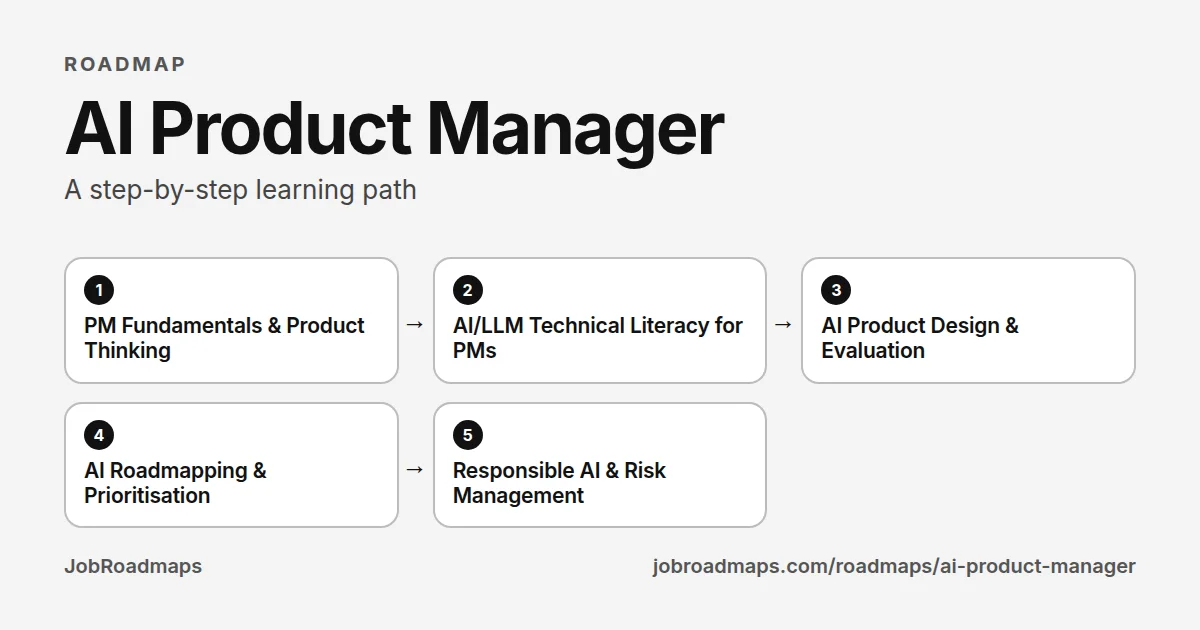
AI Product Manager learning path
Work down the line, one step at a time. Tick each skill as you can do it.
- 1
PM Fundamentals & Product Thinking
6–8 weeksMaster core PM skills: user research, writing PRDs, sprint planning, stakeholder management, and data-driven decision making. Learn product frameworks: Jobs-to-be-Done, OKRs, and the Kano model. Build your first product portfolio project.
Skills to learn
- Product Requirements Documents
- User Research
- OKRs
- Sprint Planning
- Stakeholder Management
- A/B Testing
- 2
AI/LLM Technical Literacy for PMs
4–6 weeksDevelop the technical vocabulary to work with AI engineers: understand LLM capabilities and limitations, fine-tuning vs. RAG, model evaluation metrics (BLEU, ROUGE, human eval), latency/cost trade-offs, and what "hallucination" means for your product.
Skills to learn
- LLM Capabilities & Limitations
- RAG vs Fine-tuning
- Model Evaluation Metrics
- Latency & Cost Trade-offs
- Hallucination Risk
- AI Feature Feasibility
- 3
AI Product Design & Evaluation
5–6 weeksDesign AI product experiences: handling uncertainty in outputs, progressive disclosure of AI confidence, error states, and trust-building interfaces. Build evaluation frameworks for AI features: golden datasets, human preference studies, and automated quality metrics.
Skills to learn
- AI UX Patterns
- Trust Design
- Evaluation Framework Design
- Golden Datasets
- Human Preference Studies
- AI Product Metrics
- 4
AI Roadmapping & Prioritisation
4–5 weeksBuild AI roadmaps that account for model improvement cycles, data flywheel effects, and the compounding nature of AI product investments. Prioritise between foundational AI infrastructure vs. user-facing AI features. Navigate org dynamics around AI hype vs. reality.
Skills to learn
- AI Roadmapping
- Data Flywheel Strategy
- Infrastructure vs. Features
- AI Investment Prioritisation
- Dependency Management
- Executive AI Storytelling
- 5
Responsible AI & Risk Management
4–5 weeksOwn the responsible AI process for your product: bias assessments, safety testing before launch, incident response planning, and monitoring for degraded performance. Work with legal and ethics teams on AI disclosure requirements and regulatory compliance.
Skills to learn
- AI Risk Assessment
- Bias Testing
- Safety Red Teaming for Products
- AI Incident Response
- Regulatory Compliance for AI Products
- Model Cards
jobroadmaps.com/roadmaps/ai-product-manager · Pay, demand and employer data for this role are further down the page.
Job Market Insights for AI Product Manager
Data-backed
Which skills appear most in job postings?
Read from live job postings, ranked from most to least often named.
machine learning is the most-named skill. Common, but not universal: many postings do not list it.
Past the fundamentals, 1 specialisation skill (machine learning included) start separating candidates who can do the job from candidates who have done it. The 9 niche skills are named rarely enough that knowing them is upside, not prerequisite.
Skill
How often named
product strategy
agentic AI
communication
autonomy
experimentation
technical fluency
reinforcement learning
project management
operational rigor
Sorted by how often named · JobRoadmaps
Data-backed
Which tools and artifacts appear most in job postings?
Read from live job postings, ranked from most to least often named.
Salesforce is the most-named tool, but no tool is a universal requirement here.
Tool / Artifact
How often named
Salesforce
NetSuite
SWE-Bench
SWE Atlas
Intercom
Fin
Workday
Cornerstone
Terminal-Bench
Sorted by how often named · JobRoadmaps
Industry overlay
Targeting a specific industry?
The core roadmap gets you through the door anywhere. The difference between "qualified" and "they hired someone else" often lives in industry-specific context — the norms, the compliance floors, the tools assumed fluent in that sector.
benchmark design
Scale's core product is benchmarks and leaderboards that influence model development; PMs must design fair, representative evaluations.
frontier model knowledge
Direct partnership with leading AI labs (OpenAI, Anthropic, etc.) demands understanding of cutting-edge model capabilities and research priorities.
reinforcement learning environments
Building realistic, high-fidelity simulations for agent training requires deep understanding of RL reward design and execution environment architecture.
Companies hiring:
Scale AIagentic workflows
Designing what tasks agents should handle, handoff logic to humans, and measuring end-to-end resolution requires deep understanding of agent limitations and customer processes.
customer support domain
Fin's product replaces human support agents; PMs must understand ticket routing, omnichannel integration, and support team workflows intimately.
integration & scalability
Enterprise agents must integrate seamlessly with existing CRM, ticketing, and backend systems; PMs must ensure minimal setup friction and high adoption.
Companies hiring:
IntercomIndustry premiums based on aggregated job posting data · Updated quarterly
Interactive
How ready are you right now?
Check the skills you already have to see your current job-market fit.
The most-named skill for this role is machine learning, so a gap there costs you the most. No single skill dominates, but each gap narrows which postings fit you. Check what you already have to see your biggest current gap.
Readiness Check
Check the skills you already have
0/5
base skills
Your biggest gap: machine learning, the most often named of the skills you have not ticked.
Start there, then work down the list.
Books worth reading as a AI Product Manager
Where to start, in order. The full list of 12, grouped by career stage, is on its own page.
Getting started

Prediction Machines: The Simple Economics of Artificial Intelligence
by Ajay Agrawal, Joshua Gans, Avi Goldfarb · 2018
~250 pages~6 hrs to read
Frames AI as cheaper prediction and shows how that changes which decisions and products make economic sense. A non-technical starting point for judging where AI belongs in a product.
View book →
Co-Intelligence: Living and Working with AI
by Ethan Mollick · 2024
A practical introduction to working with large language models, with principles for where they help and where they fail. Read it to build hands-on instincts before you scope AI features.
View book →
Doing the job

Designing Machine Learning Systems
by Chip Huyen · 2022
~390 pages~10 hrs to read
Covers data, training, evaluation, deployment and monitoring of production ML systems. Read it to understand the trade-offs your engineers will raise.
View book →
AI Engineering: Building Applications with Foundation Models
by Chip Huyen · 2025
~350 pages~9 hrs to read
Explains how applications on foundation models are built: prompting, retrieval, evaluation, fine-tuning and cost and latency trade-offs. Useful when you scope or review LLM features.
View book →
Senior and leading

Competing in the Age of AI: Strategy and Leadership When Algorithms and Networks Run the World
by Marco Iansiti, Karim R. Lakhani · 2020
~290 pages~7 hrs to read
Examines how data, algorithms and networks reshape business models and operating models. For product leaders setting AI strategy.
View book →
Empowered: Ordinary People, Extraordinary Products
by Marty Cagan, Chris Jones · 2020
~370 pages~9 hrs to read
Describes how to lead and coach product teams and set the vision and strategy they work from. Read it when you start leading AI product teams or other PMs.
View book →
All 12 books for a AI Product Manager →Browse all books →
Some book links are affiliate links: we earn a small commission if you buy, at no cost to you. It does not affect what we list.
Prerequisites & Education
What credentials do employers look for?
These are the most common paths into this role — no single one is required.
Education
View list — coming soon- BS in Computer Science, Engineering, or Business — technical degrees accelerate the AI PM learning curve; business degrees provide strategic framing
- BA in any discipline with strong product experience — PM roles are experience-gated; degree field matters less than shipped products
- MBA with product or technology focus — common path for senior AI PMs moving into strategic roles
Neither a technical nor business degree is required, but AI PMs who can read model evaluation results and write technical PRDs outperform peers who cannot. The engineering-adjacent path is currently favoured.
Certifications
View list — coming soon- PMI Certified Professional in Managing AI (PMI-CPMAI) — $699–$899, tool-agnostic credential for managing AI projects; covers turning AI visions into actionable plans and aligning cross-functional teams
- EC-Council Certified AI Program Manager (CAIPM) — $450, validates ability to adopt and secure AI initiatives; bridges technical AI and business strategy for tech leadership roles
- AI Product Management Specialization (Coursera / Duke) — one of the few PM certs focused on AI products; covers evaluation, roadmapping, and responsible AI ($49/mo, 3 months)
- Pragmatic Marketing PMC Certification (Pragmatic Institute) — traditional PM credential respected at enterprise companies ($2,000, 2 days)
- AIPMM Certified AI Product Manager — emerging credential as AI PM becomes a formal specialisation (variable cost)
PMI-CPMAI and EC-Council CAIPM are the two most relevant AI-specific PM credentials from recognised bodies. Both are relatively new — shipped AI products still outweigh any cert at interview.
Bootcamps & Self-Study Paths
View list — coming soon- Product School / PM Accelerator — PM bootcamps help career switchers but don't substitute for real product experience
- Reforge PM programmes — cohort-based, practitioner-taught; respected for growth and AI product tracks
- DeepLearning.AI short courses — building the technical AI literacy that distinguishes top AI PMs
The fastest path into AI PM is an internal transfer from a PM role at a company already building AI products. External AI PM hires almost always come with prior PM experience.
Portfolio
View list — coming soon- Product case study: AI feature from discovery to launch with metrics showing business impact
- Product spec / PRD for an AI feature with evaluation framework and success metrics defined
- AI product teardown: analysis of a competitor AI product's UX, capabilities, and failure modes
- Responsible AI review document for a hypothetical product launch
AI PM interviews are case-heavy. Practice: "How would you evaluate whether our LLM-powered feature is working?" and "How do you measure success for a non-deterministic AI feature?" Your portfolio should demonstrate you can answer these with real examples.
Your Roadmap
5 stepsPM Fundamentals & Product Thinking
6–8 weeksMaster core PM skills: user research, writing PRDs, sprint planning, stakeholder management, and data-driven decision making. Learn product frameworks: Jobs-to-be-Done, OKRs, and the Kano model. Build your first product portfolio project.
Skills to learn
AI/LLM Technical Literacy for PMs
4–6 weeksDevelop the technical vocabulary to work with AI engineers: understand LLM capabilities and limitations, fine-tuning vs. RAG, model evaluation metrics (BLEU, ROUGE, human eval), latency/cost trade-offs, and what "hallucination" means for your product.
Skills to learn
AI Product Design & Evaluation
5–6 weeksDesign AI product experiences: handling uncertainty in outputs, progressive disclosure of AI confidence, error states, and trust-building interfaces. Build evaluation frameworks for AI features: golden datasets, human preference studies, and automated quality metrics.
Skills to learn
AI Roadmapping & Prioritisation
4–5 weeksBuild AI roadmaps that account for model improvement cycles, data flywheel effects, and the compounding nature of AI product investments. Prioritise between foundational AI infrastructure vs. user-facing AI features. Navigate org dynamics around AI hype vs. reality.
Skills to learn
Responsible AI & Risk Management
4–5 weeksOwn the responsible AI process for your product: bias assessments, safety testing before launch, incident response planning, and monitoring for degraded performance. Work with legal and ethics teams on AI disclosure requirements and regulatory compliance.
Skills to learn
Start here this week
This week: pick one AI product you use regularly and write a one-page product spec for a feature that would address its most significant weakness. Include: what user problem it solves, how you'd evaluate model performance for that feature, what the success metrics are, and what the failure modes look like. That document tests exactly the skills the role requires.
For structured entry, the traditional PM path — starting as a PM on a non-AI product and transitioning to AI — is still the most reliable. Google APM, Microsoft PM Rotation, and Meta RPM programs offer AI product team rotations. If you're already a PM, look for internal transfer opportunities onto AI teams. The technical AI literacy piece can be built through DeepLearning.AI's short courses without requiring engineering depth.
Job Titles at Each Level
Entry
Associate PM / Product Analyst
Mid
AI Product Manager / Senior PM (AI)
Senior
Director of Product – AI / VP of Product
Steps Overview
- 1
PM Fundamentals & Product Thinking
6–8 weeks
- 2
AI/LLM Technical Literacy for PMs
4–6 weeks
- 3
AI Product Design & Evaluation
5–6 weeks
- 4
AI Roadmapping & Prioritisation
4–5 weeks
- 5
Responsible AI & Risk Management
4–5 weeks
Explore more roadmaps
Not sure this is the right path? Browse all business career roadmaps.
View Similar RoadmapsBuilt a project while following this roadmap?
Turn it into a hiring-ready case study in 10 seconds — free.
Ready to explore more?
Browse all career roadmaps across tech, business, and creative fields.