AI Ethics & Compliance Officer Career Roadmap
AI Ethics & Compliance Officers ensure that AI systems are developed and deployed responsibly. They build governance frameworks, conduct bias audits, manage regulatory compliance, and act as the internal conscience for AI product decisions.
Is this the right path for you?
AI ethics officers come from policy, legal, philosophy and ethics academia, HR and compliance, and trust and safety roles at tech companies. The role exists almost exclusively at large organizations facing regulatory pressure — you're unlikely to find a dedicated ethics officer title at a startup. Most paths run through an adjacent domain first, not directly into AI ethics.
If you find the gap between what AI can do and what AI should do more interesting than either the technical performance or the business upside — if you read AI policy documents and find the ambiguities more interesting than the positions — you're already thinking like an ethics officer. The job is structured judgment applied to systems that don't have it built in.
The role is easier to get at large companies (regulatory pressure creates the budget) than at startups (which tend to think about ethics after they have the scale to attract regulatory attention). Many 'AI ethics' titles are effectively compliance roles. The ones with actual influence are staffed by people with both substantive domain expertise (law, policy, philosophy) and enough technical literacy to evaluate AI system behavior.
Career Progression
Where does this role lead?
Click any role to explore timeline, key skills and, where the Department of Labor publishes it, pay.
Entry
Responsible AI Analyst
~1–2 yrs
You're building your knowledge of AI bias, fairness frameworks, and regulatory landscape. Backgrounds in policy, law, philosophy, or social science are all valid entry points — pair them with AI technical literacy.
Key skills
Visual roadmap
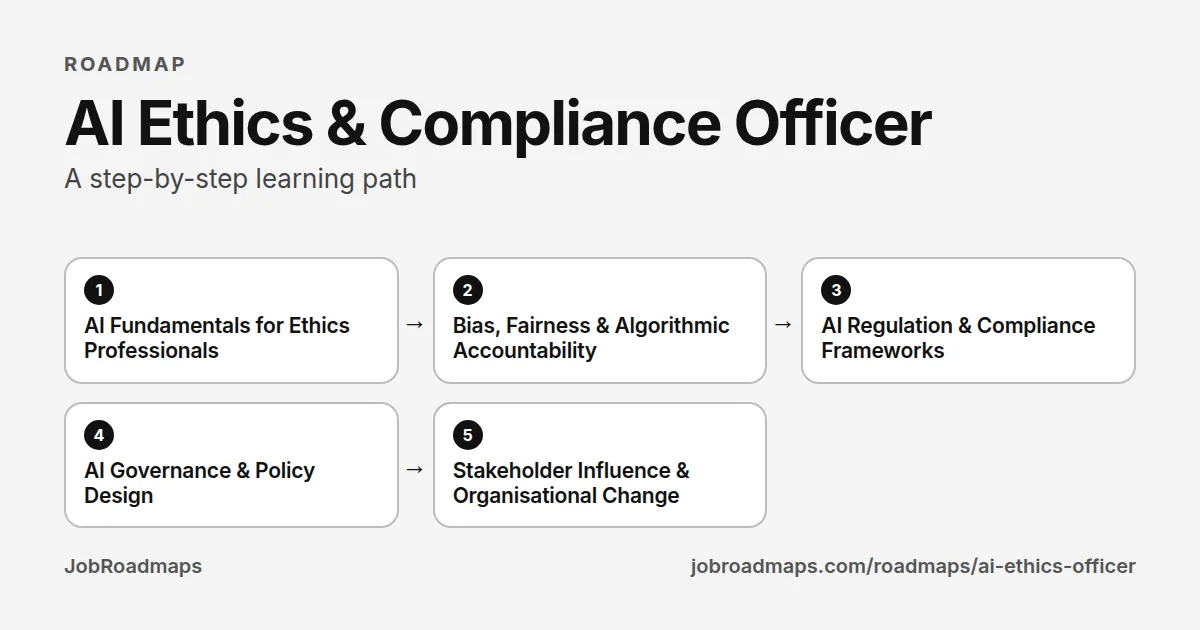
AI Ethics & Compliance Officer learning path
Work down the line, one step at a time. Tick each skill as you can do it.
- 1
AI Fundamentals for Ethics Professionals
4–6 weeksUnderstand how ML models work at a conceptual level: supervised learning, bias in training data, model outputs, and the difference between rule-based and probabilistic AI. Learn enough to interrogate AI systems without writing production code.
Skills to learn
- ML Concepts
- Data Bias
- Model Outputs
- Explainable AI Basics
- Python for Data Analysis
- AI System Architecture
- 2
Bias, Fairness & Algorithmic Accountability
6–8 weeksLearn the taxonomy of algorithmic bias: sampling bias, measurement bias, aggregation bias, and deployment bias. Use fairness toolkits (IBM AI Fairness 360, Google What-If Tool) to audit models. Understand fairness metrics: demographic parity, equal opportunity, and calibration.
Skills to learn
- AI Fairness 360
- Demographic Parity
- Equal Opportunity
- Disparate Impact Analysis
- Bias Auditing
- Counterfactual Fairness
- 3
AI Regulation & Compliance Frameworks
8–10 weeksMaster the key regulatory frameworks: EU AI Act (prohibited practices, high-risk systems, transparency requirements), NIST AI RMF, US Executive Order on AI, and GDPR in AI contexts. Understand enforcement mechanisms and penalties.
Skills to learn
- EU AI Act
- NIST AI RMF
- GDPR for AI
- High-Risk AI Classification
- Conformity Assessments
- Regulatory Filing
- 4
AI Governance & Policy Design
6–8 weeksDesign internal AI governance structures: AI review boards, model risk management frameworks, impact assessments, and incident response procedures. Write AI use policies, vendor assessment questionnaires, and employee guidelines for responsible AI use.
Skills to learn
- AI Impact Assessments
- Model Risk Management
- AI Policy Writing
- Governance Committee Design
- Vendor Due Diligence
- Incident Response
- 5
Stakeholder Influence & Organisational Change
4–6 weeksBuild the skills to drive ethical AI adoption across an organisation: influencing engineers, product managers, and executives without direct authority. Learn to present ethics risks in business terms, run ethics training, and build a culture of responsible AI.
Skills to learn
- Executive Communication
- Ethics Training Design
- Cross-Functional Influence
- Risk Communication
- Change Management
- AI Ethics Red Teaming
jobroadmaps.com/roadmaps/ai-ethics-officer · Pay, demand and employer data for this role are further down the page.
Job Market Insights for AI Ethics & Compliance Officer
Data-backed
Which skills appear most in job postings?
Read from live job postings, ranked from most to least often named.
AI governance leads the list and is named almost always. If you are only going to learn one thing before applying, the postings say start here.
The 1 base skill sit at the top of the scale, appearing across company sizes and seniority levels. Treat them as the baseline an application is read against.
Past the fundamentals, 2 specialisation skills (LLM among them) appear in a minority of postings. Not universal, but the kind of depth that makes a hiring manager stop skimming.
Skill
How often named
Sorted by how often named · JobRoadmaps
Industry overlay
Targeting a specific industry?
The core roadmap gets you through the door anywhere. The difference between "qualified" and "they hired someone else" often lives in industry-specific context — the norms, the compliance floors, the tools assumed fluent in that sector.
Fair lending compliance
ECOA and Fair Housing Act requirements for credit models are legally binding — AI ethics officers in fintech are the frontline defence against fair lending violations.
Explainability for adverse action notices
When a credit application is denied, the lender must provide a specific reason. AI ethics officers design the explanation frameworks that satisfy both regulators and customers.
Companies hiring:
JPMorgan ChaseCapital OneAffirmUpstartZestFinanceproject management
Enterprise AI governance is delivered as a multi-team program across many agencies.
responsible AI
Brand and client trust depend on demonstrably responsible use of generative AI.
stakeholder management
Governance must be agreed across creative, data and legal teams.
Companies hiring:
WPPIndustry premiums based on aggregated job posting data · Updated quarterly
Interactive
How ready are you right now?
Check the skills you already have to see your current job-market fit.
The most-named skill for this role is AI governance, so a gap there costs you the most. Skills at the top of the scale appear across most postings, so a single gap there narrows your options more than a gap in a rarer skill. Check what you already have to see your biggest current gap.
Readiness Check
Check the skills you already have
0/3
base skills
Your biggest gap: AI governance, the most often named of the skills you have not ticked.
Start there, then work down the list.
Books worth reading as a AI Ethics & Compliance Officer
Where to start, in order. The full list of 12, grouped by career stage, is on its own page.
Getting started

Weapons of Math Destruction: How Big Data Increases Inequality and Threatens Democracy
by Cathy O'Neil · 2016
~270 pages~7 hrs to read
Case after case of scoring and prediction models that harm people while looking objective, written by a former quant. A good first read for seeing what an AI ethics review is actually looking for.
View book →
Atlas of AI: Power, Politics, and the Planetary Costs of Artificial Intelligence
by Kate Crawford · 2021
~290 pages~7 hrs to read
Follows AI systems back to their material inputs: mining, data labelling, energy and the institutions that fund them. Read it early to widen the question from 'is this model fair' to 'who bears the cost of this system'.
View book →
Doing the job
Fairness and Machine Learning: Limitations and Opportunities
by Solon Barocas, Moritz Hardt, Arvind Narayanan · 2023
The standard textbook on how fairness is defined, measured and contested in machine learning. Read it when you start running bias audits and need to understand what each metric can and cannot tell you.
View book →Practical Fairness: Achieving Fair and Secure Data Models
by Aileen Nielsen · 2020
~280 pages~7 hrs to read
A hands-on guide to checking datasets and models for unfair outcomes, with the legal and security angles alongside the code. Useful when you are working directly with data science teams on audits.
View book →
Senior and leading

The Alignment Problem: Machine Learning and Human Values
by Brian Christian · 2020
~360 pages~9 hrs to read
A reported history of how researchers have tried to make machine learning systems do what we actually intend, covering fairness, transparency and reinforcement. Read it when you advise leadership and need the field's full picture.
View book →
Human Compatible: Artificial Intelligence and the Problem of Control
by Stuart Russell · 2019
~340 pages~9 hrs to read
An AI researcher argues for building systems that stay uncertain about human preferences and under human control. Relevant when your remit reaches long-term risk and board-level questions.
View book →
All 12 books for a AI Ethics & Compliance Officer →Browse all books →
Some book links are affiliate links: we earn a small commission if you buy, at no cost to you. It does not affect what we list.
Prerequisites & Education
What credentials do employers look for?
These are the most common paths into this role — no single one is required.
Education
View list — coming soon- JD, MA in Public Policy, or PhD in Philosophy / Science & Technology Studies — analytical framework for regulatory and ethical grey areas
- BS in Computer Science or Data Science — technical background that builds credibility with engineering teams
- MBA with technology focus — common path for ethics leads in large enterprise environments
AI ethics roles are uniquely multidisciplinary. The most effective candidates combine policy or legal training with enough technical literacy to interrogate AI systems directly.
Certifications
View list — coming soon- Certified AI Governance Professional (AIGP, IAPP) — the emerging gold standard; aligned with EU AI Act and NIST AI RMF ($550)
- CIPP/E – Certified Information Privacy Professional EU (IAPP) — essential for European-regulated environments; GDPR expertise is a core requirement ($550)
- Responsible AI Practitioner Certificate (ISACA) — practical enterprise credential for implementing responsible AI frameworks ($575)
AIGP is rapidly becoming the most recognised AI ethics credential as the EU AI Act creates compliance demand. Pair it with CIPP/E for maximum European market relevance.
Alternative Paths
View list — coming soon- AI Ethics courses (Coursera / Montreal AI Ethics Institute) — free and low-cost foundations
- NIST AI RMF self-study — the US government framework now widely adopted in enterprise AI governance
- EU AI Act training programmes — growing market of compliance-focused training as regulation takes effect
AI ethics is a reputation-first field. Academic publications, policy submissions, advisory roles, and conference speaking build the profile that credentials alone cannot.
Portfolio
View list — coming soon- Completed AI impact assessment for a real or hypothetical product, using NIST AI RMF or EU AI Act framework
- Published policy brief or blog post on an AI ethics issue demonstrating analytical depth
- AI fairness audit using IBM AI Fairness 360 or similar toolkit with documented methodology
- Sample AI use policy or employee AI guidelines document
AI ethics is as much a reputation discipline as a technical one. Published writing, conference presentations, and advisory board positions build the external credibility that distinguishes senior ethics officers from analysts.
Your Roadmap
5 stepsAI Fundamentals for Ethics Professionals
4–6 weeksUnderstand how ML models work at a conceptual level: supervised learning, bias in training data, model outputs, and the difference between rule-based and probabilistic AI. Learn enough to interrogate AI systems without writing production code.
Skills to learn
Bias, Fairness & Algorithmic Accountability
6–8 weeksLearn the taxonomy of algorithmic bias: sampling bias, measurement bias, aggregation bias, and deployment bias. Use fairness toolkits (IBM AI Fairness 360, Google What-If Tool) to audit models. Understand fairness metrics: demographic parity, equal opportunity, and calibration.
Skills to learn
AI Regulation & Compliance Frameworks
8–10 weeksMaster the key regulatory frameworks: EU AI Act (prohibited practices, high-risk systems, transparency requirements), NIST AI RMF, US Executive Order on AI, and GDPR in AI contexts. Understand enforcement mechanisms and penalties.
Skills to learn
AI Governance & Policy Design
6–8 weeksDesign internal AI governance structures: AI review boards, model risk management frameworks, impact assessments, and incident response procedures. Write AI use policies, vendor assessment questionnaires, and employee guidelines for responsible AI use.
Skills to learn
Stakeholder Influence & Organisational Change
4–6 weeksBuild the skills to drive ethical AI adoption across an organisation: influencing engineers, product managers, and executives without direct authority. Learn to present ethics risks in business terms, run ethics training, and build a culture of responsible AI.
Skills to learn
Start here this week
This week: read the EU AI Act executive summary and the NIST AI Risk Management Framework. Write two pages on what they would require of a specific company you know well — what would need to change, what's already compliant, what's ambiguous. That's a governance deliverable. It's also the kind of artifact that demonstrates readiness for the role in interviews.
For structured entry, legal or policy backgrounds are the most direct pipeline. LLM courses that teach AI literacy without requiring deep technical skill — fast.ai's Practical AI for Everyone, AI For Everyone by Andrew Ng — provide the technical grounding. The Montreal AI Ethics Institute and Alan Turing Institute publish frameworks that practitioners use. Read the primary literature, not the summaries.
Job Titles at Each Level
Entry
AI Policy Analyst / Responsible AI Analyst
Mid
AI Ethics Officer / Responsible AI Lead
Senior
Chief Ethics Officer / VP of Responsible AI
Steps Overview
- 1
AI Fundamentals for Ethics Professionals
4–6 weeks
- 2
Bias, Fairness & Algorithmic Accountability
6–8 weeks
- 3
AI Regulation & Compliance Frameworks
8–10 weeks
- 4
AI Governance & Policy Design
6–8 weeks
- 5
Stakeholder Influence & Organisational Change
4–6 weeks
Explore more roadmaps
Not sure this is the right path? Browse all business career roadmaps.
View Similar RoadmapsBuilt a project while following this roadmap?
Turn it into a hiring-ready case study in 10 seconds — free.
Ready to explore more?
Browse all career roadmaps across tech, business, and creative fields.