AI Data Governance Manager Career Roadmap
AI Data Governance Managers oversee the data that powers AI systems — ensuring data quality, lineage, privacy compliance, and appropriate use. As AI models consume more enterprise data, this role has become critical for managing both legal risk and model reliability.
Is this the right path for you?
AI data governance managers come from data management and data engineering roles, from IT governance and CDO organizations, from compliance and legal teams that handle data, and from enterprise architecture backgrounds. The role sits at the intersection of data quality, regulatory compliance, and AI system reliability — a combination that's in demand but hard to find in one person.
If data quality failures alarm you more than they alarm everyone else in the room — if you think about provenance, lineage, and bias risks before you think about what the data can be used for — you're already thinking like a data governance manager. The job rewards systematic anxiety about data pipelines and the organizational authority to act on it.
Data governance is an unsexy title with growing leverage. AI systems are only as reliable as the data they're trained on and the data they inference against — which companies are starting to understand after deploying AI systems that failed in production due to data issues. The window to specialize in AI data governance is open now, before the role gets formalized and credential-gated.
Career Progression
Where does this role lead?
Click any role to explore timeline, key skills and, where the Department of Labor publishes it, pay.
Entry
Data Steward
~1–2 yrs
You're maintaining data quality and documentation for a business domain. It's operational work, but it builds the knowledge of data assets and business context that governance managers rely on.
Key skills
Visual roadmap
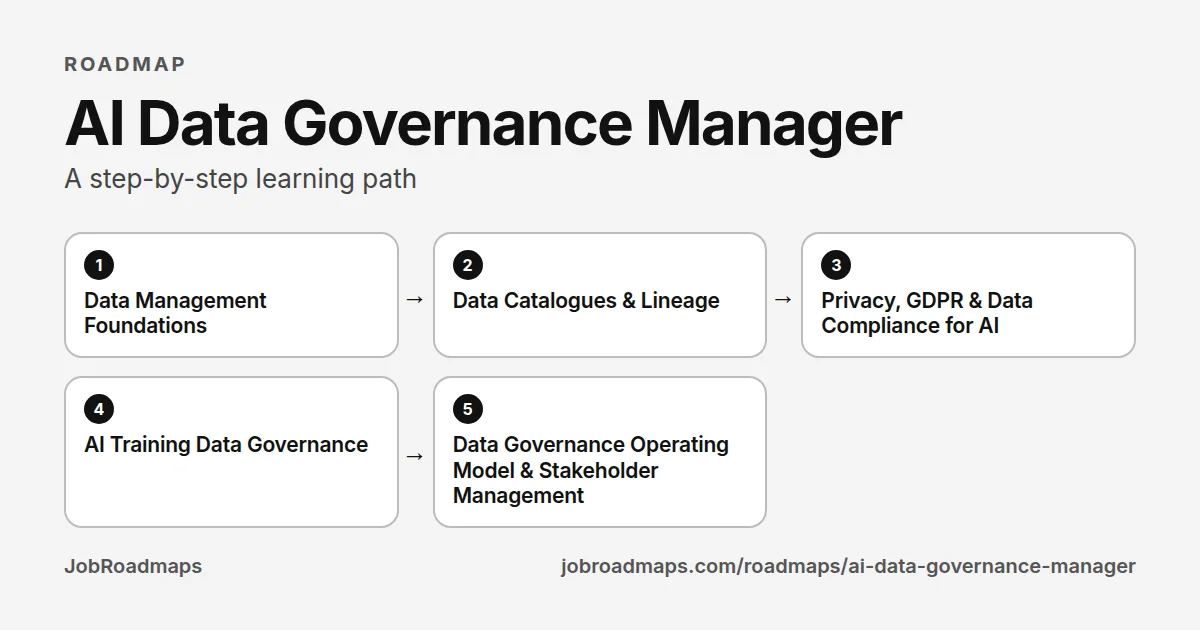
AI Data Governance Manager learning path
Work down the line, one step at a time. Tick each skill as you can do it.
- 1
Data Management Foundations
6–8 weeksUnderstand the DAMA-DMBOK framework covering data quality, metadata management, master data management, and data warehousing. Learn SQL for data profiling and quality assessment. Understand the difference between operational and analytical data.
Skills to learn
- DAMA-DMBOK
- SQL
- Data Quality Assessment
- Master Data Management
- Metadata Management
- Data Profiling
- 2
Data Catalogues & Lineage
6–8 weeksImplement enterprise data catalogues (Collibra, Alation, DataHub, Apache Atlas) to document data assets, owners, and usage. Build data lineage graphs that trace data from source to AI model training. Learn data contract patterns for reliable pipelines.
Skills to learn
- Collibra / Alation / DataHub
- Data Lineage
- Data Cataloguing
- Data Ownership Models
- Data Contracts
- Business Glossary Management
- 3
Privacy, GDPR & Data Compliance for AI
6–8 weeksMaster GDPR requirements for AI: lawful basis for training data, data subject rights (deletion, correction) in ML pipelines, and privacy impact assessments. Learn techniques: data anonymisation, pseudonymisation, differential privacy, and synthetic data generation.
Skills to learn
- GDPR for AI
- Privacy Impact Assessments
- Data Anonymisation
- Differential Privacy
- Synthetic Data
- Right to Erasure in ML
- 4
AI Training Data Governance
6–8 weeksGovern the data used to train and fine-tune AI models: dataset cards, data provenance, consent tracking, and bias documentation. Understand the risks of web-scraped training data. Design data access controls and audit trails for AI workloads.
Skills to learn
- Dataset Cards
- Data Provenance
- Consent Management
- Bias Documentation
- Model Cards
- AI Data Audit Trails
- 5
Data Governance Operating Model & Stakeholder Management
5–7 weeksBuild a data governance operating model: governance councils, data steward networks, policy enforcement mechanisms, and change management. Measure data quality KPIs and report to leadership. Align data governance with AI strategy and business objectives.
Skills to learn
- Data Governance Operating Model
- Data Stewardship Networks
- KPI Definition
- Policy Enforcement
- Stakeholder Communication
- Change Management
jobroadmaps.com/roadmaps/ai-data-governance-manager · Pay, demand and employer data for this role are further down the page.
Job Market Insights for AI Data Governance Manager
Data-backed
What do employers actually ask for?
Read from live job postings — how often each credential is named, from rare to almost always.
"Computer Science background" is the most common credential named, yet it appears only occasionally in what we could read. Postings that state it are the minority, but these counts are a floor, so do not read this as "no one asks".
Our read: a portfolio that proves the skill, and a referral from someone inside the company, usually carry more weight than a credential match on paper. That is judgement, not something these counts measure.
Requirement
How often named
Computer Science background
Our read: how often a credential is named is not how strictly it is enforced. Equivalent experience, a standout portfolio, or a referral often counts for more than the credential listed.
Data-backed
Which skills appear most in job postings?
Read from live job postings, ranked from most to least often named.
data quality leads the list and is named frequent. If you are only going to learn one thing before applying, the postings say start here.
Past the fundamentals, 4 specialisation skills (data quality included) start separating candidates who can do the job from candidates who have done it. The 3 niche skills are named rarely enough that knowing them is upside, not prerequisite.
Skill
How often named
data quality
Salesforce
metadata management
access control
cross-functional collaboration
Sorted by how often named · JobRoadmaps
Data-backed
Which tools and artifacts appear most in job postings?
Read from live job postings, ranked from most to least often named.
Databricks is the most-named tool, but no tool is a universal requirement here.
Tool / Artifact
How often named
Unity Catalog
Sorted by how often named · JobRoadmaps
Industry overlay
Targeting a specific industry?
The core roadmap gets you through the door anywhere. The difference between "qualified" and "they hired someone else" often lives in industry-specific context — the norms, the compliance floors, the tools assumed fluent in that sector.
Customer data usage policies for AI
SaaS enterprise customers want contractual guarantees about whether their data trains shared AI models — governance managers define and enforce these policies.
Data residency for multi-region AI
Enterprise SaaS customers require data to remain in specific geographies — governance frameworks must ensure AI workloads don't inadvertently transfer data.
Companies hiring:
SalesforceHubSpotWorkdayServiceNowZendeskenterprise governance frameworks
Large organizations require formal governance council structures, domain models, and organizational change management.
cross-functional alignment
Enterprise governance demands coordinating policies across departments, business units, and technical teams.
data quality at scale
Enterprises manage massive data volumes and require robust quality assurance and governance processes.
Companies hiring:
WPPToastInstacartIndustry premiums based on aggregated job posting data · Updated quarterly
Interactive
How ready are you right now?
Check the skills you already have to see your current job-market fit.
The most-named skill for this role is data quality, so a gap there costs you the most. Skills at the top of the scale appear across most postings, so a single gap there narrows your options more than a gap in a rarer skill. Check what you already have to see your biggest current gap.
Readiness Check
Check the skills you already have
0/5
base skills
Your biggest gap: data quality, the most often named of the skills you have not ticked.
Start there, then work down the list.
Books worth reading as a AI Data Governance Manager
Where to start, in order. The full list of 11, grouped by career stage, is on its own page.
Getting started
Data Governance: How to Design, Deploy, and Sustain an Effective Data Governance Program
by John Ladley · 2012
~310 pages~8 hrs to read
A full walkthrough of setting up a governance programme: roles, policies, operating model and how to get it funded. The best single place to learn what the job involves.
View book →
DAMA-DMBOK: Data Management Body of Knowledge
by DAMA International · 2017
~590 pages~15 hrs to read
The reference text for the data management profession, with chapters on governance, quality, metadata, privacy and architecture. Read it in sections to learn the shared vocabulary of the field.
View book →
Doing the job

Data Quality Fundamentals: A Practitioner's Guide to Building Trustworthy Data Pipelines
by Barr Moses, Lior Gavish, Molly Vorwerck · 2022
Explains how to measure, monitor and fix data quality across pipelines, including observability and incident response. Fits the part of the role that decides whether AI training and input data can be trusted.
View book →Data Privacy: A Runbook for Engineers
by Nishant Bhajaria · 2022
Shows how to classify personal data, build privacy controls into systems and handle deletion and access requests at scale. Read it when you need to turn privacy requirements into work engineering teams can ship.
View book →
Senior and leading

Data Management at Scale: Modern Data Architecture with Data Mesh and Data Fabric
by Piethein Strengholt · 2020
~400 pages~10 hrs to read
Looks at governance, metadata, lineage and ownership in large organisations with many data domains. Suited to someone designing a federated model across business units.
View book →Data Mesh: Delivering Data-Driven Value at Scale
by Zhamak Dehghani · 2022
~410 pages~10 hrs to read
Sets out an approach that gives domain teams ownership of data products under shared governance rules. Read it when you must decide how much to centralise and how much to push to teams.
View book →
All 11 books for a AI Data Governance Manager →Browse all books →
Some book links are affiliate links: we earn a small commission if you buy, at no cost to you. It does not affect what we list.
Prerequisites & Education
What credentials do employers look for?
These are the most common paths into this role — no single one is required.
Education
View list — coming soon- BS/MS in Information Management, Data Science, or Law — the role blends information management and legal disciplines
- BS in Computer Science or Engineering with self-taught governance experience — common technical path
- MA in Library Science or Information Studies — data cataloguing and metadata expertise translates directly
Data governance is unusually welcoming to cross-functional backgrounds. What matters is demonstrated ability to design, document, and enforce data policies across an organisation.
Certifications
View list — coming soon- CDMP – Certified Data Management Professional (DAMA) — the primary governance credential; covers the full DAMA-DMBOK framework ($311)
- CIPP/E – Certified Information Privacy Professional EU (IAPP) — required for GDPR-exposed roles; DPO positions legally require it in some jurisdictions ($550)
- Collibra Ranger Certification — platform-specific but valuable at enterprises using Collibra as their governance tool (variable cost)
- Certified AI Governance Professional (AIGP, IAPP) — emerging credential for AI-specific governance work ($550)
CDMP is the foundational credential for this role. Add CIPP/E if your organisation has European data exposure. AIGP is increasingly expected for AI governance specialisations.
Alternative Paths
View list — coming soon- DAMA study group + CDMP exam preparation — community-driven preparation widely used by governance professionals
- Atlan / Alation / Collibra free training — platform vendors offer free training that builds practical tool fluency
- Data governance courses on LinkedIn Learning / Coursera — accessible foundations for career switchers
This role is typically reached through 5–10 years of data-adjacent experience (analytics, engineering, or compliance) rather than direct entry. Governance certifications are most valuable when paired with that background.
Portfolio
View list — coming soon- Data governance framework document for a business domain (policies, ownership model, business glossary)
- Data lineage diagram showing data flow from source to AI model training
- Privacy impact assessment template for AI workloads
- Sample AI training data policy covering consent, retention, deletion, and bias documentation
Data governance is a documentation-heavy discipline. Show you can write clear policies that both engineers and business stakeholders accept. A sample governance programme document speaks louder than any certification.
Your Roadmap
5 stepsData Management Foundations
6–8 weeksUnderstand the DAMA-DMBOK framework covering data quality, metadata management, master data management, and data warehousing. Learn SQL for data profiling and quality assessment. Understand the difference between operational and analytical data.
Skills to learn
Data Catalogues & Lineage
6–8 weeksImplement enterprise data catalogues (Collibra, Alation, DataHub, Apache Atlas) to document data assets, owners, and usage. Build data lineage graphs that trace data from source to AI model training. Learn data contract patterns for reliable pipelines.
Skills to learn
Privacy, GDPR & Data Compliance for AI
6–8 weeksMaster GDPR requirements for AI: lawful basis for training data, data subject rights (deletion, correction) in ML pipelines, and privacy impact assessments. Learn techniques: data anonymisation, pseudonymisation, differential privacy, and synthetic data generation.
Skills to learn
AI Training Data Governance
6–8 weeksGovern the data used to train and fine-tune AI models: dataset cards, data provenance, consent tracking, and bias documentation. Understand the risks of web-scraped training data. Design data access controls and audit trails for AI workloads.
Skills to learn
Data Governance Operating Model & Stakeholder Management
5–7 weeksBuild a data governance operating model: governance councils, data steward networks, policy enforcement mechanisms, and change management. Measure data quality KPIs and report to leadership. Align data governance with AI strategy and business objectives.
Skills to learn
Start here this week
This week: audit one dataset you have legitimate access to. Document its provenance (where did it come from, when was it collected, who collected it), its gaps (what's missing, what's inconsistently recorded), its bias risks (what populations or scenarios are underrepresented), and what decisions it should and shouldn't be used for. That document is a governance deliverable and a portfolio piece.
For structured entry, the DAMA Data Management Body of Knowledge (DMBOK) is the field's reference framework. The CDMP (Certified Data Management Professional) is the primary credential. For AI-specific governance, the NIST AI RMF and ISO/IEC 42001 are the emerging compliance standards. The combination of data management fundamentals and AI-specific regulatory literacy is what distinguishes AI data governance from generic data governance.
Job Titles at Each Level
Entry
Data Governance Analyst / Data Steward
Mid
AI Data Governance Manager / Data Governance Lead
Senior
Chief Data Officer / Head of Data Governance
Steps Overview
- 1
Data Management Foundations
6–8 weeks
- 2
Data Catalogues & Lineage
6–8 weeks
- 3
Privacy, GDPR & Data Compliance for AI
6–8 weeks
- 4
AI Training Data Governance
6–8 weeks
- 5
Data Governance Operating Model & Stakeholder Management
5–7 weeks
Explore more roadmaps
Not sure this is the right path? Browse all business career roadmaps.
View Similar RoadmapsBuilt a project while following this roadmap?
Turn it into a hiring-ready case study in 10 seconds — free.
Ready to explore more?
Browse all career roadmaps across tech, business, and creative fields.